
Grammar courses are a good base, not a detour
Grammar-structured apps teach Japanese in the order Japanese is built: particles, verb groups, the te-form, the plain form, and so on, with short explanations and exercises for each. Learners who come out of them have an advantage that is easy to underrate: they know why a sentence is wrong, and they can fix it themselves once they notice. Speaking-first learners often plateau precisely because they lack that.
What such a course cannot do, by its nature, is make you retrieve a form while a person waits. Every exercise shows you options. Conversation shows you nothing; you have to bring the form yourself, now. So the next step is not more grammar. It is giving the grammar you have a voice.
| Japanese | Romaji | Meaning |
|---|---|---|
| 文法を声に出そう | Bunpō o koe ni dasō | Let's say the grammar out loud (casual) |
| 文法は分かります。 | Bunpō wa wakarimasu. | I understand the grammar. |
| でも、口から出ません。 | Demo, kuchi kara demasen. | But it won't come out of my mouth. |
| 知っている形を使いたいです。 | Shitte iru katachi o tsukaitai desu. | I want to use the forms I know. |
One form, four spoken jobs: the te-form
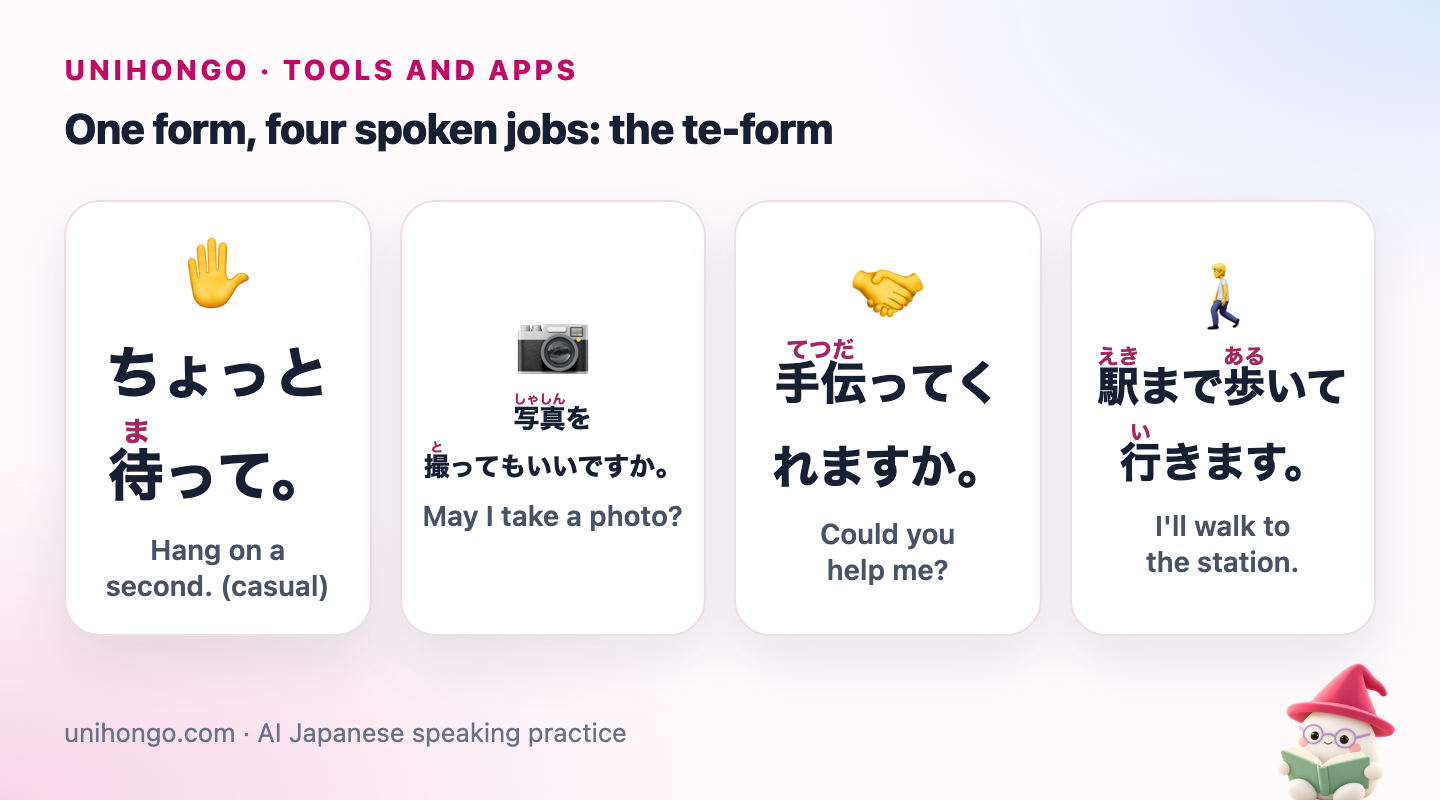
Take the te-form, which every grammar course teaches early. In a course it is a conjugation. In speech it is at least four different tools: a quick casual request, a permission question, a request for help, and a way to say how you do something. The cards show one everyday sentence for each job. When you can produce all four without thinking about the conjugation, the te-form has become speech.
| Japanese | Romaji | Meaning |
|---|---|---|
| ちょっと待って。 | Chotto matte. | Hang on a second. (casual) |
| 写真を撮ってもいいですか。 | Shashin o totte mo ii desu ka. | May I take a photo? |
| 手伝ってくれますか。 | Tetsudatte kuremasu ka. | Could you help me? |
| 駅まで歩いて行きます。 | Eki made aruite ikimasu. | I'll walk to the station. |
| 座ってください。 | Suwatte kudasai. | Please sit down. |
| 窓を開けてもいいですか。 | Mado o akete mo ii desu ka. | May I open the window? |
Do the same with every form you know. The potential form has jobs (can you, I can't), the past has jobs (what did you do, I went), the volitional has jobs (shall we, let's). A grammar point without a spoken job is only knowledge.
Convert your grammar list into speaking prompts
Here is the conversion idea as a table, then the sentences as phrase rows. The pattern is always the same: a grammar point, the real question that calls for it, and a model answer you can vary. Build your own table from the course's syllabus; it takes an evening and becomes your speaking curriculum.
| Japanese | Romaji | Meaning |
|---|---|---|
| 日本に行ったことがあります。 | Nihon ni itta koto ga arimasu. | I have been to Japan. |
| 納豆を食べたことがありますか。 | Nattō o tabeta koto ga arimasu ka. | Have you ever eaten natto? |
| 明日は雨が降るかもしれません。 | Ashita wa ame ga furu kamo shiremasen. | It might rain tomorrow. |
| 早く寝たほうがいいですよ。 | Hayaku neta hō ga ii desu yo. | You'd better go to bed early. |
| 卒業したら、日本で働くつもりです。 | Sotsugyō shitara, Nihon de hataraku tsumori desu. | After graduating, I intend to work in Japan. |
| 音楽を聞きながら勉強します。 | Ongaku o kikinagara benkyō shimasu. | I study while listening to music. |
| Grammar point | Question that calls for it | Spoken job |
|---|---|---|
| ta koto ga aru (experience) | Have you ever...? | Talking about experiences |
| kamo shiremasen (maybe) | Will it rain tomorrow? | Hedging a prediction |
| ta hō ga ii (advice) | I'm tired... | Giving gentle advice |
| tsumori (intention) | What will you do after graduating? | Stating plans |
| nagara (while) | How do you study? | Describing habits |
The retrieval drill: question first, grammar second
Grammar courses go rule, then example. Speaking goes question, then answer, and the rule is never consulted. So drill in that direction. Have a partner, or a recording of yourself, ask a question; answer within two seconds using the target form; then change one detail and answer again. Five answers per form, three forms per day. The point is not to get it right; it is to make the form arrive before the thought does.
Here is one round for the experience form. Read the question, cover the answer, speak, then check.
| Japanese | Romaji | Meaning |
|---|---|---|
| 京都に行ったことがありますか。 | Kyōto ni itta koto ga arimasu ka. | Q: Have you ever been to Kyoto? |
| はい、二回行ったことがあります。 | Hai, nikai itta koto ga arimasu. | A: Yes, I've been twice. |
| 寿司を作ったことがありますか。 | Sushi o tsukutta koto ga arimasu ka. | Q: Have you ever made sushi? |
| いいえ、まだ作ったことがありません。 | Iie, mada tsukutta koto ga arimasen. | A: No, I haven't made it yet. |
| 日本の映画を見たことがありますか。 | Nihon no eiga o mita koto ga arimasu ka. | Q: Have you ever seen a Japanese film? |
| はい、たくさん見たことがあります。 | Hai, takusan mita koto ga arimasu. | A: Yes, I've seen many. |
Mini dialogue: weekend plans with a classmate
A classmate asks about the weekend. Watch how many grammar points from a typical course appear in six casual lines: the volitional, the te-form, kamo shiremasen in its short form kamo, and tsumori. Both speakers use casual speech, as classmates do.

| Japanese | Romaji | Meaning |
|---|---|---|
| 週末、何するつもり? | Shūmatsu, nani suru tsumori? | Classmate: What are you planning for the weekend? |
| まだ決めてない。天気によるかも。 | Mada kimetenai. Tenki ni yoru kamo. | You: Haven't decided yet. Might depend on the weather. |
| 晴れたら、一緒に海に行こうよ。 | Haretara, issho ni umi ni ikō yo. | Classmate: If it's sunny, let's go to the sea together. |
| いいね。でも、雨が降るかもしれないよ。 | Ii ne. Demo, ame ga furu kamo shirenai yo. | You: Nice. But it might rain. |
| じゃあ、雨だったら映画を見て、ご飯を食べよう。 | Jā, ame dattara eiga o mite, gohan o tabeyō. | Classmate: Then if it rains, let's watch a film and eat. |
| うん、そうしよう。土曜日の朝に連絡して。 | Un, sō shiyō. Doyōbi no asa ni renraku shite. | You: Yeah, let's do that. Message me Saturday morning. |
Kimetenai is the spoken contraction of kimete inai, which courses usually write in full. Hearing the contraction and still recognising your grammar point is part of the next step.
Mistakes grammar-first learners make when they start speaking
| Japanese | Romaji | Meaning |
|---|---|---|
| 短い文で話します。 | Mijikai bun de hanashimasu. | I speak in short sentences. |
| 疲れた。だから、早く帰る。 | Tsukareta. Dakara, hayaku kaeru. | I'm tired. So I'm going home early. (casual) |
| 間違えても、最後まで言います。 | Machigaete mo, saigo made iimasu. | Even if I make a mistake, I say it to the end. |
- Over-building. You know how to say although, because and in the case that, so you try to use them all in one sentence and run out of breath. Speak in short sentences and link them with sorede, demo and jā.
- Starting every sentence with watashi wa. The course needed a subject to show you the pattern. Speech drops it.
- Ending everything in desu and masu with friends. Grammar courses teach the polite form first, but your classmates will use the short form and expect you to, eventually.
- Self-correcting mid-sentence three times. Finish the sentence, even wrong, and fix it after. Listeners can follow a wrong sentence; they cannot follow a sentence that restarts.
- Translating from a rule. If you catch yourself thinking group two verb, drop ru, add te, the form is not ready. Drill it until it is a sound.
The second line shows the fix for over-building: two short casual sentences joined by dakara do the work that one long node-clause sentence would do, and they arrive twice as fast. Grammar learners already know every piece here; the skill is choosing the simple one under pressure.
A four-week plan from grammar to speech
One cycle is four weeks. Keep the course for new material if you like, but the hours below are spoken hours.
| Japanese | Romaji | Meaning |
|---|---|---|
| 毎日、十五問答えます。 | Mainichi, jūgomon kotaemasu. | Every day I answer fifteen questions. |
| 四週間後に、会話を録音します。 | Yonshūkan go ni, kaiwa o rokuon shimasu. | In four weeks I'll record a conversation. |
| Week | Focus | Daily output |
|---|---|---|
| 1 | The te-form and the past, four jobs each | Fifteen retrieval answers; one two-minute self-talk about yesterday |
| 2 | Experience, maybe, advice | Fifteen retrieval answers; one roleplay about plans with a partner who replies |
| 3 | Casual short forms of weeks 1 and 2 | Repeat week 1 and 2 roleplays in casual speech |
| 4 | Mixing freely | A five-minute conversation about your week; record it and compare with week 1 |