
What a general assistant does well for speaking
Three things make voice mode worth your time. It is patient: you can ask for the same sentence five times and get it five times. It is available: at six in the morning before work or after midnight, with no booking. And it is broad: it can be a sushi chef, a landlord, a job interviewer or a friend who wants to talk about your weekend, and it knows the vocabulary for all of them. For a learner whose real problem is that they never speak, those three things remove the usual excuses.
What it does not supply by default is a teacher's discipline. That is what the rest of this guide adds, starting with the attitude in the first line below.
| Japanese | Romaji | Meaning |
|---|---|---|
| 間違えても大丈夫。 | Machigaete mo daijōbu. | It's fine to make mistakes. |
| 今日は仕事の話をしましょう。 | Kyō wa shigoto no hanashi o shimashō. | Let's talk about work today. |
| あなたは日本人の友達です。 | Anata wa Nihonjin no tomodachi desu. | You are my Japanese friend. (setting a role) |
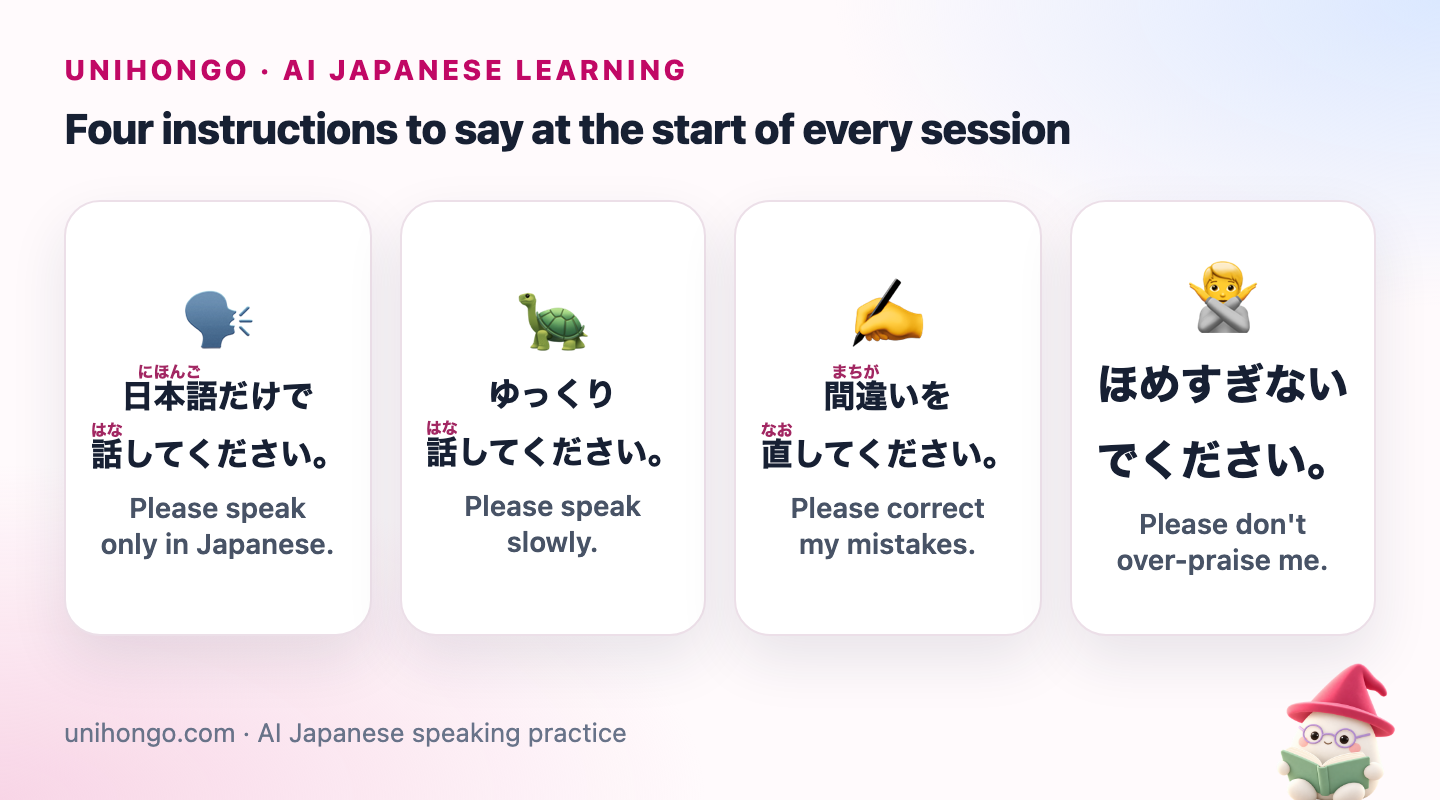
Four instructions to say at the start of every session
Say these four lines, in Japanese, before anything else. They fix the four behaviours that otherwise waste your time: drifting into English, speaking too fast, letting mistakes pass, and praising everything. Saying them in Japanese also tells the assistant your level and warms up your voice.
| Japanese | Romaji | Meaning |
|---|---|---|
| 日本語だけで話してください。 | Nihongo dake de hanashite kudasai. | Please speak only in Japanese. |
| ゆっくり話してください。 | Yukkuri hanashite kudasai. | Please speak slowly. |
| 間違いを直してください。 | Machigai o naoshite kudasai. | Please correct my mistakes. |
| ほめすぎないでください。 | Homesuginaide kudasai. | Please don't over-praise me. |
Homesugiru is homeru, to praise, plus sugiru, too much. The negative request form, ~naide kudasai, is the polite way to ask someone not to do something, and you will use it again in the next section.
A longer set-up script: level, role and rules
Once the four lines are automatic, use a fuller script that fixes your level, the persona and how corrections should arrive. Read it aloud at the start; the assistant will follow it reasonably well for the session, and you can repeat any line when it slips. Adapt the level and the role to your needs.
| Japanese | Romaji | Meaning |
|---|---|---|
| 私は日本語を勉強しています。レベルは初級です。 | Watashi wa Nihongo o benkyō shite imasu. Reberu wa shokyū desu. | I'm studying Japanese. My level is beginner. |
| 簡単な言葉を使ってください。 | Kantan na kotoba o tsukatte kudasai. | Please use simple words. |
| 英語に切り替えないでください。 | Eigo ni kirikaenaide kudasai. | Please don't switch to English. |
| 私が英語で話しても、日本語で答えてください。 | Watashi ga Eigo de hanashite mo, Nihongo de kotaete kudasai. | Even if I speak English, answer in Japanese. |
| 間違いがあったら、正しい文を言ってから、会話を続けてください。 | Machigai ga attara, tadashii bun o itte kara, kaiwa o tsuzukete kudasai. | If there is a mistake, say the correct sentence, then continue the conversation. |
| 一回の返事は二文までにしてください。 | Ikkai no henji wa nibun made ni shite kudasai. | Please keep each reply to two sentences. |
| コンビニの店員になってください。 | Konbini no ten'in ni natte kudasai. | Please be a convenience store clerk. |
What to watch for, and the lines that fix it
Four tendencies are worth knowing in advance. First, drifting into English: a general assistant mirrors the language of your last message, so one English question can switch the whole session. Second, agreeable feedback: left alone it tends to say your Japanese is wonderful, which is pleasant and useless. Third, speed and length: without instructions it may answer in long, fast paragraphs. Fourth, no pronunciation scoring: it responds to what it transcribed, so a mispronounced long vowel that was transcribed correctly will never be mentioned.
Each of the first three has a fix you can say mid-conversation. The fourth needs a different tool, which the last section covers.
| Japanese | Romaji | Meaning |
|---|---|---|
| 日本語でお願いします。 | Nihongo de onegai shimasu. | In Japanese, please. |
| もっと自然な言い方はありますか。 | Motto shizen na iikata wa arimasu ka. | Is there a more natural way to say that? |
| 今の文、どこが間違っていましたか。 | Ima no bun, doko ga machigatte imashita ka. | What was wrong with that sentence? |
| もう少し短く答えてください。 | Mō sukoshi mijikaku kotaete kudasai. | Please answer a little more briefly. |
| もう一度、ゆっくりお願いします。 | Mō ichido, yukkuri onegai shimasu. | Once more, slowly please. |
| Tendency | How you notice | What to say or do |
|---|---|---|
| Drifts into English | A reply arrives in English | Nihongo de onegai shimasu, and reply in Japanese yourself |
| Over-praises | Every answer is sugoi, kanpeki | Ask for one correction per reply and the natural version of your sentence |
| Too fast or too long | You lose the thread | Ask for slower speech and a two-sentence limit |
| Ignores pronunciation | It never mentions your sounds | Use a tool that scores sounds, or record yourself and compare |
A ten-minute session routine
Structure beats wandering. A routine that works: two minutes of set-up and warm-up, five minutes of roleplay or conversation on one topic, two minutes of corrections, one minute of summary. The correction phase is where the value is, so never skip it. Ask for the three most important mistakes rather than all of them, and ask for the corrected sentences so that you can repeat them aloud.

| Japanese | Romaji | Meaning |
|---|---|---|
| 今日の会話を始めましょう。 | Kyō no kaiwa o hajimemashō. | Let's start today's conversation. |
| カフェで注文する練習をしたいです。 | Kafe de chūmon suru renshū o shitai desu. | I want to practise ordering at a café. |
| 店員の役をお願いします。 | Ten'in no yaku o onegai shimasu. | Please play the clerk. |
| 今日の間違いを三つ教えてください。 | Kyō no machigai o mittsu oshiete kudasai. | Tell me three of today's mistakes. |
| 正しい文をもう一度言ってください。 | Tadashii bun o mō ichido itte kudasai. | Say the correct sentence once more. |
| 今日の新しい言葉をまとめてください。 | Kyō no atarashii kotoba o matomete kudasai. | Please summarise today's new words. |
Yaku is a role, as in a play. Ten'in no yaku o onegai shimasu, please play the clerk, is also exactly what you would say to a human partner or to a dedicated tutor, so it is worth learning well.
A short session, as it sounds
Here is how a well-set-up roleplay sounds, with the assistant as a café clerk and a correction at the end. Notice that the learner's slightly textbook phrasing, chiisai no de for the small one, is corrected to the way a café actually says it, without stopping the scene.
| Japanese | Romaji | Meaning |
|---|---|---|
| いらっしゃいませ。ご注文は? | Irasshaimase. Gochūmon wa? | Assistant as clerk: Welcome. Your order? |
| ホットコーヒーを一つ、お願いします。 | Hotto kōhī o hitotsu, onegai shimasu. | You: One hot coffee, please. |
| サイズはいかがなさいますか。 | Saizu wa ikaga nasaimasu ka. | Clerk: What size would you like? |
| えーと、小さいのでいいです。 | Ēto, chiisai no de ii desu. | You: Um, a small one is fine. |
| 店内でお召し上がりですか。 | Tennai de omeshiagari desu ka. | Clerk: For here? |
| 持ち帰りで。 | Mochikaeri de. | You: To take away. |
| とても自然でした。「小さいので」は「Sサイズで」がもっとよく使われます。 | Totemo shizen deshita. 'Chiisai no de' wa 'Esu saizu de' ga motto yoku tsukawaremasu. | Assistant: Very natural. For 'the small one', 'size S' is more commonly used. |
Where a Japanese-only tutor fits beside it
A general assistant is at its best when you supply the structure. A dedicated tutor is at its best when the structure comes built in. Unihongo is an example of the second kind: the AI Sensei speaks only Japanese, so the English-drift problem does not arise; roleplay missions such as Order at a Café or Japanese Job Interview have objectives you complete by speaking; a session report afterwards lists corrections, vocabulary and grammar; and the pronunciation lab scores sounds, mora timing and pitch, which no chat assistant measures. It is Japanese-only, so it is not the tool for asking what a word means in your own language.
A sensible split: use the general assistant for open conversation and explanations, and the dedicated tutor for corrected, measured practice and pronunciation. Both get better when you arrive with a topic and leave with a written list of mistakes.
| You want | General assistant with voice | Japanese-only tutor |
|---|---|---|
| Any topic, any hour | Yes | Yes, within Japanese |
| Stays in Japanese | Only if instructed, and it can slip | By design |
| Corrections | On request, in conversation | In conversation and in a report afterwards |
| Pronunciation scoring | Not designed for it | Yes: sounds, mora timing, pitch |
| Explanations in your language | Yes | Not the purpose |
| Roleplay with objectives | Free-form, you define it | Missions with objectives, plus free roleplay |
Mistakes that waste a voice session
- Starting without the four lines. Within two exchanges you are in English being told you are brilliant.
- Letting it talk. If its replies are longer than yours, you are listening practice, not speaking practice. Ask for two-sentence replies.
- Accepting praise as feedback. Ask what was wrong with the last sentence until it finds something; there is usually something.
- Trusting the transcription for pronunciation. It hears what it expects. Record yourself or use a scoring tool for sounds.
- No written record. The assistant forgets your mistakes between sessions unless you ask it to summarise; write them down.
- Only polite forms. Ask it to be a friend and to use casual Japanese for one session a week, or you will understand teachers and nobody else.