

Give the whole sentence, not the grammar point
The most common grammar question learners ask an AI is a bare comparison: what is the difference between node and kara. The AI will produce a paragraph that is true in general and useless for the sentence you had in mind. Grammar choices in Japanese depend on the sentence, the register and the relationship between speakers, so an answer without those is guesswork.
Give the full sentence you wanted to say, the sentence you actually said if different, who you were speaking to, and what you meant. A question with that much context takes ten seconds longer to ask and produces an answer you can actually use.
| Japanese | Romaji | Meaning |
|---|---|---|
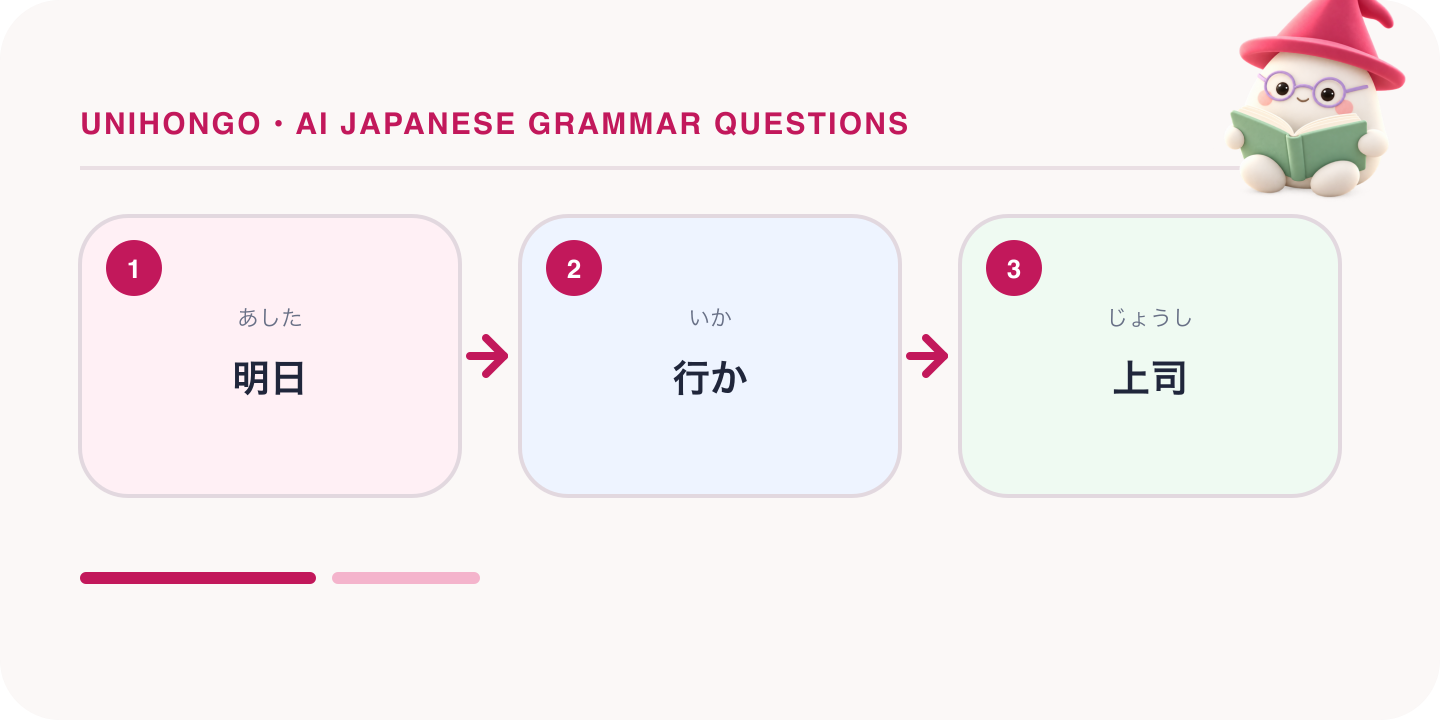
| この文はどこが変ですか。「明日は雨なので、行かない。」 | Kono bun wa doko ga hen desu ka. Ashita wa ame na node, ikanai. | What is odd about this sentence: Since it will rain tomorrow, I won't go. |
| 上司に対して言う場合です。 | Jōshi ni taishite iu baai desu. | This is for saying to my boss. |
| 言いたかったのは、断る理由を丁寧に伝えることです。 | Iitakatta no wa, kotowaru riyū o teinei ni tsutaeru koto desu. | What I wanted was to give my reason for declining politely. |
| 文全体を見て、他にも直すところがあれば教えてください。 | Bun zentai o mite, hoka ni mo naosu tokoro ga areba oshiete kudasai. | Look at the whole sentence and tell me if anything else needs fixing. |
Ask for minimal pairs
A minimal pair is two sentences that differ in one thing. Descriptions of grammar are abstract; a minimal pair makes the difference visible. Ask the AI to give the same sentence with node and with kara, with ni and with de, with te-form and with tari, and to say in one line what changes in meaning or feeling. Then ask it for a situation where only one of the pair would be natural, because that is the test of whether you have understood.
The frame kono bunpō wa dō chigaimasu ka works for almost any pair. Follow it with dotchi ga shizen desu ka, which is more natural, for your specific sentence, and dō iu toki ni tsukaimasu ka, when is it used, for the general case. Say both sentences of the pair aloud immediately; the contrast lodges better in the mouth than on the screen.
| Japanese | Romaji | Meaning |
|---|---|---|
| この文法はどう違いますか。 | Kono bunpō wa dō chigaimasu ka. | How do these grammar points differ? |
| 「ので」と「から」で同じ文を作ってください。 | Node to kara de onaji bun o tsukutte kudasai. | Make the same sentence with node and with kara. |
| どっちが自然ですか。 | Dotchi ga shizen desu ka. | Which is more natural? |
| 片方しか使えない場面を教えてください。 | Katahō shika tsukaenai bamen o oshiete kudasai. | Give me a situation where only one of them works. |
| どういう時に使いますか。 | Dō iu toki ni tsukaimasu ka. | When is it used? |
Ask why, not just what
An AI that says the correct form is X has told you nothing you can transfer. An AI that says X fits because the reason is the speaker's own judgement and the listener is a superior has given you a rule you can reuse. Always follow a correction with dōshite desu ka, why, and then push once more: is there a case where the other form would be right? The second push is where the shallow answers fall apart and the good ones get interesting.
The table lists question frames in Japanese and the kind of answer each one pulls out of an AI Sensei. Keep them somewhere you can see them during a session until they become automatic.
| Question frame | Reading | What it gets you |
|---|---|---|
| どうしてですか。 | Dōshite desu ka. | The reason behind a correction |
| 逆の場合はどうなりますか。 | Gyaku no baai wa dō narimasu ka. | The mirror case, which tests the rule |
| 例を三つください。 | Rei o mittsu kudasai. | Three examples to hear the form in use |
| 会話で使いますか、書き言葉ですか。 | Kaiwa de tsukaimasu ka, kakikotoba desu ka. | Whether it belongs in speech or writing |
| 丁寧さのレベルは同じですか。 | Teinei-sa no reberu wa onaji desu ka. | Whether the pair differs in politeness |
| ニュアンスはどう変わりますか。 | Nyuansu wa dō kawarimasu ka. | The feeling change, not just the meaning |
| この形は間違いですか、不自然なだけですか。 | Kono katachi wa machigai desu ka, fushizen na dake desu ka. | Whether it is wrong or merely awkward |
| 自信はどのくらいありますか。 | Jishin wa dono kurai arimasu ka. | A signal of how far to trust the answer |
| もっと簡単な言い方はありますか。 | Motto kantan na iikata wa arimasu ka. | A plainer alternative for everyday speech |
The last two frames are the ones learners forget. Asking how confident the AI is often makes it hedge where the point is subtle, and that hedge is your cue to check elsewhere.
Check the answer against a second source
Treat every grammar answer from an AI as a hypothesis. For common patterns it will usually be right; for nuance, register and rare forms it can be confidently wrong, and it will not always know which kind of question you asked. A second source takes two minutes: a grammar dictionary entry, a search for the pattern in real Japanese text, or a native speaker's reaction to the minimal pair.
A cheap check is to ask the same AI the reverse question. If it told you that A is more natural than B, start a new question with B as the correct form and see whether it agrees. If it flips, the point is either subtle or the AI is unsure, and either way you should look further before drilling it.
| Japanese | Romaji | Meaning |
|---|---|---|
| 逆に、「B」のほうが正しいですよね。 | Gyaku ni, B no hō ga tadashii desu yo ne. | Actually, B is the correct one, isn't it? |
| この文法を使った実際の例文を三つ見せてください。 | Kono bunpō o tsukatta jissai no reibun o mittsu misete kudasai. | Show me three real example sentences using this grammar. |
| 辞書には違う説明がありました。どちらが正しいですか。 | Jisho ni wa chigau setsumei ga arimashita. Dochira ga tadashii desu ka. | The dictionary had a different explanation. Which is right? |
- Ask the reverse question in a fresh message and see if the answer holds
- Look the pattern up in a grammar dictionary and compare the stated conditions
- Search for the exact phrase and read three real sentences that use it
- Ask a native speaker which of the minimal pair they would say, without explaining why you ask
- Ask the AI for its three example sentences and check they match its own rule
- Note any point where two sources disagree and bring it to a human tutor
Most answers will pass. The habit matters for the few that do not, because a wrong rule drilled thirty times is a fossilised error you will later pay to remove.
Turn the answer into ten spoken examples
Understanding a grammar point and being able to use it in speech are different skills, and only the second one matters in conversation. As soon as you have an answer you trust, make ten sentences of your own with the form. Say them aloud, one at a time, and have the AI Sensei correct each before you move to the next. Use your own life for content, since sentences about your job and your weekend are the ones you will need.
Then vary one thing at a time: the tense, the politeness level, the subject, a negative. Ten sentences with variation cover more ground than fifty repetitions of the same one. Finish by using the form in a role-play the same day, because a form that appears under the mild pressure of a conversation is one you own. The next day, ask the AI to quiz you on it before starting anything new.
| Japanese | Romaji | Meaning |
|---|---|---|
| この文法で、自分の文を十個作ります。直してください。 | Kono bunpō de, jibun no bun o jukko tsukurimasu. Naoshite kudasai. | I'll make ten sentences of my own with this grammar. Please correct them. |
| 今度は過去形で言ってみます。 | Kondo wa kakokei de itte mimasu. | This time I'll try it in the past tense. |
| 同じ文を敬語にするとどうなりますか。 | Onaji bun o keigo ni suru to dō narimasu ka. | What happens to the same sentence in keigo? |
| 昨日の文法をクイズにしてください。 | Kinō no bunpō o kuizu ni shite kudasai. | Turn yesterday's grammar into a quiz. |
| ロールプレイの中でこの形を使いたいです。 | Rōrupurei no naka de kono katachi o tsukaitai desu. | I want to use this form inside a role-play. |
What AI explanations get wrong, and how to notice
AI grammar explanations fail in predictable ways. The first is over-generalisation: a rule stated for all cases that actually holds for most. Node is softer than kara is true often enough to be useful and wrong often enough to matter. The second is register blindness: an explanation that is correct for written Japanese offered for a casual conversation, or the reverse. The third is invented nuance, where the AI produces a confident difference between two forms that native speakers treat as interchangeable in that sentence.
You notice these by looking for a few signals. Absolute words such as always and never in a nuance explanation should raise an eyebrow. An answer with no example sentence is a description, not evidence. An explanation that changes when you ask again with the same context is unsure. And any rule you cannot find in real sentences after a short search is probably tidier than the language. When you see a signal, go to the second source and come back with the example that settles it.
| Japanese | Romaji | Meaning |
|---|---|---|
| 「いつも」と言いましたが、例外はありませんか。 | Itsumo to iimashita ga, reigai wa arimasen ka. | You said always, but are there no exceptions? |
| この二つは本当に違いますか。同じに聞こえます。 | Kono futatsu wa hontō ni chigaimasu ka. Onaji ni kikoemasu. | Are these two really different? They sound the same to me. |
| それは話し言葉でも同じですか。 | Sore wa hanashikotoba demo onaji desu ka. | Is that the same in spoken language? |
| さっきと説明が違います。どちらが正しいですか。 | Sakki to setsumei ga chigaimasu. Dochira ga tadashii desu ka. | That is different from what you said before. Which is right? |
Common mistakes when asking an AI about grammar
The first mistake is asking in the abstract and drilling the abstract answer. The second is switching to English for the question and never coming back, so a grammar doubt costs you twenty minutes of Japanese. The third is collecting explanations without producing sentences, which feels like study and changes nothing in your speech. The fourth is accepting the first answer because it was fluent; fluency is not accuracy.
The fifth is asking about too much at once. One form, one sentence, one situation, ten examples, then a role-play. That loop takes fifteen minutes and produces a form you can use tonight. A list of twelve grammar questions answered in one sitting produces a document you will not open again.
| Japanese | Romaji | Meaning |
|---|---|---|
| 質問は日本語でします。わからなければ英語で聞きます。 | Shitsumon wa nihongo de shimasu. Wakaranakereba eigo de kikimasu. | I'll ask in Japanese. If I don't understand, I'll ask in English. |
| 今日は一つの文法だけ集中します。 | Kyō wa hitotsu no bunpō dake shūchū shimasu. | Today I'll focus on just one grammar point. |
| 説明はいいので、例文をください。 | Setsumei wa ii node, reibun o kudasai. | Skip the explanation, just give me example sentences. |