
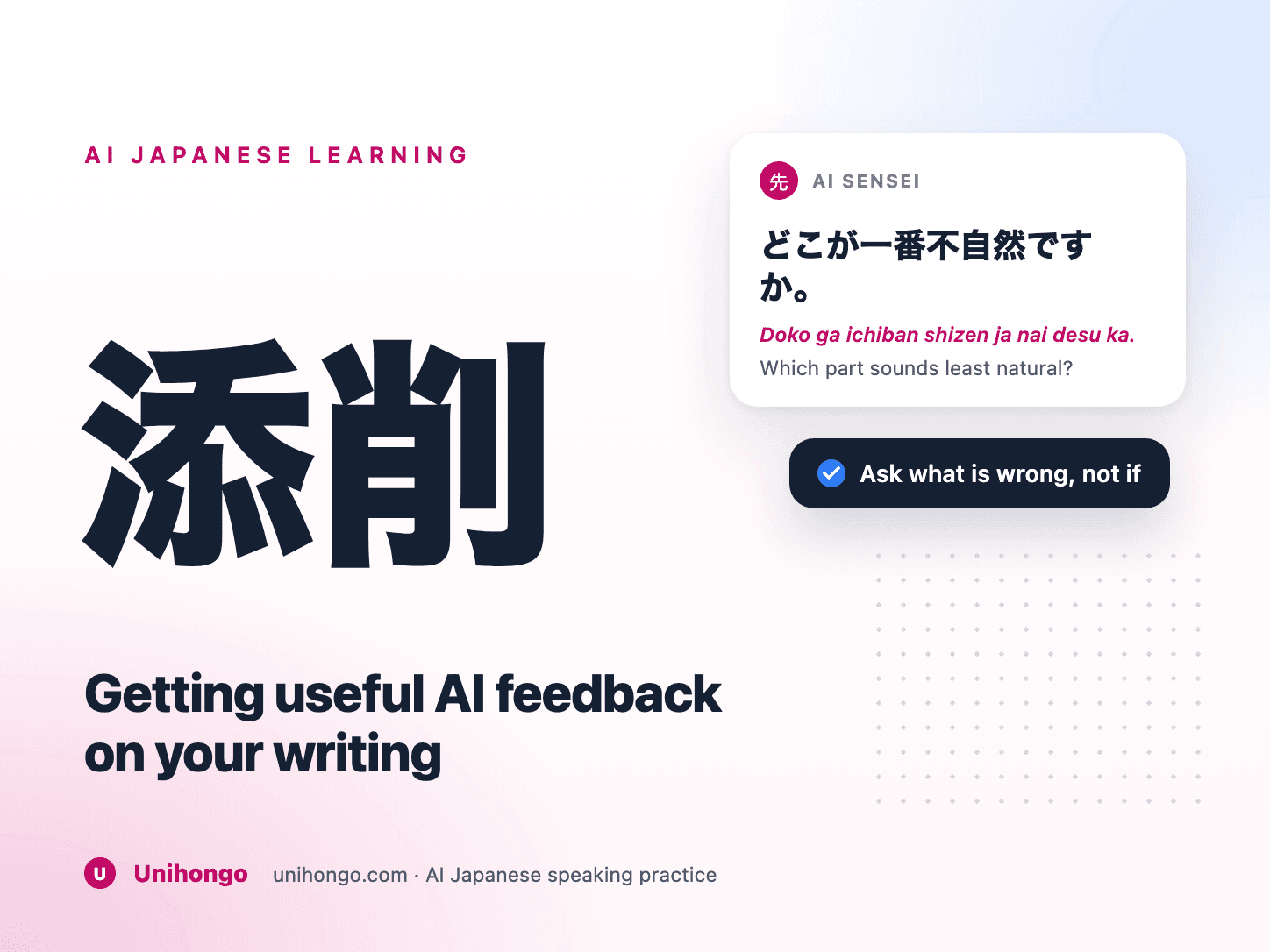
The question determines the answer
The default question, whether a sentence is correct, is the one that produces the least useful answer. It invites agreement, and a sentence that is grammatical but unnatural will usually be approved.
Questions that assume something could be improved produce far better feedback, because they ask for a judgement rather than a verdict.
| Instead of asking | Ask | Why |
|---|---|---|
| Is this correct? | What would a native speaker change? | Assumes improvement is possible |
| Is this natural? | Which part sounds least natural? | Forces a specific answer |
| Fix my Japanese | Make the smallest change needed | Keeps the sentence yours |
| Is this polite enough? | What register is this in? | Descriptive, not a verdict |
| Rewrite this | Explain what is wrong, then fix it | Produces something learnable |
Every question in the second column asks for a description rather than a judgement, which is what makes the answers usable.
Ask for the smallest change
Left alone, AI rewrites towards good Japanese rather than towards your Japanese. The result is often a sentence you could not have produced and will not learn from.
Asking explicitly for the minimum edit keeps the sentence recognisably yours and makes the difference visible, which is where the learning is.
- Ask for the smallest change that fixes the problem.
- Ask it to keep your vocabulary where possible.
- Ask what specifically was wrong with the original.
- Compare the two versions rather than accepting the new one.
- Reject rewrites that use grammar well above your level.
What it is genuinely good at
For certain categories the feedback is reliable and hard to get elsewhere, particularly the errors that no tool flags and that human readers are too polite to mention.
Register is the standout case: asking what level of politeness a message is in produces an accurate and useful answer, and it is the error Japanese readers notice most.
- Register consistency across a message.
- Whether keigo points in the right direction.
- Particles, which no spellchecker catches.
- Whether a phrasing sounds like a textbook.
- Whether a message would read as blunt.
What to verify
The unreliable category is explanation rather than correction. A confident account of why one form is more natural than another can be mistaken, and nothing in the delivery signals it.
Anything that depends on lived usage rather than on rules is worth checking with a person or a reference.
- Nuance between two similar words.
- Whether an expression is current or dated.
- Regional or generational usage.
- Whether something would cause offence in a specific relationship.
- Etymology and historical explanations.
Using it to learn rather than to fix
The difference between using AI as a proofreader and using it as a teacher is what you do with the correction. A corrected message that is sent and forgotten produces a good message and no learning.
The productive habit is to ask why, decide whether the reason generalises, and note the ones that do.
- Ask what the underlying rule is, if any.
- Ask whether the same error appears elsewhere in the text.
- Note corrections that recur across messages; those are your real errors.
- Rewrite the sentence yourself rather than pasting the fix.
- Check whether the same error appears in your speech.
Fitting it alongside speaking
Written feedback and spoken feedback catch different errors. Writing exposes register and particles; speaking exposes speed, pronunciation and the patterns you avoid because they are slow.
A learner who only ever gets written feedback tends to have accurate Japanese that arrives too slowly, which is why the two belong together.
In Unihongo the spoken half comes from sessions in the immersive 3D classroom and the session report afterwards, which flags register slips in speech in the same way this catches them in writing.
If the same error appears in both your writing and your speech, it is a real gap rather than a slip. Those are the ones worth drilling.