

Why a reader changes Japanese reading
The hardest part of reading Japanese is not grammar or vocabulary but the look-up loop. On paper, an unknown kanji stops you: you need the reading before you can search, and finding it by radical or by drawing takes a minute each time. Twenty unknown words on a page means twenty interruptions, and the sentence you were reading is gone by the time you return.
On a reader, a long press on the word shows the reading and a short definition in a small window over the text. The sentence is still in view, and you go straight back to it. That single change makes native books possible far earlier than most learners expect. There is a trap, though: the dictionary is so easy that you can tap every word and never actually read.
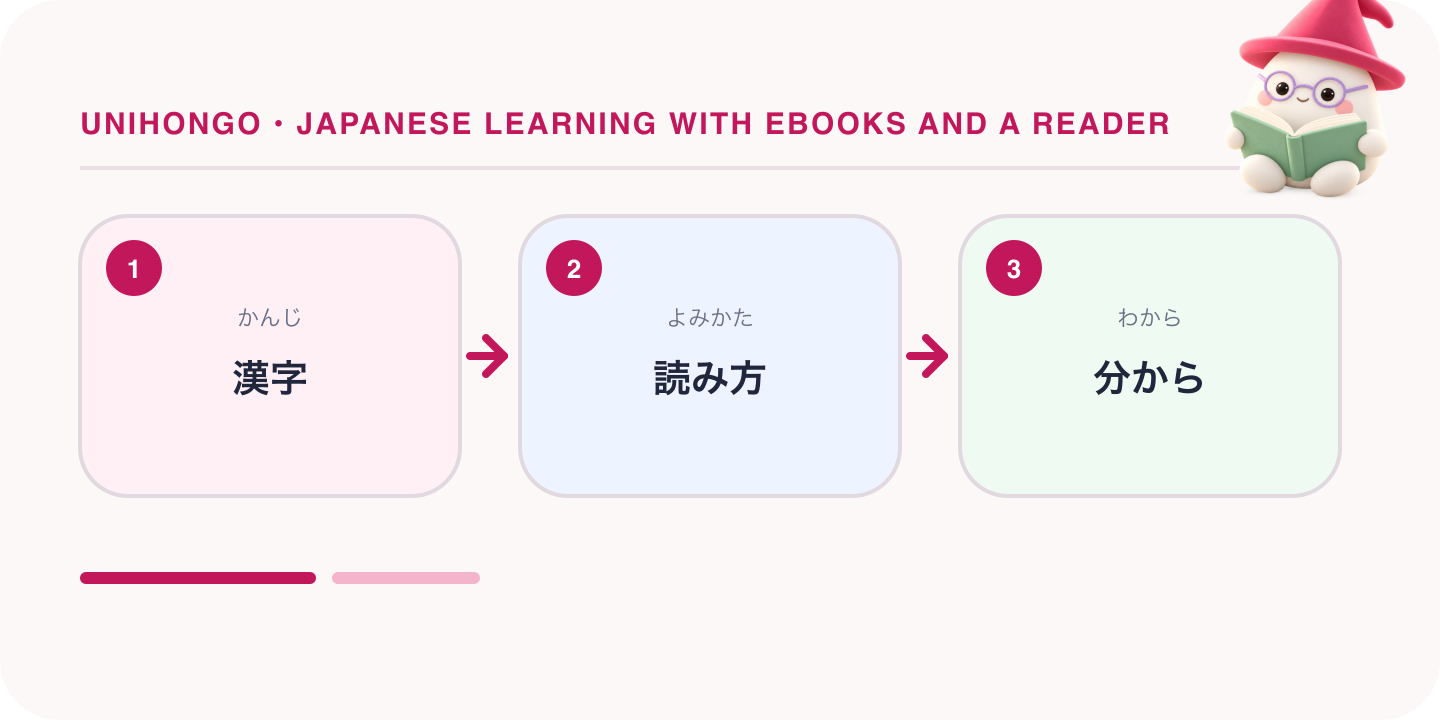
| Japanese | Romaji | Meaning |
|---|---|---|
| この漢字、読み方が分からない。 | Kono kanji, yomikata ga wakaranai. | I don't know how to read this kanji. |
| 単語を長押しすると辞書が出ます。 | Tango o nagaoshi suru to jisho ga demasu. | If you long-press a word the dictionary appears. |
| 紙の本より電子書籍のほうが読みやすい。 | Kami no hon yori denshi shoseki no hō ga yomiyasui. | Ebooks are easier to read than paper books. |
| 文の途中で止まらないで読みたい。 | Bun no tochū de tomaranaide yomitai. | I want to read without stopping mid-sentence. |
| 調べすぎると内容が頭に入らない。 | Shirabesugiru to naiyō ga atama ni hairanai. | If I look up too much, the content doesn't sink in. |
Settings worth changing on day one
Start with the font. Japanese type at the default size hides the difference between similar kanji, and learners squint at strokes they would recognise at a larger size. Raise it until the characters are comfortably clear, even if that means only a few lines per screen. As you get faster, bring it down again. Gothic type, with its even strokes, is easier for beginners than the mincho face novels are printed in.
Next, decide about direction. Japanese fiction is usually laid out vertically, tategaki, and read right to left. Many apps can switch a book to horizontal, yokogaki, which feels familiar at first. Start horizontal if you like, but switch back within a few weeks, because vertical is what printed Japanese looks like.
Finally, install the dictionaries. Set a Japanese-English one as the default, add a Japanese-Japanese one beside it, and make sure look-up works offline. Turn off any pop-up that offers a full translation of the sentence: it is tempting, and it removes the reading practice entirely.
| Japanese | Romaji | Meaning |
|---|---|---|
| 文字を大きくしてください。 | Moji o ōkiku shite kudasai. | Please make the text bigger. |
| 縦書きと横書き、どちらが読みやすいですか。 | Tategaki to yokogaki, dochira ga yomiyasui desu ka. | Vertical or horizontal, which is easier to read? |
| 明朝体はまだ読みにくいです。 | Minchōtai wa mada yominikui desu. | Mincho typeface is still hard for me to read. |
| 辞書をオフラインでも使えるようにした。 | Jisho o ofurain demo tsukaeru yō ni shita. | I set the dictionary up to work offline too. |
Furigana, readings and the dictionary habit
Furigana, the small kana printed over kanji, appears in books aimed at children and teenagers and in many manga. It is a great bridge, but a reader cannot add it to books that do not have it. In an adult novel you will see furigana only on rare readings, unusual names and words the author wants read a particular way. That is not a problem once you accept the dictionary as your furigana: a tap gives the reading, and after the third time you no longer need it.
A habit worth building from the first day is to read the whole sentence before tapping anything. Guess the unknown word from context and from the kanji you recognise, then look it up and check your guess. Learners who tap first never develop the guessing muscle that makes real reading fluent. Allow one look-up per paragraph on a first read, and reread with more only if it did not make sense.
| Japanese | Romaji | Meaning |
|---|---|---|
| この本はふりがなが付いていますか。 | Kono hon wa furigana ga tsuite imasu ka. | Does this book have furigana? |
| まず文脈から意味を推測してみる。 | Mazu bunmyaku kara imi o suisoku shite miru. | First I try to guess the meaning from context. |
| 一段落に一回だけ辞書を引く。 | Ichi danraku ni ikkai dake jisho o hiku. | I look up the dictionary only once per paragraph. |
| 国語辞典に切り替えました。 | Kokugo jiten ni kirikaemashita. | I switched to a Japanese-Japanese dictionary. |
| 三回目で読み方を覚えた。 | Sankaime de yomikata o oboeta. | I remembered the reading on the third time. |
From graded readers to native books
Graded readers control vocabulary and grammar by level, and they are the right place to start on a reader because the dictionary is barely needed. Read them fast and read many. The aim at this stage is to get used to Japanese sentence rhythm and to the sight of kanji without stopping, not to learn new words.
Move up when you find yourself looking up fewer than one word per page. The step from graded readers to adult novels is too big for most people, so use the rungs between. Manga with furigana teaches casual spoken Japanese. Light novels and children's classics use everyday words in short sentences. Essay collections and travel writing are surprisingly readable because the sentences are plain and the topic is concrete. Choose by interest rather than level: a detective story you cannot put down carries you through unknown words.
| Type of book | Reading | What it gives you |
|---|---|---|
| 多読用の本 | tadoku-yō no hon | Graded readers: speed and confidence |
| 絵本 | ehon | Picture books: short natural sentences |
| 児童書 | jidōsho | Children's books: full furigana, everyday words |
| 漫画 | manga | Casual speech, sound words, furigana |
| ライトノベル | raito noberu | Light novels: dialogue-heavy, fast plots |
| エッセイ | essei | Essays: plain sentences, real opinions |
| 旅行記 | ryokōki | Travel writing: place names, food, transport |
| 推理小説 | suiri shōsetsu | Detective novels: repetitive, addictive plots |
| ビジネス書 | bijinesu-sho | Business books: workplace vocabulary |
| 純文学 | junbungaku | Literary fiction: for much later |
Most reading stores let you download a sample of the first chapter. Read it before buying: if you look up more than a handful of words per page, the book can wait.
Highlighting for review without drowning
Every reader lets you highlight and add notes, and the highlights can usually be exported or viewed as a list. This is the best vocabulary source you will ever have, because every word on it came with a sentence and a story. The danger is highlighting too much. Fifty highlights per chapter cannot be reviewed, and the list becomes something you feel guilty about.
Use a simple rule: highlight a word the second time you meet it, not the first, and only if you would want to say it yourself. First meetings are just looked up and forgotten. That keeps the list to a dozen words per chapter, which is manageable. Once a week, open the list, keep the words that still feel useful, and put them into whatever review system you use, with the sentence from the book as the example.
- Highlight on the second meeting, not the first
- Keep only words you would want to say yourself
- One colour for words, another for sentences worth repeating
- Review the list weekly and delete freely
- Copy the book's sentence, not a dictionary example, into your cards
- Say each reviewed word in a sentence before you mark it known
A weekly reading routine
Reading works when it is small and regular. Twenty minutes a day is far better than a two-hour Sunday session, because the vocabulary of the book stays warm between sittings. A workable week looks like this: read every day at the same point in your routine, on the train or before bed; on two days, spend five extra minutes reviewing highlights; and on one day, talk about what you read.
The talking day is where reading turns into language you can use. Summarise the chapter aloud, describe a character, or explain why you did or did not like a scene. Do it with a partner, a teacher or your AI Sensei, and use at least two words from the highlight list. You will find that words you recognised instantly on the page are much harder to produce, and that gap is exactly what the session closes.
| Japanese | Romaji | Meaning |
|---|---|---|
| 毎日二十分だけ読むことにしている。 | Mainichi nijuppun dake yomu koto ni shite iru. | I make a point of reading just twenty minutes a day. |
| 電車の中で一章読みました。 | Densha no naka de isshō yomimashita. | I read one chapter on the train. |
| 主人公は東京で一人暮らしをしています。 | Shujinkō wa Tōkyō de hitorigurashi o shite imasu. | The main character lives alone in Tokyo. |
| この場面がいちばん好きでした。 | Kono bamen ga ichiban suki deshita. | This scene was my favourite. |
| 読むのは分かるけど、話すと出てこない。 | Yomu no wa wakaru kedo, hanasu to dete konai. | I understand when reading, but it won't come out when I speak. |
Tablet or dedicated e-reader
Both work. A dedicated e-reader has a paper-like screen, a battery that lasts weeks and almost nothing else on it, which matters if messages pull you away. Its store and format choice can be narrow, and some models handle vertical text or furigana less gracefully than a tablet app.
A tablet runs any reading app, including the store apps from Japanese bookshops, so the catalogue is wider and manga support better; glare, battery life and distraction are the cost. Whichever you choose, check before buying that the store sells Japanese titles to your account and region, because that varies.
| Japanese | Romaji | Meaning |
|---|---|---|
| 電子書籍リーダーは目が疲れにくい。 | Denshi shoseki rīdā wa me ga tsukarenikui. | An e-reader is easy on the eyes. |
| タブレットなら漫画も読みやすい。 | Taburetto nara manga mo yomiyasui. | With a tablet, manga is easy to read too. |
| この国からは日本の電子書籍が買えますか。 | Kono kuni kara wa Nihon no denshi shoseki ga kaemasu ka. | Can I buy Japanese ebooks from this country? |
| 通知を切って読書に集中する。 | Tsūchi o kitte dokusho ni shūchū suru. | I turn off notifications and focus on reading. |
When reading stalls
Most stalls have one of three causes. The book is too hard, and every sentence needs three look-ups; drop a level and come back to it in a few months. The book is too dull, and you have no reason to turn the page; abandon it without guilt, because there is no prize for finishing. Or the reading has become invisible: you tap, read the definition, move on, and could not say what the last paragraph was about. That is the dictionary running the show.
The fix for the third case is to read a page guessing everything, then reread it with the dictionary. Most guesses will be right, which builds the confidence to look up less. If one kanji keeps blocking you, write it once by hand and say a word containing it aloud; a character you have written and spoken is harder to forget than one you have only tapped.
| Japanese | Romaji | Meaning |
|---|---|---|
| この本はまだ難しすぎる。 | Kono hon wa mada muzukashisugiru. | This book is still too hard. |
| つまらないのでやめました。 | Tsumaranai node yamemashita. | It was boring so I gave up on it. |
| 辞書なしで一ページ読んでみた。 | Jisho nashi de ichi pēji yonde mita. | I tried reading one page without a dictionary. |
| この漢字が何度も出てきて止まってしまう。 | Kono kanji ga nando mo dete kite tomatte shimau. | This kanji keeps coming up and stopping me. |