
Two different products, not two versions of one
A human teacher sells scheduled attention. You buy an hour, and inside it somebody who knows your history decides what you need next, notices that you have started avoiding a grammar point, and answers questions about your own situation. The scarcity is the point: it is expensive, booked in advance, and finite.
An AI tutor sells access. It is there at six in the morning and at midnight, it never sighs when you repeat the same sentence for the ninth time, and its cost does not rise with the hours you use. The scarcity is reversed: minutes are cheap and attention is endless, but nothing in the arrangement knows what you need or notices when you disappear.
Cost, availability, and the volume that follows
Cost and availability are really one factor, because together they decide how much Japanese leaves your mouth in a month. Human lessons are priced per hour, so a normal budget buys a few hours, of which you speak maybe half. Flat-fee or free-tier AI practice, at fifteen minutes on five days a week, produces several hours of your own speech in the same month.
That difference compounds where most learners are weak. Retrieval speed, comfort with being corrected, and keeping a conversation going when a word is missing all improve with repetition rather than insight. What repetition cannot supply is direction, and that is where the expensive hour earns its price.
Patience and the social cost of a mistake
The quietest advantage of AI practice is that nothing is at stake. You can produce a badly formed sentence, hear the correction, and try again four times without anybody adjusting their opinion of you. Learners who freeze in front of people often speak freely to a machine within a session or two, and that unblocking is genuine progress.
The same absence of stakes is a limitation. Real conversation carries mild pressure: someone is waiting, they may not simplify, and the fear of getting it wrong is part of what you are training against. A learner who only practises where mistakes cost nothing can be fluent in rehearsal and mute in a shop.
Correction quality and who is accountable
AI correction is instant, consistent, and tireless, which suits high-frequency errors: particles, verb forms, politeness levels, word order. Its weaknesses are specific. It can over-correct a sentence that was already fine, offer a rewrite that is grammatical but not what a person would say, and it has no memory of your goals beyond what it can see.
A human teacher corrects less often and more selectively, and that selectivity is the value. A good teacher ignores three errors to fix the one becoming a habit, because they remember last month. They are also accountable in a way software is not: they notice you skipped a fortnight and ask why. No app has ever been disappointed in you, which is why so many subscriptions go quiet.
Cultural nuance and exam coaching
Register questions with a real answer attached are where the gap is widest. Whether a phrase is too polite for a colleague you eat lunch with, or how a particular manager will read a particular email, are judgements about people rather than about grammar. AI answers from the textbook middle, which is safe but often not what someone in the room would actually say.
Exams are the second clear gap. The JLPT tests reading and listening under time pressure and has no speaking section, so a conversation tutor cannot train the format or the pacing. It can strengthen the underlying recognition, but the plan and the decision about which level to sit belong with a teacher or a course.
| Japanese | Romaji | Meaning |
|---|---|---|
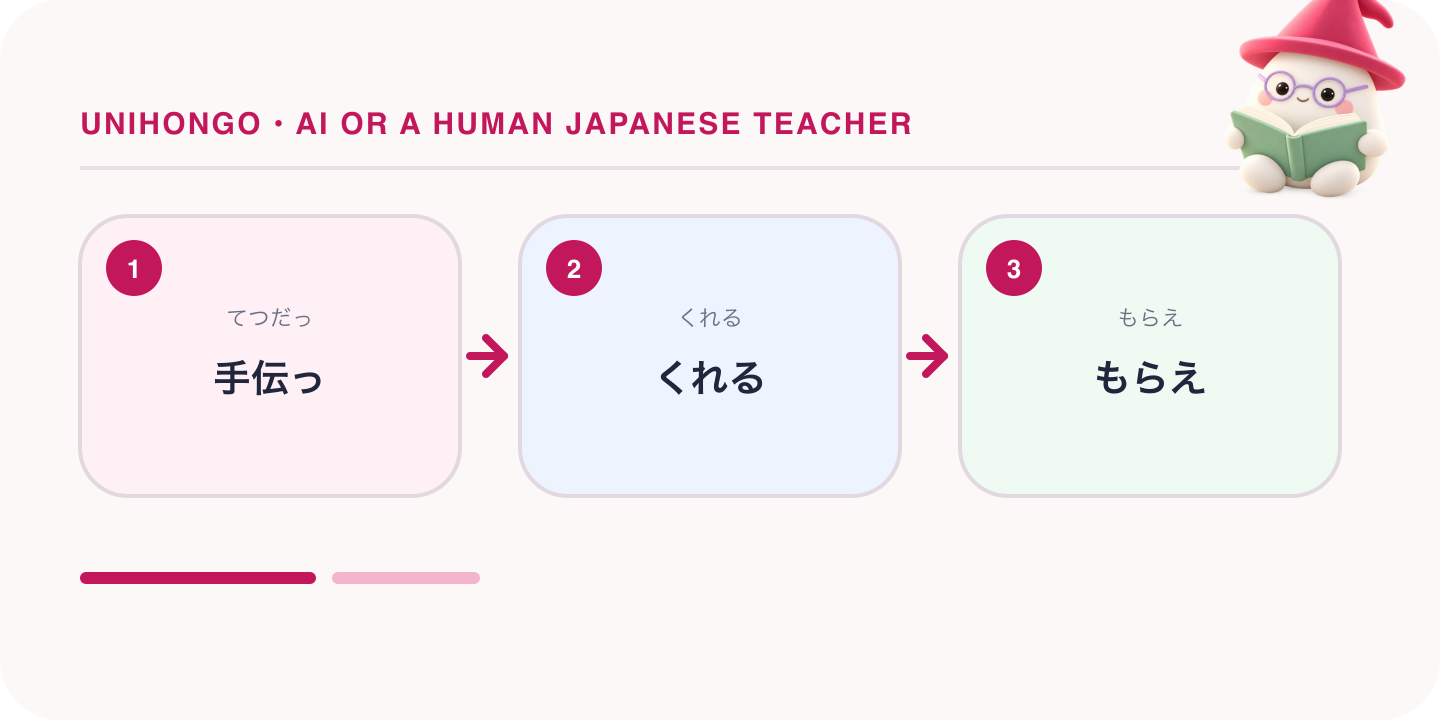
| 手伝ってくれる? | Tetsudatte kureru? | Can you give me a hand? |
| 手伝ってもらえますか。 | Tetsudatte moraemasu ka. | Could you help me? |
| 手伝っていただけませんか。 | Tetsudatte itadakemasen ka. | Would you be able to help me? |
| ちょっと今、よろしいでしょうか。 | Chotto ima, yoroshii deshō ka. | Do you have a moment now? |
| お忙しいところ、申し訳ありません。 | O-isogashii tokoro, mōshiwake arimasen. | I am sorry to trouble you while you are busy. |
| 遅れてすみません。 | Okurete sumimasen. | Sorry I am late. |
| 遅くなり、申し訳ございませんでした。 | Osoku nari, mōshiwake gozaimasen deshita. | I am very sorry for being late. |
| 明日、休ませていただけますか。 | Ashita, yasumasete itadakemasu ka. | Would it be possible for me to take tomorrow off? |
An AI tutor will produce this whole ladder on request, correctly and in seconds. What it cannot tell you is which rung fits your office, your manager, and the size of the favour you are asking. That judgement is what you buy from a person.
AI or human, factor by factor
| Factor | AI tutor | Human teacher |
|---|---|---|
| Cost pattern | Flat monthly fee or a free tier with daily limits | Paid per lesson, so cost rises with hours |
| Availability | Any hour, no booking, no cancellation | Fixed slots agreed in advance |
| Patience | Unlimited retries of the same sentence | Generous, but a person is waiting |
| Correction style | Immediate and consistent, sometimes over-eager | Selective, judged against your history |
| Cultural nuance | Textbook-level guidance on register | Knows what people say, to whom, and when |
| Accountability | Never notices that you stopped | Notices, asks, and expects something next time |
| Exam coaching | Drills and mock questions on request | Strategy, timing, and marked practice |
| Speaking volume | High, because minutes are cheap and daily | Low, an hour or two a month on most budgets |
Read the table by column rather than by row. The AI column is strong wherever the answer is repetition and weak wherever it is judgement; the human column is the reverse. The sensible response is to give each column the work it is good at.
Questions a human teacher answers better
These questions share a feature: they are about your life, your relationships, or your future, and the right answer depends on facts no machine has. Expect a reply that starts with a question back, because a person needs to know who your boss is before telling you how polite to be. Save them up during the fortnight and bring a short list.
| Japanese | Romaji | Meaning |
|---|---|---|
| 上司にこのメールを送っても失礼じゃないですか。 | Jōshi ni kono mēru o okutte mo shitsurei ja nai desu ka. | Would it be rude to send this email to my boss? |
| 私の日本語は、仕事で使えるレベルですか。 | Watashi no nihongo wa, shigoto de tsukaeru reberu desu ka. | Is my Japanese at a level I could use at work? |
| 部長にお礼を言うとき、どこまで丁寧にすればいいですか。 | Buchō ni orei o iu toki, doko made teinei ni sureba ii desu ka. | When thanking a department manager, how polite should I be? |
| この言い方は、地域によって変わりますか。 | Kono iikata wa, chiiki ni yotte kawarimasu ka. | Does this expression change depending on the region? |
| 面接でこう答えたら、印象はどうですか。 | Mensetsu de kō kotaetara, inshō wa dō desu ka. | If I answer this way in an interview, how would it come across? |
| 半年後の試験に間に合いますか。 | Hantoshi go no shiken ni maniaimasu ka. | Will I be ready in time for the exam in six months? |
| 次に何を勉強すればいいですか。 | Tsugi ni nani o benkyō sureba ii desu ka. | What should I study next? |
| 友達の親に会うとき、何と言えばいいですか。 | Tomodachi no oya ni au toki, nan to ieba ii desu ka. | What should I say when I meet my friend's parents? |
A useful reply to the first line sounds like 上司との関係によりますね。普段はどう話していますか。 Jōshi to no kankei ni yorimasu ne. Fudan wa dō hanashite imasu ka. It depends on your relationship with your boss. How do you normally speak to him? That counter-question is what an AI tutor cannot ask, because it has never met anyone in your office.
Questions an AI tutor handles fine
These requests would waste a paid hour, and a machine answers them instantly, without limit, at any time of night. They are about repetition, variation, or a rule with a definite answer. Say them in Japanese so the session stays in Japanese, and expect the tutor to comply immediately rather than negotiating.
| Japanese | Romaji | Meaning |
|---|---|---|
| この文法をもう一度、例文で説明してください。 | Kono bunpō o mō ichido, reibun de setsumei shite kudasai. | Please explain this grammar again with example sentences. |
| 同じ質問をもう五回してください。 | Onaji shitsumon o mō gokai shite kudasai. | Please ask me the same question five more times. |
| 今の文を、丁寧な形に直してください。 | Ima no bun o, teinei na katachi ni naoshite kudasai. | Please change the sentence I just said into the polite form. |
| ホテルでチェックインする場面を練習しましょう。 | Hoteru de chekkuin suru bamen o renshū shimashō. | Let us practise checking in at a hotel. |
| もっと難しい質問をしてください。 | Motto muzukashii shitsumon o shite kudasai. | Please ask me harder questions. |
| 私の発音を聞いて、直してください。 | Watashi no hatsuon o kiite, naoshite kudasai. | Please listen to my pronunciation and correct it. |
| この単語を使った文を三つ作ります。聞いてください。 | Kono tango o tsukatta bun o mittsu tsukurimasu. Kiite kudasai. | I will make three sentences with this word. Please listen. |
| 最初からもう一度やりましょう。 | Saisho kara mō ichido yarimashō. | Let us start again from the beginning. |
The hybrid most learners land on
After a few months, learners who keep both settle into the same shape: short AI sessions on most days for volume, and one human lesson every week or two for direction. The human hour becomes a review and planning meeting rather than conversation practice, which makes it noticeably more productive, since you arrive with material instead of small talk.
- Most days: ten to twenty minutes of speaking with an AI tutor, one situation per session.
- Every session: keep two corrected sentences and note anything that surprised you.
- Once a week or fortnight: a human lesson opened with your list of saved questions.
- In the lesson: ask for one habit to fix and one thing to practise before next time.
- The following days: drill exactly that, in the situation where it goes wrong.
- Every month or so: ask the teacher whether the habit has actually gone.
The handover works in both directions. What the teacher flags becomes this week's drill, and what the drilling failed to fix becomes the next lesson's first question.
Lines for the handover between the two
Run the handover in Japanese rather than in your own language. The first five lines belong in the human lesson, where they report what you did alone and ask for a verdict on something specific. The last one belongs in the AI session, where it turns the teacher's advice into repetitions.
| Japanese | Romaji | Meaning |
|---|---|---|
| 今週は毎日、一人で会話の練習をしました。 | Konshū wa mainichi, hitori de kaiwa no renshū o shimashita. | This week I practised conversation on my own every day. |
| この表現が正しいかどうか、確認してもらえますか。 | Kono hyōgen ga tadashii ka dō ka, kakunin shite moraemasu ka. | Could you check whether this expression is correct? |
| 同じ間違いを何度も直されました。 | Onaji machigai o nando mo naosaremashita. | I was corrected for the same mistake many times. |
| 助詞の使い分けが、まだよく分かりません。 | Joshi no tsukaiwake ga, mada yoku wakarimasen. | I still do not really understand how to choose between particles. |
| 次のレッスンまでに、この場面を練習しておきます。 | Tsugi no ressun made ni, kono bamen o renshū shite okimasu. | I will practise this situation before the next lesson. |
| 先生が教えてくれた言い方を練習しましょう。 | Sensei ga oshiete kureta iikata o renshū shimashō. | Let us practise the expression my teacher taught me. |
Reporting your week in Japanese also keeps the lesson from sliding into a discussion about Japanese, and it gives the teacher the information they need to choose what comes next.
Mistakes people make with each
Both tools fail in predictable ways, and almost always because of how they are used rather than what they are. The AI mistakes come from treating unlimited access as a substitute for direction. The human mistakes come from spending a scarce, expensive hour on something a machine would have done for nothing.
- Treating an AI session as entertainment: chatting pleasantly, never being corrected, never repeating anything.
- Believing every AI correction without checking the surprising ones with a person or a reference.
- Practising only in situations you are already good at, because the machine never pushes back.
- Letting a subscription run for months without noticing you stopped opening it.
- Using a paid human hour for free conversation that produces no notes and no plan.
- Asking a human to drill repetitions that a machine does at no cost.
- Hiding your AI practice from your teacher, so nobody catches a mistake it kept approving.