
Vocabulary apps give words; conversation needs sentences
A vocabulary app does one job well: it puts a large number of words into your memory and keeps them there with reviews. Memrise adds something many apps lack, short videos of native speakers saying the words and phrases, so you learn how the word sounds at natural speed from a real mouth. Both are valuable, and nothing in this guide asks you to stop. Words are the raw material of speech.
But a word is not a sentence, and a sentence is not a conversation. To say that the ramen was good, you need the word, the past tense of an i-adjective, a register, and the courage to say it while someone waits. The app gave you the word. The rest is production, which is a separate practice.
| Japanese | Romaji | Meaning |
|---|---|---|
| 自分の文を作ろう | Jibun no bun o tsukurō | Let's make our own sentences (casual) |
| 単語はたくさん知っています。 | Tango wa takusan shitte imasu. | I know a lot of words. |
| でも、文にできません。 | Demo, bun ni dekimasen. | But I can't make them into sentences. |
| 単語をつなげたいです。 | Tango o tsunagetai desu. | I want to connect the words. |
One word, four sentences of your own
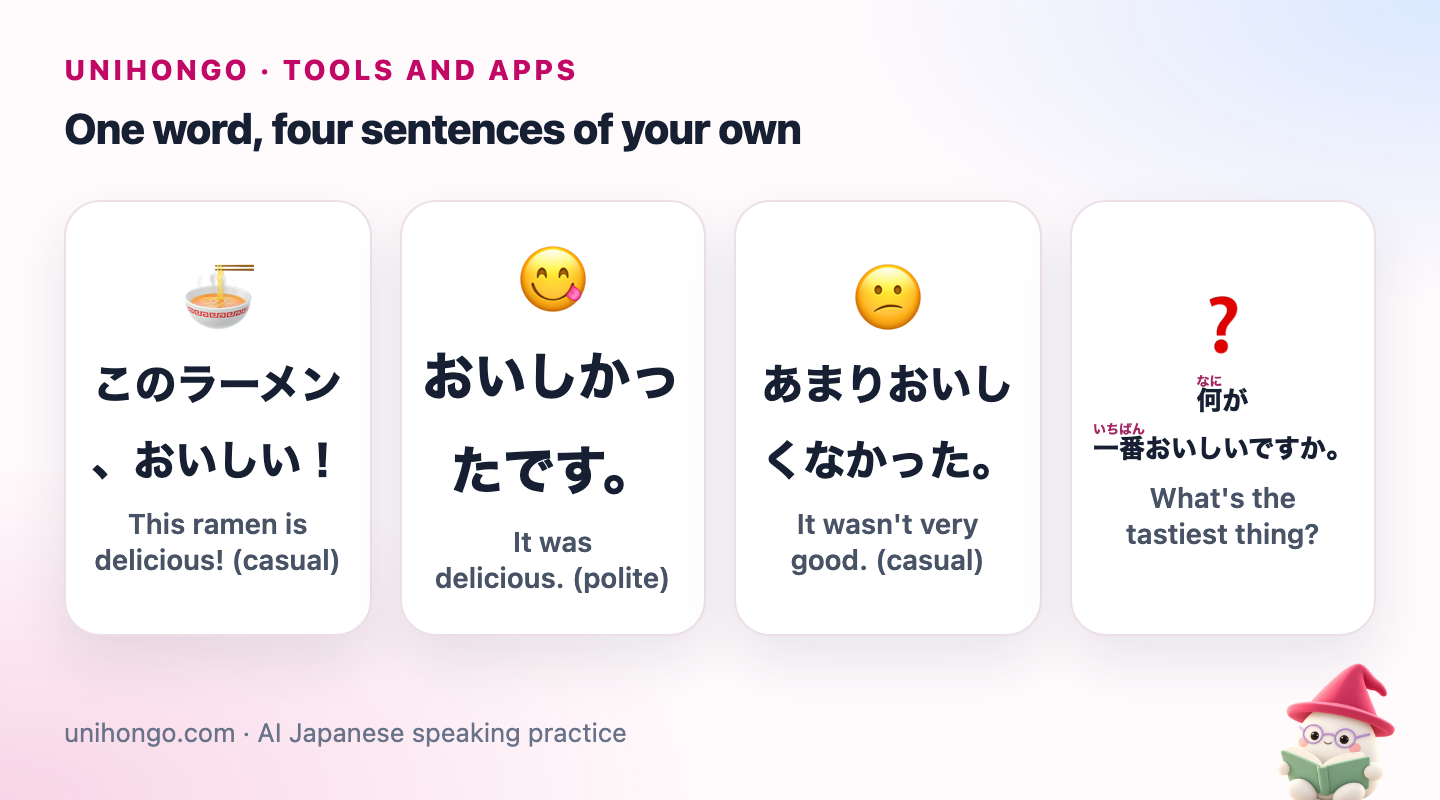
Take any word you know and put it through four frames: a casual statement, a polite statement, a negative, and a question. The cards do it with oishii, delicious, which every learner knows as a word and few can conjugate aloud at speed. Four sentences from one card is the exchange rate that turns vocabulary into speech.
| Japanese | Romaji | Meaning |
|---|---|---|
| このラーメン、おいしい! | Kono rāmen, oishii! | This ramen is delicious! (casual) |
| おいしかったです。 | Oishikatta desu. | It was delicious. (polite) |
| あまりおいしくなかった。 | Amari oishikunakatta. | It wasn't very good. (casual) |
| 何が一番おいしいですか。 | Nani ga ichiban oishii desu ka. | What's the tastiest thing? |
| この店、安い! | Kono mise, yasui! | This shop is cheap! (casual) |
| あまり安くなかったです。 | Amari yasukunakatta desu. | It wasn't very cheap. (polite) |
Then do the same with yasui (cheap), as in the last two rows, and with every adjective in your deck. Nouns take a different set of four: kore wa X desu, X ga arimasu ka, X ja arimasen, X wa doko desu ka.
From a native-speaker clip to your own line
The clips of real speakers are the most speaking-friendly thing in a vocabulary app, if you use them as a starting point rather than a finish. Shadow the clip, matching speed and pitch. Then change one word and say your version at the same speed. Then say the version you would use with a friend, or with a shopkeeper, depending on which the clip was. Here are common phrases of the kind such clips contain, each followed by a learner's own variation.
| Japanese | Romaji | Meaning |
|---|---|---|
| お疲れ様です。 | Otsukaresama desu. | Thanks for your work. (polite, coworkers) |
| お疲れ。 | Otsukare. | Good work today. (casual, friends) |
| お腹すいた。 | Onaka suita. | I'm hungry. (casual) |
| お腹がすきました。 | Onaka ga sukimashita. | I'm hungry. (polite) |
| ちょっと疲れた。 | Chotto tsukareta. | I'm a bit tired. (casual) |
| ちょっと疲れました。 | Chotto tsukaremashita. | I'm a bit tired. (polite) |
| 眠い。コーヒー飲みたい。 | Nemui. Kōhī nomitai. | I'm sleepy. I want a coffee. (casual) |
Alternatives by what they add
- Another vocabulary SRS (Anki, WaniKani for kanji): adds a different review style. Fits when you want more words, not more speaking.
- A grammar-structured course (LingoDeer, Bunpro, a textbook): adds the particles and conjugations that turn words into sentences. Fits when you have words but make the same structural mistakes.
- A human tutor from a marketplace (italki, Preply): adds live correction and a person's judgement about what sounds natural. Fits when you can book a weekly slot.
- A language exchange app (HelloTalk, Tandem): adds real people who answer, in exchange for your language. Fits when you enjoy chat and can work across time zones.
- A general AI assistant with voice (ChatGPT): adds an open-ended partner on any topic. Fits when you want flexibility and will instruct it to stay in Japanese.
- A Japanese-only AI conversation partner (Unihongo): adds spoken roleplay with objectives and corrections at any hour, without booking. The AI Sensei in its 3D classroom can play a clerk, a friend or a coworker, slow down, and switch between casual and polite; the session report lists corrections and vocabulary, and its vocabulary games and Kana Dash give words a speed workout. It is Japanese-only. Fits when producing sentences and getting feedback is the missing piece.
The sentence-building drill
For any word, add three pieces of information: who or what, where, when. The table shows the idea; the rows below say the results aloud. Do it for five words a day, out loud, and the sentences start arriving pre-built.
| Japanese | Romaji | Meaning |
|---|---|---|
| 昨日、友達と駅の近くのカフェに行きました。 | Kinō, tomodachi to eki no chikaku no kafe ni ikimashita. | Yesterday I went to a café near the station with a friend. |
| 駅の近くに安いスーパーがあります。 | Eki no chikaku ni yasui sūpā ga arimasu. | There's a cheap supermarket near the station. |
| 週末は家で日本語を勉強します。 | Shūmatsu wa ie de Nihongo o benkyō shimasu. | At weekends I study Japanese at home. |
| 明日は雨かもしれません。 | Ashita wa ame kamo shiremasen. | It might rain tomorrow. |
| Word | Add who, where, when | Spoken result |
|---|---|---|
| kafe (café) | friend, near the station, yesterday | Kinō, tomodachi to eki no chikaku no kafe ni ikimashita |
| sūpā (supermarket) | cheap one, near the station | Eki no chikaku ni yasui sūpā ga arimasu |
| benkyō (study) | Japanese, at home, weekends | Shūmatsu wa ie de Nihongo o benkyō shimasu |
| ame (rain) | tomorrow, probably | Ashita wa ame kamo shiremasen |
Mini dialogue: a new word goes live at a greengrocer's
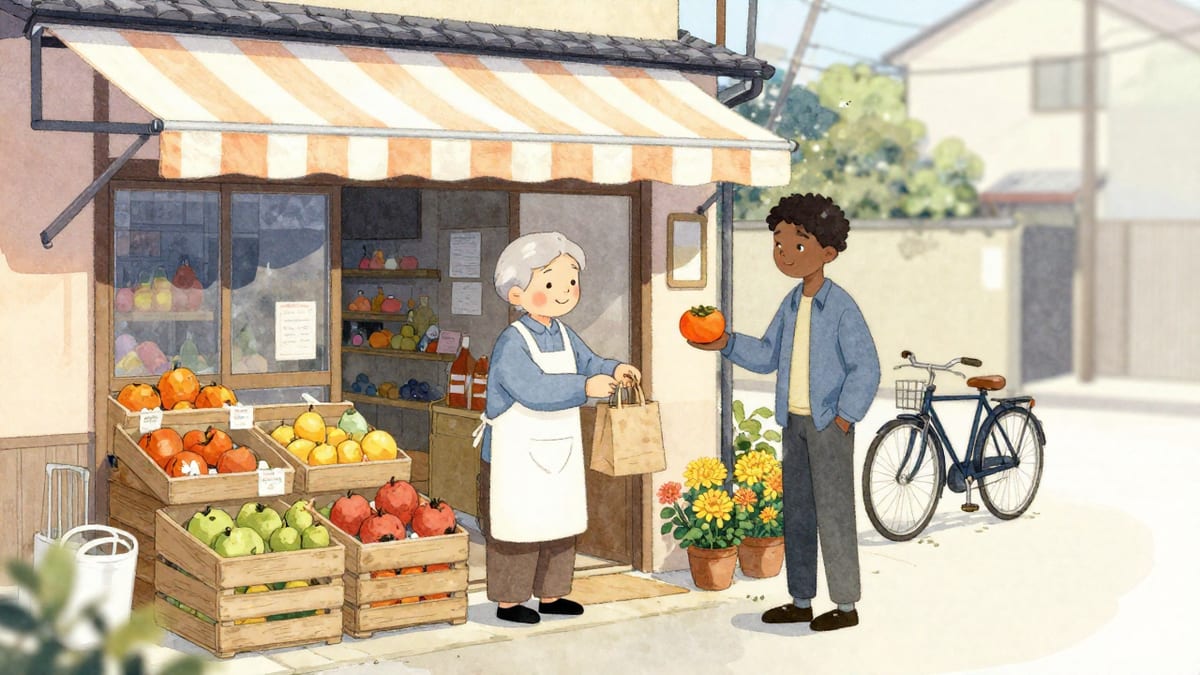
The learner learned kaki, persimmon, this morning and now meets one at a small neighbourhood shop. The exchange is short and polite, and the new word appears in a full sentence twice. This is the whole method in thirty seconds: a word from the app, a sentence of your own, a real reply.
| Japanese | Romaji | Meaning |
|---|---|---|
| すみません、この柿はいくらですか。 | Sumimasen, kono kaki wa ikura desu ka. | You: Excuse me, how much are these persimmons? |
| 一つ百五十円です。甘いですよ。 | Hitotsu hyakugojūen desu. Amai desu yo. | Shopkeeper: A hundred and fifty yen each. They're sweet. |
| じゃあ、柿を三つください。 | Jā, kaki o mittsu kudasai. | You: Then three persimmons, please. |
| はい、三つで四百五十円です。 | Hai, mittsu de yonhyakugojūen desu. | Shopkeeper: Right, four hundred and fifty yen for three. |
| 初めて柿を食べます。 | Hajimete kaki o tabemasu. | You: It's my first time eating persimmon. |
| そうですか。今が一番おいしい時期ですよ。 | Sō desu ka. Ima ga ichiban oishii jiki desu yo. | Shopkeeper: Is that so? Now is the best season for them. |
| 楽しみです。ありがとうございます。 | Tanoshimi desu. Arigatō gozaimasu. | You: I'm looking forward to it. Thank you. |
Mittsu de yonhyakugojūen: de after a quantity means for that many. The prices here are only an example; shops vary.
Mistakes vocabulary-first learners make
| Japanese | Romaji | Meaning |
|---|---|---|
| 食べた? | Tabeta? | Did you eat? (casual) |
| まだ食べていません。 | Mada tabete imasen. | I haven't eaten yet. (polite) |
| 私は駅に行きます。 | Watashi wa eki ni ikimasu. | I'm going to the station. |
| 自分の生活の言葉を覚えます。 | Jibun no seikatsu no kotoba o oboemasu. | I learn the words of my own life. |
- Saying the dictionary form only. Taberu is a card; tabeta, tabemasen and tabetai are speech. Conjugate every verb aloud in four forms when you learn it.
- Listing nouns without particles. Watashi, eki, iku is understood but not Japanese. Say the particles until they are automatic: watashi wa eki ni ikimasu.
- Translating word order. The verb goes last. Build the sentence from the end if you have to.
- Learning the polite form of everything and sounding like a recording with friends. Learn the casual version alongside, and use it when your partner does.
- Collecting words you will never say. Prioritise the words of your own life: your job, your food, your commute, your hobby. They are the ones conversation will ask for.
A weekly plan: words in, sentences out
Keep your reviews. Add the output column and the sentences start coming by themselves within a few weeks.
| Japanese | Romaji | Meaning |
|---|---|---|
| 毎日、五つの単語で文を作ります。 | Mainichi, itsutsu no tango de bun o tsukurimasu. | Every day I make sentences with five words. |
| 新しい言葉は、その日に使います。 | Atarashii kotoba wa, sono hi ni tsukaimasu. | I use new words on the day I learn them. |
| Day | Reviews (keep) | Output (add) |
|---|---|---|
| Monday to Friday | Your usual session | Five words into four sentences each, aloud; shadow and vary two clips |
| Wednesday | Your usual session | A roleplay in a shop or café with a partner who replies, using three new words |
| Saturday | Lighter session | Tell someone about your week in ten sentences using this week's words |
| Sunday | Rest | Record a one-minute self-introduction; compare with last month's |