
Listening builds the ear; speaking builds the mouth
A lesson podcast gives you three things every speaker needs: natural dialogues, explanations of what makes them natural, and a lot of hours of Japanese in your ears. That is real learning, and the comprehension it builds is the foundation that speaking will stand on. What it cannot give, because it is audio you receive, is retrieval: the act of pulling a word out of memory while someone waits. Every minute you listen, the hosts do the retrieving for you.
The way out is not to listen less but to attach output to every lesson. The dialogue you just understood is the best speaking material you will ever get: short, natural, explained, and already in your head.
| Japanese | Romaji | Meaning |
|---|---|---|
| 聞いたことを話してみよう | Kiita koto o hanashite miyō | Let's try saying what we heard (casual) |
| 聞くのは得意です。 | Kiku no wa tokui desu. | Listening is my strong point. |
| 話すのはまだ苦手です。 | Hanasu no wa mada nigate desu. | Speaking is still my weak point. |
| 今日のレッスンの会話を使います。 | Kyō no ressun no kaiwa o tsukaimasu. | I'll use today's lesson dialogue. |
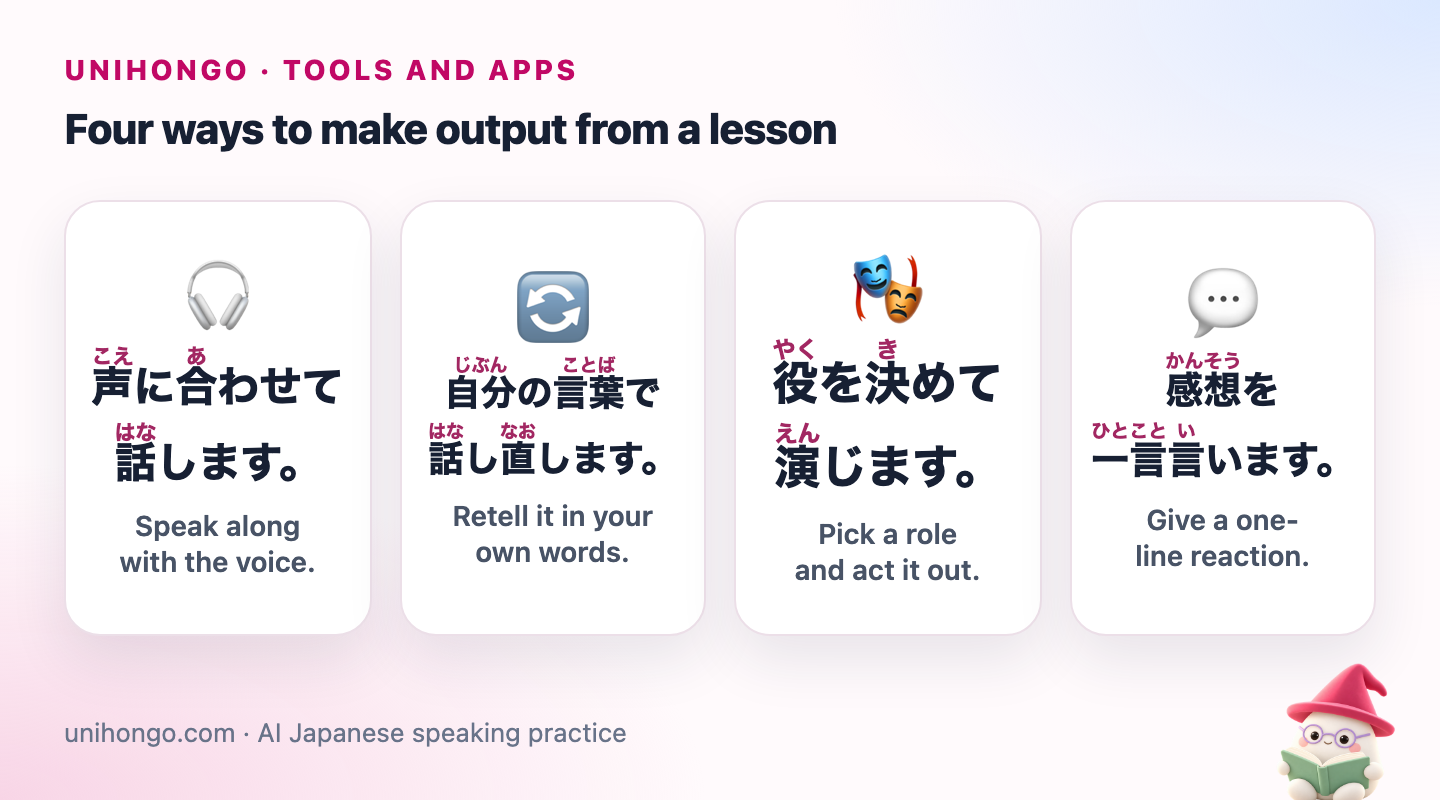
Four ways to make output from a lesson
Every lesson dialogue can be turned into speech in four ways, from easiest to most conversational. The cards name them in Japanese. Shadowing copies; retelling retrieves; roleplay converses; and a one-line reaction connects the lesson to your own opinion.
| Japanese | Romaji | Meaning |
|---|---|---|
| 声に合わせて話します。 | Koe ni awasete hanashimasu. | Speak along with the voice. |
| 自分の言葉で話し直します。 | Jibun no kotoba de hanashinaoshimasu. | Retell it in your own words. |
| 役を決めて演じます。 | Yaku o kimete enjimasu. | Pick a role and act it out. |
| 感想を一言言います。 | Kansō o hitokoto iimasu. | Give a one-line reaction. |
The fourth is the easiest to skip and the most useful for conversation. After every lesson, say one sentence about it: omoshirokatta, that was interesting; muzukashikatta, that was hard; watashi mo yoku iimasu, I often say that too. A reaction is an opinion, and opinions are what conversations are made of.
Shadowing done right
Shadowing is speaking along with the recording, a beat behind, copying everything: speed, pitch, the small sounds. It is the only solo exercise that trains the mouth at natural tempo. Do it with the transcript closed after the first pass, and do not stop when you stumble; the recording does not. Below is the kind of everyday dialogue lesson podcasts love. Read it once, then shadow it from memory, then say it at the same speed without the audio.
Three passes are enough for one sitting. On the first, aim only to keep up, even if half the sounds are mush. On the second, copy the pitch: where the voice rises on ne and falls at the end of a statement. On the third, match the small reactions, sō desu ne and hē, which carry most of the feeling in a Japanese dialogue and which learners tend to skip. If the dialogue is casual, notice the dropped particles and the contractions and copy those too.
| Japanese | Romaji | Meaning |
|---|---|---|
| 今日はいい天気ですね。 | Kyō wa ii tenki desu ne. | A: Nice weather today, isn't it? |
| そうですね。暖かいですね。 | Sō desu ne. Atatakai desu ne. | B: It is. It's warm, isn't it? |
| 週末はどこか行きましたか。 | Shūmatsu wa dokoka ikimashita ka. | A: Did you go anywhere at the weekend? |
| 友達と映画を見に行きました。 | Tomodachi to eiga o mi ni ikimashita. | B: I went to see a film with a friend. |
| へえ、何を見たんですか。 | Hē, nani o mitan desu ka. | A: Oh, what did you see? |
| 新しいアニメの映画です。とても面白かったです。 | Atarashii anime no eiga desu. Totemo omoshirokatta desu. | B: A new animated film. It was very good. |
Retelling: the three-sentence summary
Retelling is the drill that most directly converts comprehension into retrieval. After the dialogue, pause the lesson and say what happened in three sentences, in the third person, in the past. You will discover instantly which words you only recognise and which you own. The structure is always the same: who did what, what complicated it, how it ended. Here is a retelling of the dialogue above, then a set for a typical café lesson.
| Japanese | Romaji | Meaning |
|---|---|---|
| 二人は天気の話をしました。 | Futari wa tenki no hanashi o shimashita. | The two of them talked about the weather. |
| 一人は週末に友達と映画を見ました。 | Hitori wa shūmatsu ni tomodachi to eiga o mimashita. | One of them saw a film with a friend at the weekend. |
| 映画はとても面白かったそうです。 | Eiga wa totemo omoshirokatta sō desu. | The film was very good, apparently. |
| 男の人がカフェで注文しました。 | Otoko no hito ga kafe de chūmon shimashita. | A man placed an order at a café. |
| でも、店員さんが聞き返しました。 | Demo, ten'in-san ga kikikaeshimashita. | But the clerk asked him to repeat. |
| 最後に、二人は笑いました。 | Saigo ni, futari wa waraimashita. | In the end, the two of them laughed. |
Sō desu after a plain past form, as in omoshirokatta sō desu, means I heard that, and is the natural way to report what someone in a dialogue said. It is also exactly how you would retell a friend's story in real life.
Roleplay with one detail changed
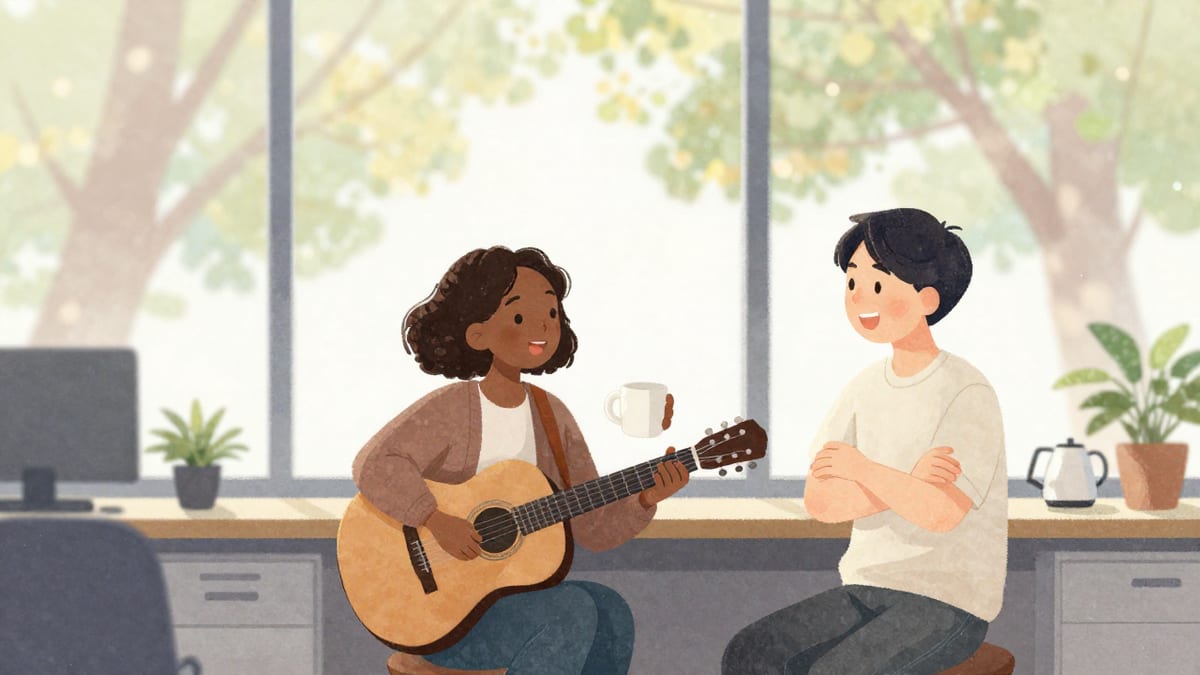
Shadowing and retelling are solo. Roleplay needs a partner, and the trick that makes it work is to change one detail so you cannot simply replay the recording. If the dialogue was about a film, make it a concert. If someone was late because of the train, make it rain. The frame stays, the content changes, and suddenly you are speaking rather than reciting. Here the learner takes the weekend dialogue and changes the activity; the partner, whether a friend, a tutor or an AI Sensei, asks a follow-up the podcast never did.
| Japanese | Romaji | Meaning |
|---|---|---|
| 週末はどこか行きましたか。 | Shūmatsu wa dokoka ikimashita ka. | Partner: Did you go anywhere at the weekend? |
| 友達とコンサートに行きました。 | Tomodachi to konsāto ni ikimashita. | You: I went to a concert with a friend. |
| いいですね。誰のコンサートですか。 | Ii desu ne. Dare no konsāto desu ka. | Partner: Nice. Whose concert? |
| えーと、日本のバンドです。名前は忘れました。 | Ēto, Nihon no bando desu. Namae wa wasuremashita. | You: Um, a Japanese band. I've forgotten the name. |
| そうですか。どうでしたか。 | Sō desu ka. Dō deshita ka. | Partner: I see. How was it? |
| すごくよかったです。でも、人が多かったです。 | Sugoku yokatta desu. Demo, hito ga ōkatta desu. | You: It was great. But there were a lot of people. |
Namae wa wasuremashita is a rescue line worth keeping: it lets you continue a story when a detail will not come, instead of stalling the whole conversation.
Mistakes listeners make when they start producing
| Japanese | Romaji | Meaning |
|---|---|---|
| 全部分からなくても、話します。 | Zenbu wakaranakute mo, hanashimasu. | Even if I don't understand everything, I speak. |
| 同じ会話を、カジュアルにしてください。 | Onaji kaiwa o, kajuaru ni shite kudasai. | Please do the same dialogue casually. |
| 間違いを教えてください。 | Machigai o oshiete kudasai. | Please tell me my mistakes. |
- Waiting until they understand everything. Comprehension is never complete; speaking with eighty percent understanding is how everyone learns.
- Shadowing silently, in the head. The exercise is in the mouth. If your neighbours cannot hear a murmur, it is not shadowing.
- Reciting the dialogue verbatim in roleplay. Change one detail every time, or the recording is doing the thinking.
- Using podcast politeness with friends. Many lesson dialogues are in polite form; with classmates you will need the casual versions. Ask a partner to do the same scene casually.
- Never getting corrected. Solo output builds fluency but can also build fluent mistakes. Make sure something hears you: a tutor, an exchange partner or an AI partner with corrections.
A weekly rhythm: lessons in, speech out
Keep the lessons you enjoy; attach output to each. This rhythm takes about ten extra minutes a day.
| Japanese | Romaji | Meaning |
|---|---|---|
| 毎日、会話を二回シャドーイングします。 | Mainichi, kaiwa o nikai shadōingu shimasu. | Every day I shadow the dialogue twice. |
| 金曜日に、誰かとロールプレイをします。 | Kin'yōbi ni, dareka to rōrupurei o shimasu. | On Friday I do a roleplay with someone. |
| Day | Listening | Output |
|---|---|---|
| Monday to Thursday | One new lesson on the commute | Shadow twice, retell in three sentences |
| Friday | Replay the week's dialogues | Roleplay two of them with one detail changed, with a partner who replies |
| Saturday | A longer or harder episode for pleasure | One-line reaction to it, recorded |
| Sunday | Rest | Tell someone, in Japanese, what the week's lessons were about |