

Setting the speaker to Japanese
Every major smart speaker can run in Japanese, but the switch lives in slightly different places. In general you open the companion app on your phone, go to the settings for the assistant or the device, and choose the language. Some devices allow two languages at once, so the speaker replies in Japanese when you speak Japanese and in English when you slip back. That option is comfortable for a shared household, but for your own practice a Japanese-only setting is better: it removes the escape hatch.
Once the language is Japanese, the voice, the wake word response and the built-in content all change. News briefings come from Japanese sources, the weather is read in Japanese, and the speaker's small talk and jokes become Japanese too. Before you start drilling, spend a few minutes saying whatever comes to mind and listening to how the device responds. You will notice it uses desu and masu forms almost everywhere, which makes it a good model for the polite register most learners need first.
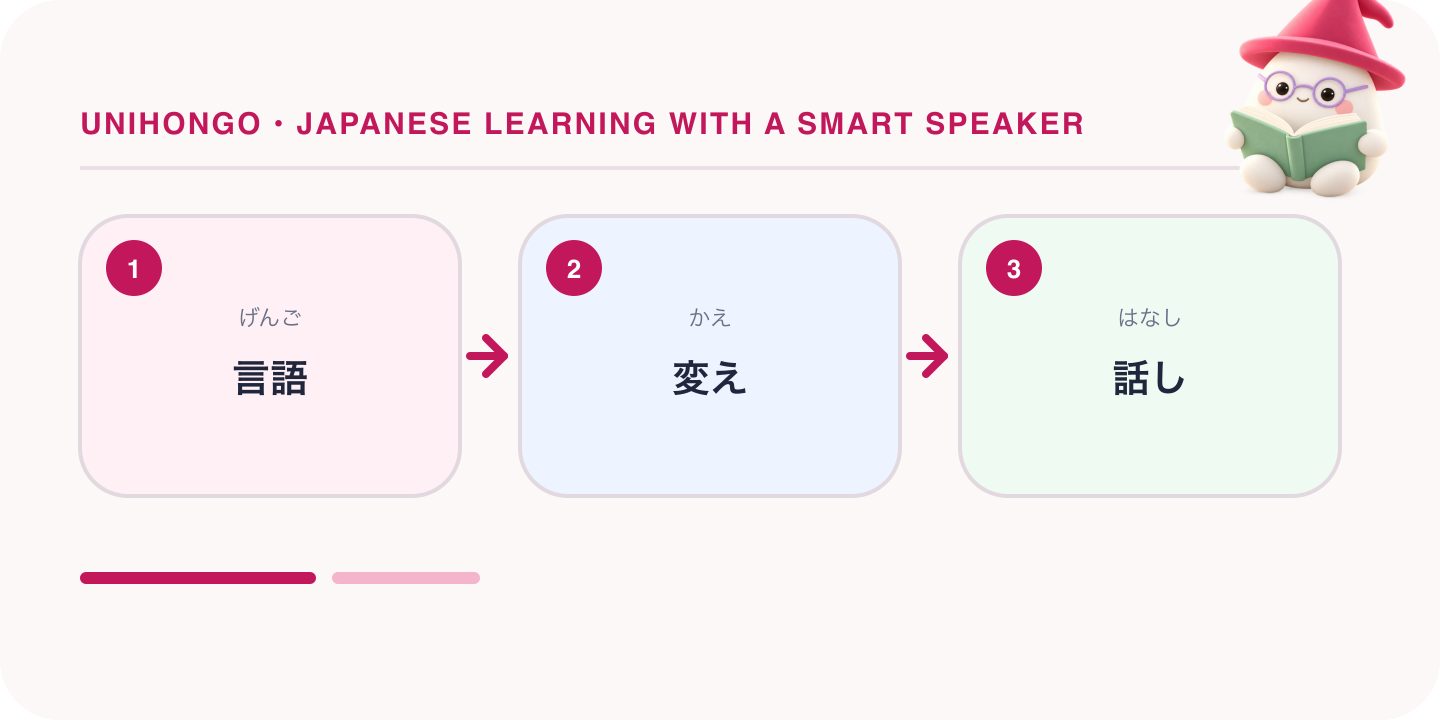
| Japanese | Romaji | Meaning |
|---|---|---|
| 言語を日本語に変えて。 | Gengo o Nihongo ni kaete. | Change the language to Japanese. |
| 日本語で話して。 | Nihongo de hanashite. | Speak in Japanese. |
| もう一度言って。 | Mō ichido itte. | Say that again. |
| ゆっくり話して。 | Yukkuri hanashite. | Speak slowly. |
| 音量を上げて。 | Onryō o agete. | Turn the volume up. |
Twenty commands worth saying every day
The value of the speaker is repetition without embarrassment. Choose a small set of commands you will genuinely use, say them every day, and let the device's misunderstandings tell you where your pronunciation drifts. The requests below use the te-form, which is the natural way to ask a machine or a close friend for something, and the same verbs work with kudasai when you speak to a person.
Build the set around your routine: morning alarms and weather, lunchtime timers, evening lights and music, so the practice attaches to something you already do.
| Japanese | Romaji | Meaning |
|---|---|---|
| 朝七時に起こして。 | Asa shichi-ji ni okoshite. | Wake me at seven in the morning. |
| アラームを止めて。 | Arāmu o tomete. | Stop the alarm. |
| 今日の天気は? | Kyō no tenki wa? | What is today's weather? |
| 明日は雨が降る? | Ashita wa ame ga furu? | Will it rain tomorrow? |
| 今何時? | Ima nan-ji? | What time is it now? |
| 今日は何日? | Kyō wa nan-nichi? | What is the date today? |
| 電気をつけて。 | Denki o tsukete. | Turn the lights on. |
| 電気を消して。 | Denki o keshite. | Turn the lights off. |
| 買い物リストに卵を追加して。 | Kaimono risuto ni tamago o tsuika shite. | Add eggs to the shopping list. |
| 明日の予定を教えて。 | Ashita no yotei o oshiete. | Tell me tomorrow's schedule. |
Timers, kitchen talk and counting practice
Timers are the best drill on the device because they force numbers and counters. Minutes use fun and pun with sound changes: ippun, nifun, sanpun, yonpun, gofun, roppun, nanafun, happun, kyūfun, juppun. Say a different length each time you cook. Seconds use byō and hours use jikan, so a timer for one and a half hours is ichi-jikan han.
Naming timers takes the drill one step further. Say pasuta no taimā o hachi-fun setto shite and the speaker will confirm the name back to you. Later you can ask how long is left with pasuta no taimā wa ato nan-pun, and you are listening for a number in natural speech. Try to catch the answer without looking at your phone.
| Japanese | Romaji | Meaning |
|---|---|---|
| タイマーを十分にセットして。 | Taimā o juppun ni setto shite. | Set a timer for ten minutes. |
| パスタのタイマーを八分セットして。 | Pasuta no taimā o hachi-fun setto shite. | Set a pasta timer for eight minutes. |
| タイマーはあと何分? | Taimā wa ato nan-pun? | How many minutes are left on the timer? |
| タイマーをキャンセルして。 | Taimā o kyanseru shite. | Cancel the timer. |
| 二百グラムは何オンス? | Nihyaku guramu wa nan-onsu? | How many ounces is two hundred grams? |
| 一時間半後に教えて。 | Ichi-jikan han-go ni oshiete. | Remind me in an hour and a half. |
News, music and radio as listening practice
A Japanese-language speaker gives you the easiest listening routine there is: say nyūsu o nagashite while you make coffee and a short bulletin plays. Early on you will catch only the topic words, tenki, keizai, senkyo, jishin, and that is fine. The aim of the morning briefing is not comprehension of every sentence but repeated exposure to the rhythm of formal spoken Japanese. Over a few months the same fixed phrases, tsugi no nyūsu desu, kuwashiku wa kōsha no saito de, become familiar, and then the content starts to arrive.
Music requests are a different kind of drill. You have to say an artist name or a song title in katakana pronunciation, and the speaker will only find it if you say it the Japanese way. That is unexpectedly useful: many learners struggle with loanwords, and the device gives instant feedback on whether your katakana English is recognisable. Ask for a genre in Japanese, such as jazu or shitī poppu, and you get a playlist plus the spoken names of tracks as they change.
| Japanese | Romaji | Meaning |
|---|---|---|
| ニュースを流して。 | Nyūsu o nagashite. | Play the news. |
| 今日のニュースを教えて。 | Kyō no nyūsu o oshiete. | Tell me today's news. |
| 日本の音楽をかけて。 | Nihon no ongaku o kakete. | Play some Japanese music. |
| この曲は誰の曲? | Kono kyoku wa dare no kyoku? | Whose song is this? |
| 次の曲にして。 | Tsugi no kyoku ni shite. | Skip to the next song. |
| ラジオをつけて。 | Rajio o tsukete. | Turn on the radio. |
Questions the speaker answers well
Beyond commands, a speaker will answer factual questions, translate words and explain simple terms. These are genuinely useful for learning because they invite you to form questions, which is a weak point for many learners who can only answer them. The table below groups the question patterns by what they practise, so you can pick one pattern a week and say it in several variations.
| Question | Reading | What it practises |
|---|---|---|
| 東京は今何時? | Tōkyō wa ima nan-ji? | Time and place names |
| 猫は英語で何? | Neko wa Eigo de nani? | Asking for translations |
| 「懐かしい」ってどういう意味? | Natsukashii tte dō iu imi? | Asking what a word means |
| 富士山の高さは? | Fujisan no takasa wa? | Numbers and measurements |
| 明日の最高気温は? | Ashita no saikō kion wa? | Weather vocabulary |
| 最寄りの駅までどのくらい? | Moyori no eki made dono kurai? | Distance and duration |
| 今日は何の日? | Kyō wa nan no hi? | Dates and events |
| 百二十三かける四は? | Hyaku nijū san kakeru yon wa? | Large numbers |
| おすすめの映画は? | Osusume no eiga wa? | Recommendations |
| 今週の予定は? | Konshū no yotei wa? | Calendar and days of the week |
The answers come back fast and in full sentences, so this is also listening practice for the pattern the speaker uses to reply: Tōkyō wa ima gogo san-ji desu, and so on. Repeat the answer out loud before you move on. Saying the reply is where the pattern sticks.
What a smart speaker cannot do
Be honest about the limits, because they shape how you should use the device. A speaker recognises intent, not grammar. If you say taimā go-fun with no particle and no verb, it sets the timer anyway. That is convenient in the kitchen and useless as feedback: you can say broken Japanese for a year and never find out. It also cannot hold a conversation. Ask a follow-up question that depends on the previous one and it often loses the thread.
There is no correction, no explanation and no memory of what you struggled with last week. Recognition failures are your only signal, and they are noisy: sometimes the device misses a perfect sentence because of background noise.
- It accepts sentences with missing particles and wrong verb forms without comment
- It cannot follow a topic across several turns the way a person does
- It never explains why something was misunderstood
- It speaks one polite register and never models casual or rough speech
- It offers no record of your progress or your recurring mistakes
- It responds to volume and clarity, so shouting can hide a real pronunciation gap
None of this makes the speaker useless. It belongs at the reflex end of your practice; something that talks back and corrects you belongs at the other.
Pairing the speaker with real conversation practice
The speaker gets a sentence into your mouth; a conversation partner gets it into your head. A simple weekly pattern works well. Each morning, use the speaker for your fixed commands and one new question pattern. Two or three evenings a week, sit down with your AI Sensei and turn the same material into dialogue: what you cooked, how long it took, what the weather was, what you listened to. The Sensei can ask follow-up questions, which is exactly what the speaker cannot do, and afterwards you get a list of corrections you can carry back to the next morning's commands.
Use the corrections to adjust your speaker practice. If the Sensei flags that you drop the particle o before verbs, say it clearly in every command for a week. If your long vowels are short, ask the speaker for kōhī and Tōkyō and see whether it understands you.
| Japanese | Romaji | Meaning |
|---|---|---|
| 今日は料理を三十分で作った。 | Kyō wa ryōri o sanjuppun de tsukutta. | Today I made dinner in thirty minutes. |
| 朝のニュースで地震のことを聞きました。 | Asa no nyūsu de jishin no koto o kikimashita. | I heard about an earthquake on the morning news. |
| 最近よく聞く曲があるんです。 | Saikin yoku kiku kyoku ga aru n desu. | There's a song I've been listening to a lot lately. |
| スピーカーが私の発音を聞き取れませんでした。 | Supīkā ga watashi no hatsuon o kikitoremasen deshita. | The speaker couldn't make out my pronunciation. |
| 「コーヒー」の「コー」が短いと言われました。 | Kōhī no kō ga mijikai to iwaremashita. | I was told the kō in kōhī was too short. |
When the speaker keeps misunderstanding you
Recognition failures cluster around a few sounds. Long vowels are the biggest: kōhī heard as kohi, or Tōkyō as Tokyo, will make the device miss the word entirely. Double consonants matter too: kitte and kite are different words, and a speaker will pick whichever it hears. The r sound sits between English r, l and d, and if it drifts too far toward one of them, ramen and damen sound alike to the machine.
When a request fails, resist the urge to repeat it louder. Say it slower with each mora given its own beat, and check the pitch of long vowels. If it still fails, change the words. Fluent speakers rephrase constantly, and a speaker that forces you to find a second way of saying something is doing you a favour. Keep a note of the sentences that failed and bring them to your next session with a partner who can hear the difference and tell you what went wrong.
| Japanese | Romaji | Meaning |
|---|---|---|
| 違う、そうじゃなくて。 | Chigau, sō ja nakute. | No, not that. |
| もう一回やり直して。 | Mō ikkai yarinaoshite. | Do it again from the start. |
| 切手じゃなくて、来て。 | Kitte ja nakute, kite. | Not stamp, come. |
| 別の言い方で言ってみます。 | Betsu no iikata de itte mimasu. | I'll try saying it another way. |
| 聞き取れなかったみたいです。 | Kikitorenakatta mitai desu. | It seems it couldn't make that out. |