
Decide by goal, not by app
The question Preply or an AI tutor sounds like a product comparison, but it is really a question about you. A tutor marketplace sells access to people: teachers with different styles, prices and specialities, booked lesson by lesson. An AI tutor sells access to practice: a conversation whenever you want, with a partner that never gets tired or judgemental. Which of those you are short of depends on what you are trying to do.
So begin by saying your goal out loud, in Japanese, in one sentence. If you cannot yet, that is your first lesson. The four sentences in the next section cover the most common goals, and each points towards a different mix.
| Japanese | Romaji | Meaning |
|---|---|---|
| まず目標を決めよう | Mazu mokuhyō o kimeyō | First, let's decide on a goal (casual) |
| 目標は何ですか。 | Mokuhyō wa nan desu ka. | What is your goal? |
| 会話を練習したいです。 | Kaiwa o renshū shitai desu. | I want to practise conversation. |
Four goals, four different mixes
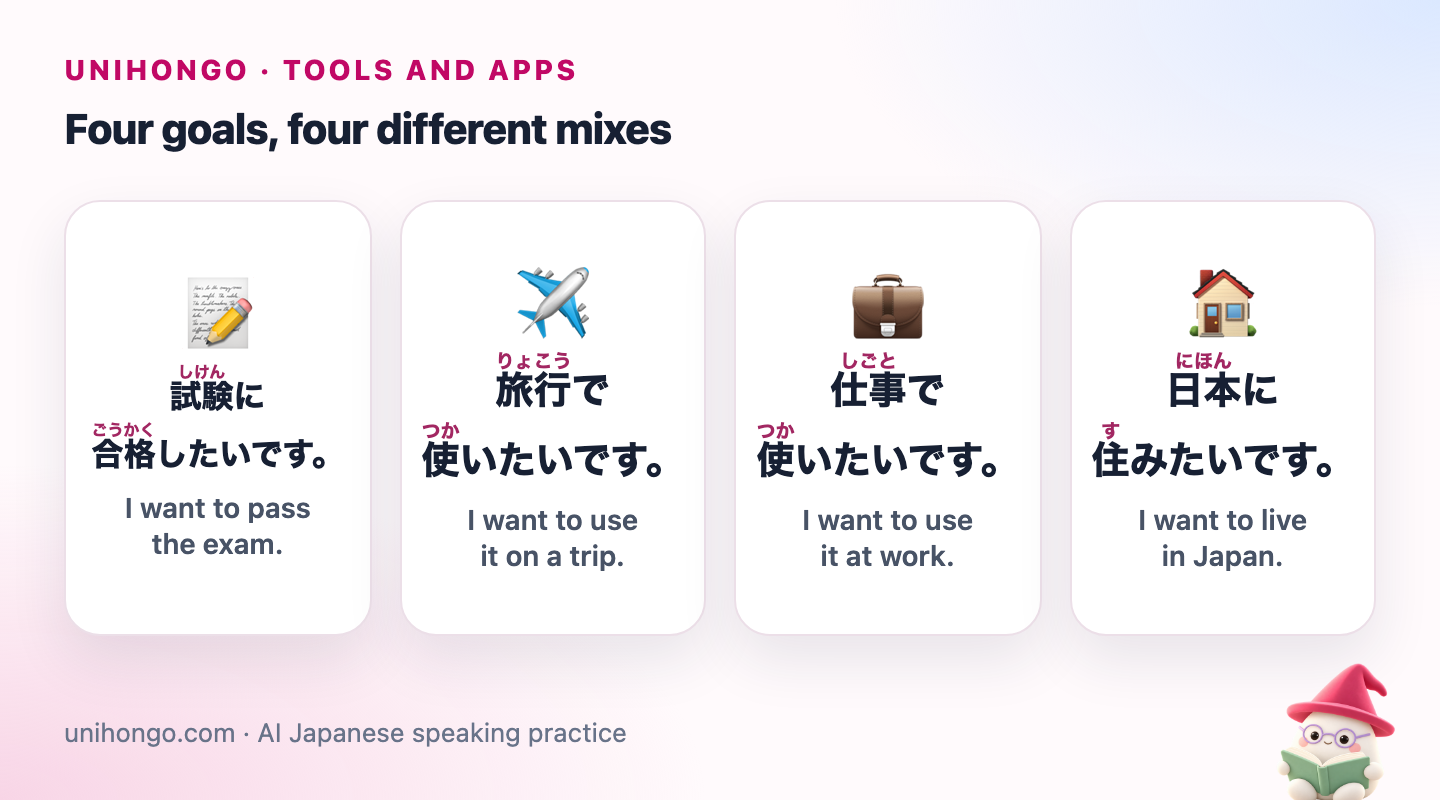
Here are the four goals learners most often bring to a first lesson, as you would say them to a tutor. Each one wants a different balance of human and machine.
| Japanese | Romaji | Meaning |
|---|---|---|
| 試験に合格したいです。 | Shiken ni gōkaku shitai desu. | I want to pass the exam. |
| 旅行で使いたいです。 | Ryokō de tsukaitai desu. | I want to use it on a trip. |
| 仕事で使いたいです。 | Shigoto de tsukaitai desu. | I want to use it at work. |
| 日本に住みたいです。 | Nihon ni sumitai desu. | I want to live in Japan. |
| Goal | Lean towards | Why |
|---|---|---|
| Exam (JLPT and others) | Human for strategy, AI for keeping the knowledge spoken | The JLPT has no speaking section, but spoken practice makes grammar stick; a tutor keeps your plan honest |
| Travel | AI, with a few human lessons for pronunciation | Travel Japanese is a small set of scenes repeated many times, ideal for roleplay |
| Work | Both, with the human checking register | Office Japanese is about politeness levels, where a person's judgement matters |
| Moving to Japan | Both, heavily | You need volume now and a person who knows what daily life asks of you |
What a Preply-style tutor gives you
A good human tutor does four things that software does not do well. They diagnose: after two lessons they know which three habits hold you back. They plan: they choose what to teach next and in which order. They judge: they tell you that a sentence is correct but that nobody would say it to a manager. And they hold you to it, because you booked, paid and promised.
To get those benefits, give the tutor the information they need in the first five minutes. State your goal, your deadline and what you have already studied. The lines below do that in polite Japanese and are worth memorising before a trial lesson.
| Japanese | Romaji | Meaning |
|---|---|---|
| 十二月に試験を受けます。 | Jūnigatsu ni shiken o ukemasu. | I'm taking an exam in December. |
| 来年の春に日本に引っ越します。 | Rainen no haru ni Nihon ni hikkoshimasu. | I'm moving to Japan next spring. |
| 仕事で使う敬語を練習したいです。 | Shigoto de tsukau keigo o renshū shitai desu. | I want to practise the polite language I use at work. |
| 面接の練習をしたいです。 | Mensetsu no renshū o shitai desu. | I want to practise for an interview. |
| 文法は分かりますが、話せません。 | Bunpō wa wakarimasu ga, hanasemasen. | I understand the grammar, but I can't speak. |
What an AI tutor gives you, and how to instruct it
An AI tutor is a conversation partner first. The best ones keep you in Japanese, correct you, and play roles so that you rehearse a situation rather than discuss it. A general assistant with voice, such as ChatGPT, can do much of this on any topic if you set it up carefully. A Japanese-only tool such as Unihongo is narrower and more guided: its AI Sensei lives in a 3D classroom, you can choose among several teacher characters, and roleplay missions such as Japanese Job Interview, Hotel Check-in Problem or Order at a Café give you objectives to complete by speaking. Unihongo also has a pronunciation lab that scores sounds, mora timing and pitch, which a human lesson rarely has time for.
Whichever you use, instruct it in Japanese. The lines below are the controls: role, speed, register. They are also useful with a human tutor, which is a sign that they are good Japanese.
| Japanese | Romaji | Meaning |
|---|---|---|
| 店員の役をしてください。 | Ten'in no yaku o shite kudasai. | Please play the role of a shop clerk. |
| 面接官になってください。 | Mensetsukan ni natte kudasai. | Please be the interviewer. |
| もっとゆっくり話してください。 | Motto yukkuri hanashite kudasai. | Please speak more slowly. |
| 敬語で話してください。 | Keigo de hanashite kudasai. | Please speak in polite language. |
| タメ口でいいですよ。 | Tameguchi de ii desu yo. | Casual speech is fine. |
| もう一回、最初からお願いします。 | Mō ikkai, saisho kara onegai shimasu. | Once more, from the beginning, please. |
Tameguchi is the casual word for casual speech, the way friends talk. Saying tameguchi de ii desu yo to a person signals that you want to drop the polite forms with them; with an AI partner it is simply a switch.
Schedule and budget: the honest trade-offs
After goal, two practical facts usually decide the question. The first is whether your week has a dependable slot. Human lessons need one; AI practice fits into the gaps, including the gap at midnight. The second is how sensitive you are to the cost of each extra hour of speaking. Human lessons are commonly priced per lesson, so speaking more means paying more, while software is usually a flat subscription or a free plan, so the tenth conversation in a week costs the same as the first.
Say these facts to yourself in Japanese, because they are also the sentences you will use to negotiate a schedule with a tutor.
| Japanese | Romaji | Meaning |
|---|---|---|
| 夜しか時間がありません。 | Yoru shika jikan ga arimasen. | I only have time at night. |
| 予算が限られています。 | Yosan ga kagirarete imasu. | My budget is limited. |
| 週に一回なら続けられます。 | Shū ni ikkai nara tsuzukeraremasu. | If it's once a week, I can keep it up. |
| 平日の夜は空いています。 | Heijitsu no yoru wa aite imasu. | I'm free on weekday evenings. |
| Your situation | Leans towards | Combination that works |
|---|---|---|
| Shift work, irregular hours | AI | AI daily; a human lesson every two weeks when a slot appears |
| Nine-to-five, free evenings | Either | One human lesson a week plus AI on weekday evenings |
| Very limited budget | AI or exchange partners | AI daily; occasional single human lessons before milestones |
| Deadline in weeks | Both | Two human lessons a week plus AI drills on the lesson material |
Mini dialogue: explaining your goal in a trial lesson
Here is a trial-lesson opening in which the learner states a work goal with a deadline and the tutor proposes a plan. The learner uses polite forms throughout; the tutor's replies are the natural polite register of a teacher.

| Japanese | Romaji | Meaning |
|---|---|---|
| 今日はよろしくお願いします。 | Kyō wa yoroshiku onegai shimasu. | You: Thank you for today's lesson. |
| よろしくお願いします。目標を教えてください。 | Yoroshiku onegai shimasu. Mokuhyō o oshiete kudasai. | Tutor: Likewise. Tell me your goal. |
| 四月から日本の会社で働きます。 | Shigatsu kara Nihon no kaisha de hatarakimasu. | You: From April I'll work at a Japanese company. |
| それで、仕事で使う敬語を練習したいです。 | Sorede, shigoto de tsukau keigo o renshū shitai desu. | You: So I want to practise the polite language I'll use at work. |
| 分かりました。今、どのくらい話せますか。 | Wakarimashita. Ima, dono kurai hanasemasu ka. | Tutor: Understood. How much can you speak now? |
| 簡単な会話はできます。でも、敬語はまだです。 | Kantan na kaiwa wa dekimasu. Demo, keigo wa mada desu. | You: I can hold a simple conversation. But not polite language yet. |
| では、毎回、会社の場面を一つ練習しましょう。 | Dewa, maikai, kaisha no bamen o hitotsu renshū shimashō. | Tutor: Then let's practise one office scene every lesson. |
A decision checklist
| Japanese | Romaji | Meaning |
|---|---|---|
| 一か月後に、また録音します。 | Ikkagetsu go ni, mata rokuon shimasu. | I'll record myself again in a month. |
| 前より話せるようになりました。 | Mae yori hanaseru yō ni narimashita. | I've become able to speak better than before. |
- Say your goal in one Japanese sentence. If the sentence includes an exam, an interview or a move, book a human.
- Count the hours you want to speak per week. If it is more than you can afford in lessons, add an AI partner for the rest.
- Look at your calendar. No dependable slot means AI first, human when you can.
- Ask how you feel about being heard. If nerves stop you talking, start in private with software and move to a person within a month.
- Whatever you pick, measure monthly: record a two-minute self-introduction now and again in four weeks.