
Reading a correction and saying it are different skills
When you read a correction, you recognise it. Recognition is fast, satisfying, and almost useless for speaking, because the next time you need the form you will be mid-sentence, under time pressure, with no text in front of you. What you need is retrieval: producing the form yourself without seeing it. That only happens if you close the report and say the sentence from memory.
The practical rule is that a correction is not finished until you have said the corrected version twice and built two new sentences on the same frame. Two repetitions handle the sound of it; two new sentences prove you took the pattern rather than the sentence. This takes about forty seconds per correction, which is why three corrections is a realistic target and fifteen is not.
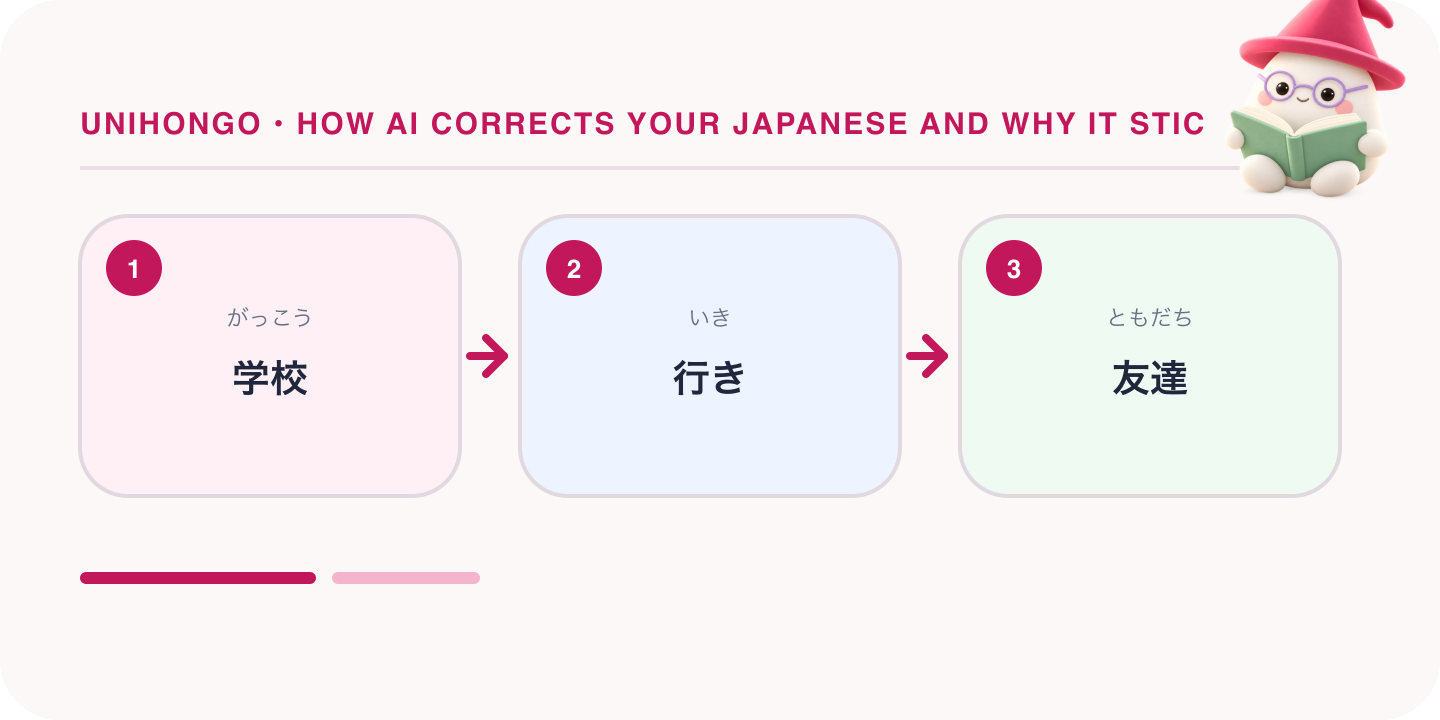
The three error types worth fixing first
| Error type | What goes wrong | Why it comes first |
|---|---|---|
| Particles | The listener loses who did what to whom, or where | Changes meaning, and the fix is one syllable |
| Verb form | Tense, te-form, negatives, and -tai are built on the wrong stem | Appears in every sentence, so one fix pays repeatedly |
| Politeness register | Correct words in the wrong social room | Rarely blocks meaning but reliably creates awkwardness |
These three share a useful property: each has a rule you can apply consciously in the very next sentence. Word choice, rhythm, and idiomatic phrasing do not work that way; they improve through exposure and volume, not through decisions made mid-sentence. That is why they belong later in your queue even though they are what makes speech sound polished.
Particles: one syllable that changes the meaning
Particle corrections are the most common thing an AI tutor will flag, and the easiest to actually fix, because the sentence around them is already right. The trap is fixing them by translation. If you decide de means at, you will keep producing gakkō de ikimasu. Fix them by role instead: ni pins a target or destination, de sets the stage on which an action happens, o marks what the action affects. The dedicated particles guide goes deeper; the pairs below are the ones that dominate correction reports.
| Japanese | Romaji | Meaning |
|---|---|---|
| 学校で行きます。 | Gakkō de ikimasu. | Before: meant as 'I go to school', but de marks the stage, not the destination. |
| 学校に行きます。 | Gakkō ni ikimasu. | After: I go to school. |
| 友達を会いました。 | Tomodachi o aimashita. | Before: au takes ni, not o. |
| 友達に会いました。 | Tomodachi ni aimashita. | After: I met a friend. |
| 電車に来ました。 | Densha ni kimashita. | Before: meant as 'I came by train', but ni points to a target. |
| 電車で来ました。 | Densha de kimashita. | After: I came by train. |
| 私は犬を好きです。 | Watashi wa inu o suki desu. | Before: suki takes ga, not o. |
| 私は犬が好きです。 | Watashi wa inu ga suki desu. | After: I like dogs. |
Repair these by saying the corrected sentence with two different nouns. Gakkō ni ikimasu, eki ni ikimasu, byōin ni ikimasu. Three destinations in eight seconds teaches the role; re-reading the single corrected line teaches nothing.
Verb form: the stem is usually the culprit
Most verb corrections are not about tense choice but about which stem the ending was attached to. The -masu stem carries the polite forms, -tai, and -nagara; the te-form has its own sound changes that do not follow the written verb. Learners who understand the rule perfectly still produce ikutai desu at speed, because knowing and producing are separate systems. Volume fixes this, not more explanation.
| Japanese | Romaji | Meaning |
|---|---|---|
| 昨日、映画を見ます。 | Kinō, eiga o mimasu. | Before: a past time word with a non-past verb. |
| 昨日、映画を見ました。 | Kinō, eiga o mimashita. | After: I watched a film yesterday. |
| 少し待ちてください。 | Sukoshi machite kudasai. | Before: matsu becomes matte in the te-form, not machite. |
| 少し待ってください。 | Sukoshi matte kudasai. | After: Please wait a moment. |
| 京都に行くたいです。 | Kyōto ni ikutai desu. | Before: -tai attaches to the masu-stem, so iku becomes iki. |
| 京都に行きたいです。 | Kyōto ni ikitai desu. | After: I want to go to Kyoto. |
| すみません、分かるません。 | Sumimasen, wakarumasen. | Before: the polite negative is built on the stem wakari. |
| すみません、分かりません。 | Sumimasen, wakarimasen. | After: Sorry, I do not understand. |
Politeness register: correct words, wrong room
Register errors rarely stop communication, which is exactly why they persist. Nobody corrects you in real life, and a listener who is being addressed too casually will simply feel it and say nothing. An AI tutor is genuinely useful here because there is no social cost to being told, and you can ask for the same sentence at three levels of formality without embarrassment.
| Japanese | Romaji | Meaning |
|---|---|---|
| 社長、これ見て。 | Shachō, kore mite. | Before: a plain command aimed at a company president. |
| 社長、こちらをご覧ください。 | Shachō, kochira o goran kudasai. | After: President, please take a look at this. |
| 先生、ありがとう。 | Sensei, arigatō. | Before: too casual for a teacher you barely know. |
| 先生、ありがとうございます。 | Sensei, arigatō gozaimasu. | After: Thank you very much, sensei. |
| お客様、何が欲しいですか。 | Okyakusama, nani ga hoshii desu ka. | Before: asking a customer what they want sounds blunt. |
| お客様、何になさいますか。 | Okyakusama, nani ni nasaimasu ka. | After: What would you like to have? |
| 部長、明日休みます。 | Buchō, ashita yasumimasu. | Before: grammatical, but it announces rather than asks. |
| 部長、明日休ませていただいてもよろしいでしょうか。 | Buchō, ashita yasumasete itadaite mo yoroshii deshō ka. | After: Would it be all right if I took tomorrow off? |
A good habit is to name the listener before you speak. Saying to yourself that this is a manager, a shop assistant, or a close friend selects the register before the sentence starts, which is far more reliable than repairing it halfway through. The polite-versus-casual guide covers the full ladder if you want the underlying system.
What to ignore while you are still building fluency
Not every correction deserves your attention this month. Some are genuinely optional, and chasing them slows you down by making every sentence feel risky. The point of early speaking practice is volume with meaning intact, so anything that does not threaten meaning or register can wait until the basics run without thought.
- Word-choice suggestions where your original was correct but less elegant.
- Dropped topic particles and shortened forms that native speakers also drop in speech.
- Kanji and writing notes, if this session was about speaking.
- Pitch accent on individual words, before vowel length and rhythm are stable.
- Occasional filler such as eto or ano, which is normal in real Japanese conversation.
- Sentence-ending nuance particles like ne and yo, which settle through imitation.
Say this out loud to yourself at the start of a session and the report becomes far less overwhelming: today I am fixing meaning and register, not polish. You can always promote an ignored category to your target later, once the queue in front of it is empty.
Asking for the feedback you actually want
The default correction behaviour of any AI tutor is a guess, and you are allowed to change it mid-conversation. Ask for silence during a long turn, for particle-only feedback, for a more natural version of a sentence you suspect is stiff, or for heavy correction on a day you feel robust. Saying these requests in Japanese is itself useful practice, so use the lines below rather than switching to English.
| Japanese | Romaji | Meaning |
|---|---|---|
| 今日は文法だけ直してください。 | Kyō wa bunpō dake naoshite kudasai. | Please correct only my grammar today. |
| 助詞の間違いだけ教えてください。 | Joshi no machigai dake oshiete kudasai. | Please tell me only about particle mistakes. |
| 話の途中では直さないでください。 | Hanashi no tochū de wa naosanaide kudasai. | Please do not correct me in the middle of speaking. |
| 今の言い方は自然でしたか。 | Ima no iikata wa shizen deshita ka. | Was the way I just said that natural? |
| もっと丁寧な言い方はありますか。 | Motto teinei na iikata wa arimasu ka. | Is there a more polite way to say it? |
| ネイティブなら何と言いますか。 | Neitibu nara nan to iimasu ka. | What would a native speaker say? |
| 今のをもう一度言ってみます。 | Ima no o mō ichido itte mimasu. | Let me try saying that again. |
| 今日はたくさん直してください。 | Kyō wa takusan naoshite kudasai. | Please correct me a lot today. |
Using the session report as a script, not a report card
A report read as a score tells you how you did, which is information you cannot act on. A report read as a script tells you what to say tomorrow, which you can. The difference is one step: convert each correction into a line you intend to produce in the next session, and note the situation where it will appear. Instead of the note 'particle error with iku', write the line you will say when the tutor asks about your weekend.
This also solves the accountability gap. An AI tutor will not remember to test you on last week's weakness or notice that you have quietly avoided a form for a fortnight. Carrying three lines forward yourself is the whole of the follow-up system, and it takes less than a minute at the end of a session while the context is still fresh.
- Rewrite each of the three corrections as a sentence you will actually say.
- Note the situation that will trigger it: ordering, small talk, a phone call.
- Open the next session by saying those three lines before anything else.
- Ask the tutor to steer the roleplay towards the situations you noted.
- Cross a line off only after you have produced it unprompted in conversation.
Spaced re-use of your own corrected sentences
| When | What you do with the corrected line | How long |
|---|---|---|
| Same session | Say it twice, then build two new sentences on the frame | 40 seconds |
| Next day | Say it from memory at the start of the warm-up | 10 seconds |
| Three days later | Use it inside a conversation, unprompted | One turn |
| One week later | Check whether the old wrong version still appears | One turn |
| One month later | Retire it if it has not been corrected again | None |
Your own corrected sentences beat any pre-made review deck, because they came from something you were genuinely trying to say and they carry the situation with them. Keep the list deliberately short. Five active lines that get used are worth more than a growing archive of corrections you never revisit, and retiring finished items is what keeps the list short enough to survive.
Why fluent-sounding feedback still needs checking
AI explanations are confident and well-formed, and that fluency is not evidence of accuracy. A model can over-correct natural casual speech into textbook Japanese, prefer a stiff phrasing that no colleague would use, or explain a rule in a way that is tidy rather than true. It also cannot see the things it was never told: your relationship with the listener, the norms of your workplace, or what the person you are quoting actually meant.
Treat surprising feedback as a lead, not a verdict. If a correction contradicts something you have heard repeatedly from native speakers, check it against a dictionary, a corpus of real sentences, or a person. Set phrases, regional usage, humour, and workplace wording are the areas where verification is most worth the two minutes it costs.
- Verify anything that contradicts what you have heard from native speakers.
- Be sceptical when a correction makes casual speech sound like a textbook.
- Give the tutor the context it lacks: who the listener is and how well you know them.
- Ask for the reason behind a correction; a weak explanation is a useful warning sign.
A five-minute correction drill
- Minute 1: read the report once and choose the three corrections that changed your meaning.
- Minute 2: say each corrected sentence twice at normal speed, without looking after the first time.
- Minute 3: build two fresh sentences on each frame, using content from your own day.
- Minute 4: say the wrong version and the right version back to back, so you can hear the contrast.
- Minute 5: write the three lines you will produce in tomorrow's session and the situation for each.
Five minutes done daily will move more Japanese into your active speech than an hour spent reading grammar explanations, because every step of it is production. The drill is also short enough to do on a day when you cannot face a full conversation, which matters more than it sounds: the corrections you keep are the ones you kept returning to.