
Recognising vs producing: why the gap feels so big
Picture-matching apps work on a clever principle: show a picture, play the Japanese, let the learner infer meaning without translation. Done for months, it produces a learner who understands a surprising amount. But every exercise asks the same question, which of these matches, and never the other one, what would you say here. Recognition is a multiple-choice task; production is an essay task. Being good at one does not make you good at the other, any more than recognising a song makes you able to sing it.
The good news is that your recognition is not wasted. Every sentence you can recognise is a sentence you can learn to produce much faster than a stranger could, because the sounds and meaning are already there. What is missing is retrieval under time pressure.
| Japanese | Romaji | Meaning |
|---|---|---|
| 自分の言葉で話したい | Jibun no kotoba de hanashitai | I want to speak in my own words |
| 聞けば分かりますが、言えません。 | Kikeba wakarimasu ga, iemasen. | I understand it when I hear it, but I can't say it. |
| 言葉は知っています。 | Kotoba wa shitte imasu. | I know the words. |
| 文が作れません。 | Bun ga tsukuremasen. | I can't build a sentence. |
The four rungs from recognition to speech
Think of each sentence as climbing a ladder with four rungs. Picture apps park you firmly on the first two. The cards below name all four in Japanese; the move from the second to the third is the one that takes deliberate work.
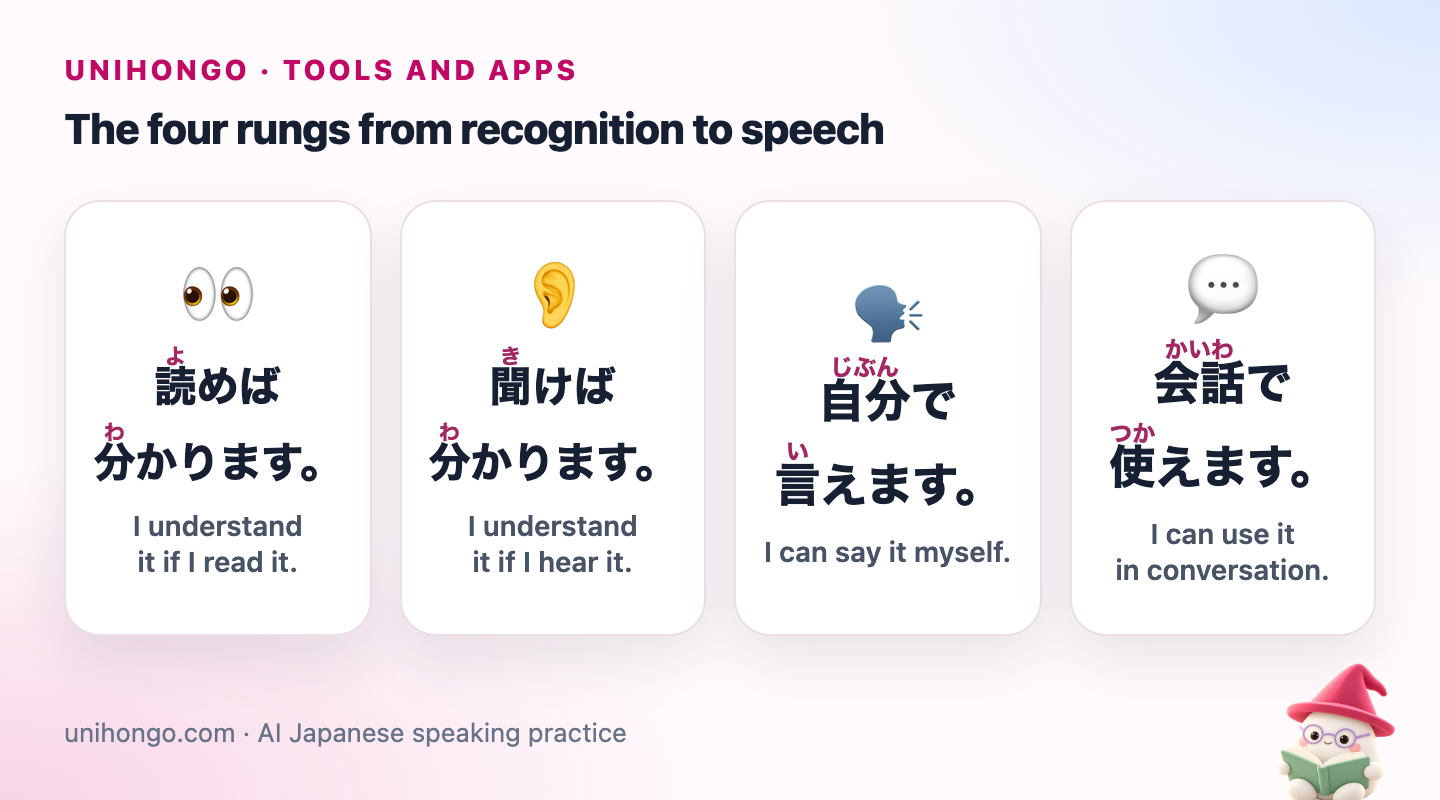
| Japanese | Romaji | Meaning |
|---|---|---|
| 読めば分かります。 | Yomeba wakarimasu. | I understand it if I read it. |
| 聞けば分かります。 | Kikeba wakarimasu. | I understand it if I hear it. |
| 自分で言えます。 | Jibun de iemasu. | I can say it myself. |
| 会話で使えます。 | Kaiwa de tsukaemasu. | I can use it in conversation. |
The third rung is reached by saying, not by more listening. The fourth is reached by saying it to someone who answers. No amount of time on the first two rungs moves you up on its own.
Describe the picture yourself
The pictures you have been matching are perfect production prompts. Instead of choosing which sentence fits, say the sentence. Start with the pattern immersion courses love, someone ga something o verb-te imasu, is doing, then add where with de, then ask a question. Here is a set to copy; after each one, invent a line about a photo of your own.
| Japanese | Romaji | Meaning |
|---|---|---|
| 女の人がりんごを食べています。 | Onna no hito ga ringo o tabete imasu. | A woman is eating an apple. |
| 男の子が公園で犬と走っています。 | Otoko no ko ga kōen de inu to hashitte imasu. | A boy is running with a dog in the park. |
| 子供たちが本を読んでいます。 | Kodomotachi ga hon o yonde imasu. | The children are reading books. |
| これは赤い車です。 | Kore wa akai kuruma desu. | This is a red car. |
| 何をしていますか。 | Nani o shite imasu ka. | What is he or she doing? |
| どこにいますか。 | Doko ni imasu ka. | Where are they? |
| 誰と一緒ですか。 | Dare to issho desu ka. | Who are they with? |
The three questions at the end turn a description into a conversation. Describe one picture, then ask a partner the questions about another, and answer theirs in return. A photo album and a patient partner are a complete speaking course for a beginner.
Alternatives by what they add
The right alternative is the one that fills the rung you are stuck on. These are the main types, described fairly; most learners combine two.
- A human tutor from a marketplace (italki, Preply): adds judgement and planning, and makes you produce under a kind but real gaze. Fits when you can book a weekly slot.
- A language exchange app (HelloTalk, Tandem): adds real people and real reactions, in exchange for helping with your language. Fits when you enjoy chat and can handle time zones.
- A grammar-structured course (LingoDeer, a textbook): adds the explicit rules, especially particles, that immersion leaves implicit. Fits when you keep making the same particle mistake and do not know why.
- A general AI assistant with voice (ChatGPT): adds an open-ended partner. Fits when you want to talk about anything and are willing to instruct it to stay in Japanese.
- A Japanese-only AI conversation partner (Unihongo): adds spoken roleplay with corrections at any hour, without booking. Its AI Sensei in a 3D classroom can play a friend, a clerk or a coworker, slow down, and switch between casual and polite, and the session report shows corrections and vocabulary. Fits when production and feedback are exactly what you lack; it is Japanese-only.
- Shadowing with audio you already own: adds mouth time for free. Fits everyone, as a warm-up before any of the above.
Mini dialogue: describing your day to a friend
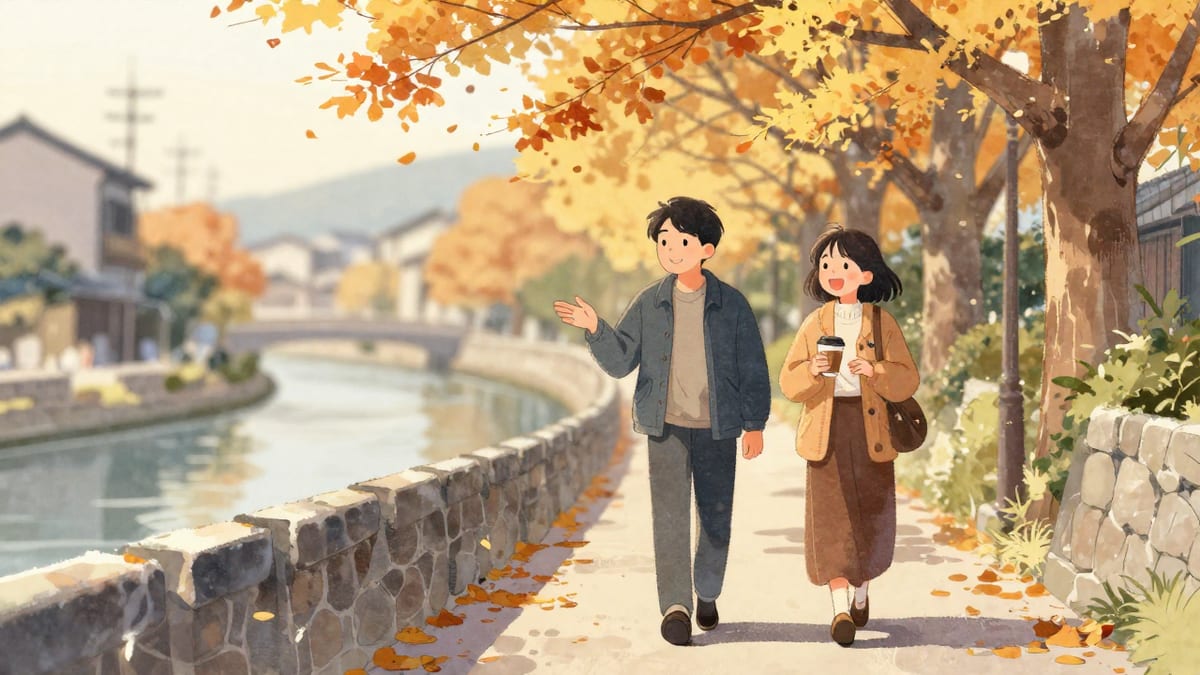
Here is where picture description turns into conversation. A friend asks about your day, and you answer with the same ga, o and de patterns you practised on pictures, except that now the picture is your own life. The friend speaks casually; the learner answers in polite form, which is a natural mix when you are not yet comfortable dropping desu.
| Japanese | Romaji | Meaning |
|---|---|---|
| 今日、何してた? | Kyō, nani shiteta? | Friend: What were you up to today? (casual) |
| 午前中は図書館で勉強していました。 | Gozenchū wa toshokan de benkyō shite imashita. | You: In the morning I was studying at the library. |
| へえ、何を? | Hē, nani o? | Friend: Oh? Studying what? |
| 日本語です。それから、公園で友達と昼ご飯を食べました。 | Nihongo desu. Sorekara, kōen de tomodachi to hirugohan o tabemashita. | You: Japanese. Then I had lunch with a friend in the park. |
| いいね。天気よかったもんね。 | Ii ne. Tenki yokatta mon ne. | Friend: Nice. The weather was good, after all. |
| はい。あなたは何をしましたか。 | Hai. Anata wa nani o shimashita ka. | You: Yes. What did you do? |
Anata wa is understandable but a little stiff between friends; Japanese speakers usually use the person's name plus san, or just a rising sō ieba, and you? Replace anata with your friend's name as soon as you can.
Mistakes when moving from pictures to sentences
| Japanese | Romaji | Meaning |
|---|---|---|
| 男の子が走っています。 | Otoko no ko ga hashitte imasu. | A boy is running. |
| 男の子はどこですか。 | Otoko no ko wa doko desu ka. | Where is the boy? |
| 毎日りんごを食べます。 | Mainichi ringo o tabemasu. | I eat an apple every day. |
| 今、りんごを食べています。 | Ima, ringo o tabete imasu. | I am eating an apple now. |
- Dropping particles. Immersion learners hear sentences as a melody and often say onna no hito ringo tabete imasu, leaving out ga and o. The meaning survives, but it marks you as a beginner. Say the particles deliberately until they come by themselves.
- Confusing ga and wa. Use ga to introduce who is doing something in a description: otoko no ko ga hashitte imasu. Use wa when the topic is already known: otoko no ko wa doko desu ka.
- Forgetting te imasu for actions in progress. Tabemasu means eats or will eat; tabete imasu means is eating. Pictures almost always want te imasu.
- Translating word order from your language. Japanese puts the verb last. Build the sentence backwards if you have to: verb first in your head, then everything in front of it.
- Staying silent until the sentence is perfect. Say the first half, pause, add the rest. Half a sentence with a correction is worth more than a perfect sentence you never said.
A two-week bridge plan
Two weeks is enough to feel the difference. Keep your immersion lessons as they are and add the output column.
| Japanese | Romaji | Meaning |
|---|---|---|
| 毎日、写真を三枚説明します。 | Mainichi, shashin o sanmai setsumei shimasu. | Every day I describe three photos. |
| 二週間後に、自分の一日を話します。 | Nishūkan go ni, jibun no ichinichi o hanashimasu. | In two weeks I'll talk about my own day. |
| Days | Input (keep) | Output (add) |
|---|---|---|
| 1 to 4 | Your usual lesson | Describe three photos aloud with ga, o, de and te imasu |
| 5 to 7 | Your usual lesson | Describe, then ask one question per photo and answer it yourself |
| 8 to 11 | Your usual lesson | A roleplay with an AI partner or a tutor about your day; collect corrections |
| 12 to 14 | Replay an old lesson | Tell a real person about your weekend in five sentences without notes |