
Tutor, AI partner, or both? The short answer
A tutor marketplace connects you with a real teacher or a community tutor for a booked lesson, usually by video. That is its strength: a person who hears what you meant to say, adjusts to your level in real time, and knows how a phrase lands in a real Japanese office or kitchen. Its limits are built into the format. Lessons are booked, so there is nothing at 11 pm when you suddenly feel like talking. Every extra lesson costs money. And a 50-minute lesson a week is, for most people, under an hour of speaking out of 168.
An AI conversation partner is the opposite shape. It is not a teacher in the full sense and it does not know your life, but it is awake at any hour, it never tires of the same scene, and it lets you try a sentence five ways before you commit. The honest conclusion is that these are different tools for different days. Keep the human lesson for direction and judgement, and add something you can do every day for volume.
| Japanese | Romaji | Meaning |
|---|---|---|
| 毎日少しでも話したい | Mainichi sukoshi demo hanashitai | I want to speak at least a little every day |
| 週に一回では足りません。 | Shū ni ikkai dewa tarimasen. | Once a week isn't enough. |
| 先生と話すと緊張します。 | Sensei to hanasu to kinchō shimasu. | I get nervous when I talk to a teacher. |
| 練習の相手がほしいです。 | Renshū no aite ga hoshii desu. | I'd like a practice partner. |
| What you need | A human tutor fits when | An AI partner fits when |
|---|---|---|
| Correction | You want to know why, and what a native speaker would say in your situation | You want instant, patient correction on many repetitions |
| Timing | You can plan a weekly slot | You practise at odd hours or in short gaps |
| Volume | One or two sessions a week is your budget | You want to speak every day without booking |
| Nerves | You are ready to be heard by a person | You want to make mistakes in private first |
| Culture and life | You have questions only a person can answer | You need a scene played again and again |
Four lines that steer any lesson
The fastest way to get more from a tutor is to stop managing the lesson in English. These four polite requests cover almost every moment when you get lost. Learn them first, because they make everything else possible. All four use the te-form plus kudasai, the standard polite request, which is exactly right for a teacher.
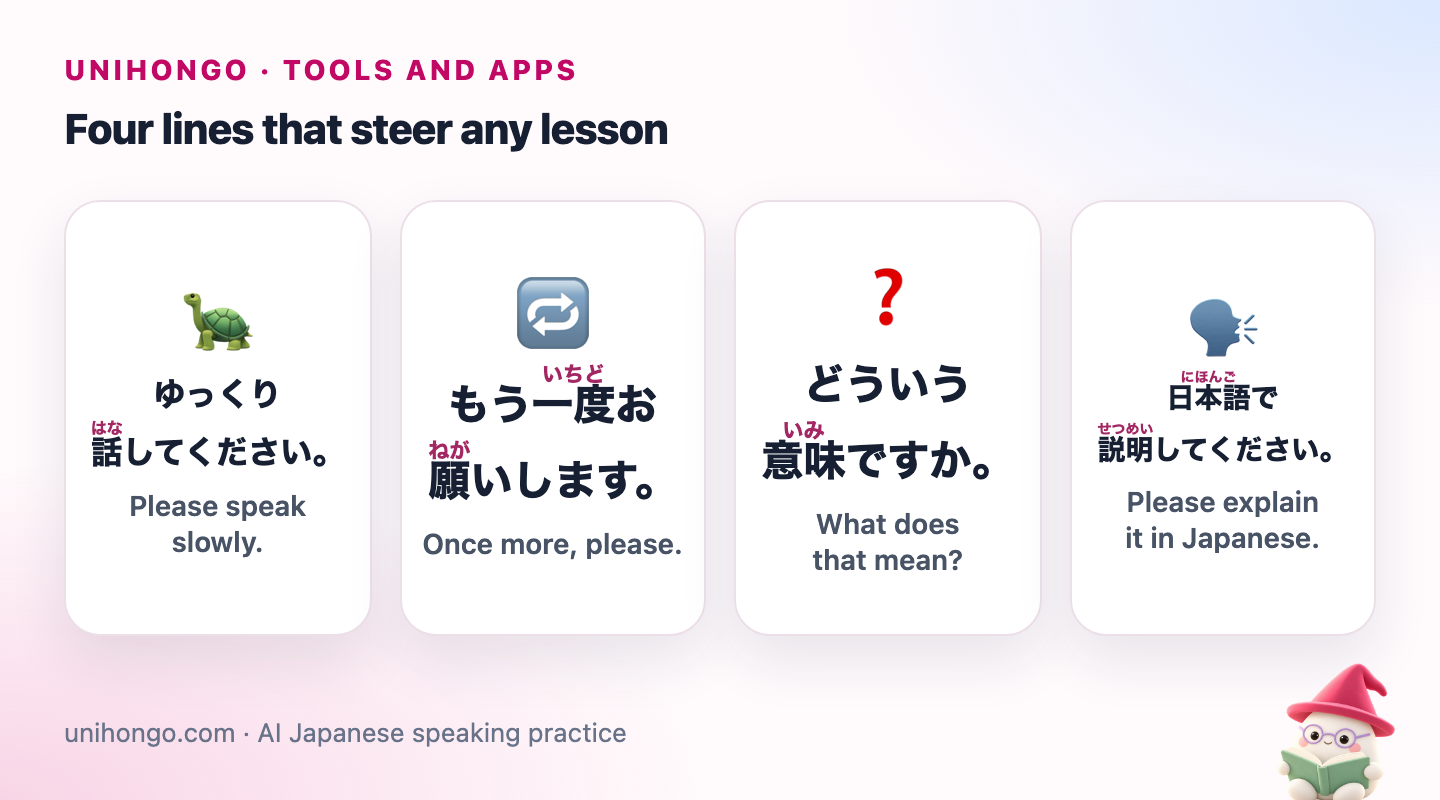
| Japanese | Romaji | Meaning |
|---|---|---|
| ゆっくり話してください。 | Yukkuri hanashite kudasai. | Please speak slowly. |
| もう一度お願いします。 | Mō ichido onegai shimasu. | Once more, please. |
| どういう意味ですか。 | Dō iu imi desu ka. | What does that mean? |
| 日本語で説明してください。 | Nihongo de setsumei shite kudasai. | Please explain it in Japanese. |
| 英語を使わないでください。 | Eigo o tsukawanaide kudasai. | Please don't use English. |
| 今の言い方は自然ですか。 | Ima no iikata wa shizen desu ka. | Was what I just said natural? |
| もっと丁寧に言うと、どうなりますか。 | Motto teinei ni iu to, dō narimasu ka. | How would I say that more politely? |
| 間違いを直してください。 | Machigai o naoshite kudasai. | Please correct my mistakes. |
Alternatives by what you are missing
Rather than asking which app is best, ask what your week lacks. Each type of product below fills a different hole, and most learners end up with two or three of them.
- Another tutor marketplace (for example Preply): fits when you simply want a different pool of teachers, trial lessons or a different scheduling style. It fills the same slot as italki, so it does not solve the six quiet days.
- A language exchange app (HelloTalk, Tandem): fits when you want real people for free, in exchange for your own language. Add it when you enjoy chat and have patience for time zones; it works best as a friendship, not a lesson.
- A general AI assistant with voice (ChatGPT and similar): fits when you want an open-ended partner on any topic. It needs careful instructions to stay in Japanese and does not score pronunciation, but it is patient and flexible.
- A Japanese-only AI conversation partner (for example Unihongo): fits when what you are missing is spoken practice with corrections, at any hour, without booking. Unihongo's AI Sensei is a voice partner in an immersive 3D classroom; you can pick a teacher, ask it to play a shop clerk or coworker, slow down, or switch between casual and polite, and roleplay missions such as Order at a Café or Japanese Job Interview give you objectives to complete by speaking. It is Japanese-only, so it is not for your other languages.
- Group conversation classes, online or at a local school: fit when you want other learners around you and a fixed weekly rhythm. Add them when motivation is the problem more than access.
- Self-talk and shadowing with audio you already own: free, and surprisingly effective for fluency. Add it when you want more mouth time but zero extra cost.
A weekly rhythm that combines both
Here is one way to spend a week so that the lesson becomes the top of a pyramid instead of the whole thing. Shift the days to fit your life; the point is that speaking happens every day, and that the lesson receives material from the week rather than starting from nothing.
| Japanese | Romaji | Meaning |
|---|---|---|
| 先週、コンビニで店員と話しました。 | Senshū, konbini de ten'in to hanashimashita. | Last week I spoke with a clerk at a convenience store. |
| この言葉の使い方を練習したいです。 | Kono kotoba no tsukaikata o renshū shitai desu. | I want to practise how to use this word. |
| 来週までに、自己紹介を練習します。 | Raishū made ni, jikoshōkai o renshū shimasu. | I'll practise my self-introduction by next week. |
| ここで言葉が出てきませんでした。 | Koko de kotoba ga dete kimasen deshita. | Here, the words wouldn't come out. |
| Day | What you do | Why |
|---|---|---|
| Monday | Tutor lesson: review last week's sentences, learn two new patterns, agree on a scene for the week | Direction and judgement |
| Tuesday to Thursday | Ten to fifteen minutes with an AI partner or in self-talk, replaying the week's scene with small changes | Volume and repetition |
| Friday | Record yourself doing the scene once without stopping; note where you froze | Measurement |
| Weekend | Exchange partner chat or a voice message, using the week's patterns on a real person | Transfer to real life |
The last line is the most useful sentence you can bring to a lesson. Point at the moment where you froze and let the tutor give you the two or three expressions you were missing.
Mini dialogue: your first ten minutes with a new tutor
A first lesson with a new tutor usually starts the same way everywhere: greetings, how long you have studied, what you want. Here is how it goes when you keep it in Japanese and use one steering phrase. Everything is polite desu and masu, which is right for a teacher you have just met.

| Japanese | Romaji | Meaning |
|---|---|---|
| 初めまして。よろしくお願いします。 | Hajimemashite. Yoroshiku onegai shimasu. | You: Nice to meet you. I look forward to working with you. |
| こちらこそ。日本語はどのくらい勉強していますか。 | Kochira koso. Nihongo wa dono kurai benkyō shite imasu ka. | Tutor: Likewise. How long have you been studying Japanese? |
| 半年くらいです。話す練習がしたいです。 | Hantoshi kurai desu. Hanasu renshū ga shitai desu. | You: About half a year. I want to practise speaking. |
| いいですね。じゃあ、今日はゆっくり話しましょう。 | Ii desu ne. Jā, kyō wa yukkuri hanashimashō. | Tutor: Good. Then let's speak slowly today. |
| すみません、もう一度お願いします。 | Sumimasen, mō ichido onegai shimasu. | You: Sorry, once more, please. |
| もちろん。ゆっくり言いますね。 | Mochiron. Yukkuri iimasu ne. | Tutor: Of course. I'll say it slowly. |
| ありがとうございます。分かりました。 | Arigatō gozaimasu. Wakarimashita. | You: Thank you. I understand now. |
Notice hanasu renshū ga shitai desu: with shitai, the thing you want to do commonly takes ga, though o is also heard. Both are fine; ga sounds slightly softer.
Mistakes that waste lesson time
| Japanese | Romaji | Meaning |
|---|---|---|
| 大丈夫です。 | Daijōbu desu. | I'm fine. / No, thank you. (ambiguous) |
| 分かりました。 | Wakarimashita. | I understood. |
| まだ分かりません。 | Mada wakarimasen. | I still don't understand. |
| ちょっと待ってください。 | Chotto matte kudasai. | Please wait a moment. |
| 私が話してもいいですか。 | Watashi ga hanashite mo ii desu ka. | May I speak? |
- Saying daijōbu desu when you mean I understood. Daijōbu desu often means no, thank you or I'm fine, so the tutor may stop explaining. Say wakarimashita for I understood and mada wakarimasen for I still don't understand.
- Answering wakarimashita when you did not understand, to be polite. Tutors would rather hear mō ichido onegai shimasu ten times than find out at the end that nothing landed.
- Spending the first fifteen minutes chatting in English about your week. Do it in Japanese, badly. That is the lesson.
- Letting the tutor talk. Some teachers fill silence. A gentle watashi ga hanashite mo ii desu ka, may I speak, resets the balance.
- Arriving with nothing. A tutor who gets a list of sentences you tried during the week can correct, deepen and extend. A tutor who gets nothing has to improvise.
What you should be able to say after a month
Four weeks of one lesson plus daily short practice should leave you with a small set of lines that come out without translation. Use this list as a test: say each one aloud, right now, without reading the romaji.
| Japanese | Romaji | Meaning |
|---|---|---|
| 私はブラジルから来ました。 | Watashi wa Burajiru kara kimashita. | I came from Brazil. |
| 日本語を半年勉強しています。 | Nihongo o hantoshi benkyō shite imasu. | I have been studying Japanese for half a year. |
| 週末は何をしましたか。 | Shūmatsu wa nani o shimashita ka. | What did you do at the weekend? |
| それはちょっと難しいですね。 | Sore wa chotto muzukashii desu ne. | That's a bit difficult, isn't it? |
| もう少し練習が必要です。 | Mō sukoshi renshū ga hitsuyō desu. | I need a little more practice. |
| 来週もよろしくお願いします。 | Raishū mo yoroshiku onegai shimasu. | See you next week, and thank you in advance. |