

What Langua is designed for
Langua is the AI product of LanguaTalk. The company's website presents two services: lessons with human tutors, and Langua, an AI tutor that is available at any hour. The site states that Langua supports over 20 languages, many of them in more than one dialect, and Japanese has its own page.
According to that page, Langua offers roleplays, debates, vocabulary practice and a large set of conversation topics. It describes AI voices that are cloned from real native speakers, a call mode for hands-free practice, and the option to make the AI speak more slowly. For learners at lower levels it describes a guided conversational course.
Langua also puts weight on what happens after the conversation. Its site lists feedback reports after each conversation, a choice of correction styles, full transcripts where you can select a word to translate it, saved vocabulary, and spaced repetition flashcards built from your own conversations. It also lists podcasts and videos with interactive transcripts, and says you can import your own content. The site states that Langua works on the web and in iOS and Android apps.
Why a Japanese learner might look for an alternative
Looking for an alternative does not mean a product is poor. Langua covers many languages, and for a learner who studies Japanese and another language it may be a practical choice. Learners usually search for alternatives for one of a few plain reasons.
- They want a tool built only for Japanese, with practice graded by level.
- They want a different lesson format, such as a classroom with a visible teacher instead of a chat or call screen.
- They want scored pronunciation practice on individual lines.
- They want a different amount of free daily practice, or a different plan structure.
- They want a mobile-first app, or a browser-first tool.
- They simply want to compare two or three tutors before paying for one.
Each product below answers some of these needs and not others. None of them covers everything a learner needs, and that includes Unihongo.
Unihongo: a Japanese-only tutor in a 3D classroom
Unihongo is an AI Japanese tutor built for speaking practice. You talk by voice with an AI Sensei in an immersive 3D classroom. Most AI tutors use a chat or voice-call interface, so the classroom is the visible difference. You can choose from 8 teacher personalities, for example gentle, strict, funny or relaxed, and from 90 conversation topics across daily life, travel, work, culture and creative challenges.
Roleplay missions are graded by level and cover situations such as cafes, convenience stores, hotels and clinics. The AI plays the clerk, doctor or interviewer and stays in character. Pronunciation practice gives line-by-line scoring and coaching. After each conversation you receive a session report with corrections, and past sessions stay in a Review history.
Unihongo also has free learning games that you can play without an account, including Vocabulary Dash, Sushi Sort and Sentence Builder, plus Kana Dash for hiragana and katakana, and a kanji library of all 2,136 joyo kanji. It runs in the browser. An Android app is in early access and an iOS app is pending. Unihongo is free to use with a free account. The free plan includes 3 minutes of live conversation with the AI Sensei a day, 2 roleplay missions a day, 5 scored pronunciation lines a day and 2 AI session reports a day, and it keeps the 10 most recent sessions in Review. Three minutes a day is short. It suits a short daily speaking habit and does not suit hour-long sessions. The games, Kana Dash and the kanji library are free and need no account.
Unihongo is not the right tool for every job. It teaches Japanese only, it is not a structured reading or kanji course with spaced repetition, and it does not replace JLPT reading practice or the cultural judgement of a human teacher.
Langua and Unihongo side by side
The table states only what each company's own website confirms as of September 2026. Where a point could not be confirmed on Langua's site, the cell says to see their site. That wording means the information was not found, not that the feature is missing.
| Point | Langua | Unihongo |
|---|---|---|
| Made by | LanguaTalk | Unihongo |
| Languages taught | Over 20, including Japanese | Japanese only |
| Lesson format | AI conversation with a call mode for hands-free practice | Voice conversation with an AI Sensei in a 3D classroom |
| Conversation types | Roleplays, debates, vocabulary practice, many topics | 90 topics and roleplay missions graded by level |
| Teacher choice | AI voices cloned from real native speakers | 8 teacher personalities |
| Beginner support | Guided conversational course for lower levels | Beginner roleplay missions and free kana and vocabulary games |
| Corrections | Choice of correction styles, feedback report after each conversation | Session report with corrections, Review history |
| Pronunciation scoring | See their site | Line-by-line scoring and coaching |
| Vocabulary review | Saved words and spaced repetition flashcards | Free learning games, no flashcard system |
| Listening content | Podcasts and videos with interactive transcripts | Listening happens inside conversations and games |
| Kanji reference | See their site | Library of 2,136 joyo kanji |
| Human tutors | Offered separately by LanguaTalk | Not offered |
| Platforms | Web, iOS and Android | Web browser, Android in early access, iOS pending |
| Pricing | See their site | Free with a free account, with daily limits |
The two products overlap in the centre, which is spoken conversation with corrections, and differ at the edges. Langua adds flashcards, media with transcripts and many languages. Unihongo adds the classroom, roleplay missions graded by level, pronunciation scoring, games and a kanji library.
Nora, Pingo AI and Talkpal
Nora, at hellonora.ai, describes itself as an AI language tutor for speaking practice in 8 languages, and Japanese is one of them. Its site lists AI-powered conversations, a real-time voice call mode, feedback in real time, difficulty that adapts to your level, a built-in dictionary, a Vocabulary Bank for saved words and sentences, progress tracking, and story-based Journeys. It also describes bilingual support and says you can switch languages when you are stuck in the middle of a sentence. This suits learners who want a voice tutor that allows them to fall back on their first language.
Pingo AI, at pingo.ai, describes itself as an AI language learning app that helps you learn by talking, with 25+ languages including Japanese. Its site says that you talk, the app listens and corrects you in the moment, and it builds a learning plan around your goals. It describes short interactive conversations for beginners, conversational roleplay as you progress, and fast-paced roleplays and debates for advanced learners. The site links to the app on the App Store and on Google Play.
Talkpal, at talkpal.ai, describes itself as an AI language learning app for speaking practice in 130+ languages, and Japanese is among the languages shown on its home page. Its site menu lists Roleplays, Debates, Call Mode, Dialogue Mode, Sentence Mode, Word Mode and Photo Mode, and the site says users receive immediate, personalised feedback. The site states that Talkpal is available on web and mobile platforms, with downloads for iOS and Android. It may suit learners who want several exercise formats.
| Product | Languages | Designed for | Official site |
|---|---|---|---|
| Langua | Over 20, including Japanese | Conversation with feedback reports, flashcards and media | languatalk.com |
| Unihongo | Japanese only | Spoken practice in a 3D classroom, roleplay missions, games | unihongo.com |
| Nora | 8, including Japanese | Real-time voice conversation with bilingual support | hellonora.ai |
| Pingo AI | 25+, including Japanese | Learning by talking, with a plan built around your goals | pingo.ai |
| Talkpal | 130+, including Japanese | Speaking practice in several modes | talkpal.ai |
Pricing and free access for Langua, Nora, Pingo AI and Talkpal are on their own sites. This article does not quote them because prices change more often than articles do.
Japanese sentences to test any AI tutor
A fair test uses the same input in every product. Say the sentences below aloud in each tutor you try. The first gives the tutor something to respond to. The second and fourth check whether it follows instructions given in Japanese. The third asks for a correction directly. The fifth opens a roleplay with a soft, natural request. The last contains a small double consonant and te-forms, so it shows how well the speech recognition hears detail.
| Japanese | Romaji | Meaning |
|---|---|---|
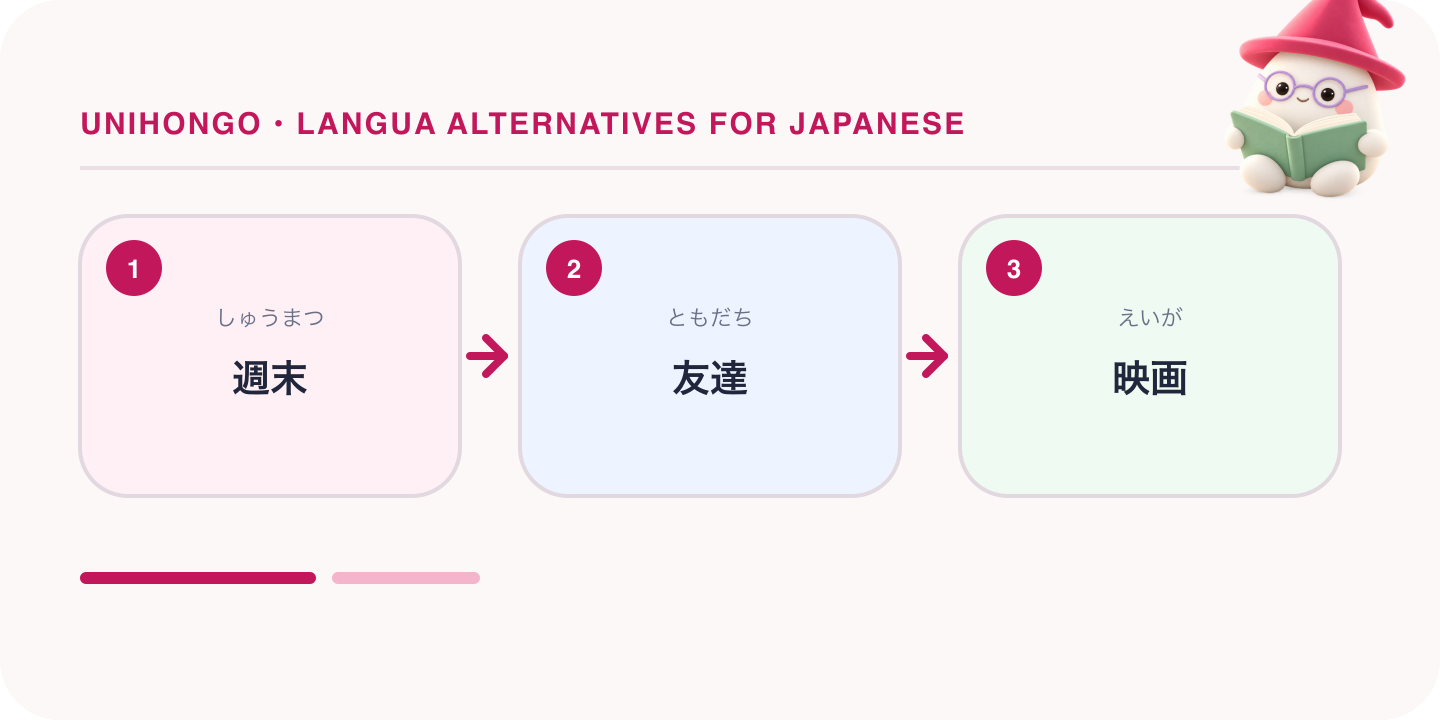
| 週末は友達と映画を見に行きました。 | Shūmatsu wa tomodachi to eiga o mi ni ikimashita. | At the weekend I went to see a film with a friend. |
| もう少しゆっくり話してもらえますか。 | Mō sukoshi yukkuri hanashite moraemasu ka. | Could you speak a little more slowly? |
| 今の文を直してください。 | Ima no bun o naoshite kudasai. | Please correct the sentence I just said. |
| もっと丁寧な言い方を教えてください。 | Motto teinei na iikata o oshiete kudasai. | Please teach me a more polite way to say it. |
| 予約を変更したいんですが。 | Yoyaku o henkō shitai n desu ga. | I would like to change my reservation. |
| 切手を買ってきてください。 | Kitte o katte kite kudasai. | Please go and buy some stamps. |
How to choose between them
Start from your goal, not from the feature list. Each of these products does one or two things that the others do not, so the right choice depends on what is missing from your study today.
- You study Japanese and another language: a multi-language tutor such as Langua, Pingo AI or Talkpal teaches both. Check each site for how its plans cover more than one language.
- You want flashcards made from your own conversations, or podcasts and videos with transcripts: Langua describes both.
- You want to switch between your first language and Japanese in one conversation: Nora describes bilingual support.
- You practise mainly on a phone: the sites of Langua, Pingo AI and Talkpal all point to iOS and Android apps.
- You want a Japanese-only tutor with a classroom setting, roleplay missions graded by level and scored pronunciation: Unihongo is built for that, within the daily limits of its free plan.
- You want free kana, vocabulary and kanji resources without an account: Unihongo's games and kanji library are open to everyone.
What no AI speaking tutor replaces
An AI tutor gives you many more minutes of speaking than a weekly lesson can. It does not give you everything. Reading and kanji need their own study, and the JLPT tests reading and listening, not speaking. A human teacher can judge whether a sentence is suitable for a particular person and situation in a way that software cannot.
A balanced week for most learners has three parts: a study system or textbook for reading, kanji and grammar, an AI tutor for daily spoken output, and a human teacher or conversation partner when possible. LanguaTalk offers human tutors on the same site as Langua. Unihongo does not, so Unihongo learners who want human lessons need to find them elsewhere.
About this comparison
This article is published by Unihongo. The descriptions of Langua, Nora, Pingo AI and Talkpal come from each company's official website as it appeared in September 2026. They describe what each company says its product does. They are not the results of a test, and they are not a ranking.
Features, platforms, free access and prices change. Before you subscribe to any product named here, including Unihongo, read its current website and try its free option or trial with your own sentences.