
What Mocchi AI Remembers About Your Japanese Learning

Mocchi AI uses learning context such as your Japanese level, study goal, preferences, and weak points to make its help more relevant. The useful result is a better next exercise, not a claim that an AI remembers every conversation perfectly.

Mocchi connects a learner's Japanese goal, recent practice, and next lesson in a personal learning map
What you need to know

What Mocchi AI Remembers About Your Japanese Learning

Imagine two learners who both miss a question about に and で. One is preparing for a first trip; the other is reading workplace messages. The grammar distinction is the same, but the examples and follow-up should differ. Mocchi's learning memory gives the tutor context for making that choice. You can make the process more effective by supplying a specific goal and correcting outdated assumptions before a lesson grows around them.

Share learning facts that can change an exercise.

Connect recurring mistakes to fresh practice.

Correct old context when your needs change.

Check recall with a new sentence, not a familiar answer.

Learning context should change what happens next

A useful remembered detail has a teaching consequence. If you say that you work rotating shifts, a realistic plan may need flexible sessions. If you repeatedly choose the wrong location particle, a later quiz can revisit that distinction. Simply repeating your name or hobby is less important than changing the difficulty, subject matter, or review target in a way that helps you learn.

Start with the obstacle rather than a biography. 'I can recognize this sentence but cannot make my own version' tells the tutor more about the next activity than 'I want to become fluent.' The first statement points toward supported production; the second still needs a smaller, testable goal.

A remembered mistake becomes a different exercise

Consider 図書館で勉強します: 'I study at the library.' The action takes place at the library, so で fits. Now compare 図書館に行きます: 'I go to the library.' Here the library is a destination, so に fits. If this is your weak point, ask Mocchi to vary the verb and setting instead of showing the same pair until you recognize its layout.
Three connected cards show a learner preference, a particle mistake, and a targeted follow-up exercise
Useful learning memory connects a relevant fact to a teaching decision and a later practice check.
JapaneseRomajiMeaning
図書館で勉強します。Toshokan de benkyō shimasu.I study at the library.
図書館に行きます。Toshokan ni ikimasu.I go to the library.

Separate your profile from today's request

A profile describes the usual situation: your level, goal, interests, and available time. Today's message can override that context for a particular task. You might usually study for N4 but need a simple restaurant exchange tonight. Say both things clearly: 'Keep my N4 goal, but make this lesson a beginner-friendly ordering practice.' This avoids treating a temporary request as a permanent change in your overall plan.

Check the assumption before accepting the lesson

When the first exercise feels too easy, too difficult, or unrelated to your objective, stop early and identify the mismatch. Specify what you can already do and what still breaks down. For example, recognizing a verb in a multiple-choice quiz does not mean you can use it in a spoken answer. Asking for a production task gives the tutor better evidence than asking it to make everything harder.

Make memory useful without oversharing

Learning-relevant context can stay broad. A fictional café, an invented company, or a general travel plan is enough for many exercises. Avoid sharing passwords, payment details, addresses, or private messages that contain someone else's information. Mocchi does not need those details to explain a particle or create vocabulary practice. Review the site's privacy information separately when deciding what you are comfortable putting into any account-based service.

Key points

A practical way to improve

Tell Mocchi your current level, one situation you want to handle, and one recurring difficulty. Ask for two short questions that combine those details. After answering, request a different example of the same difficulty. At your next visit, say what you want to revisit and check whether the exercise still matches your goal. If the tutor uses an old detail, correct it directly before continuing.

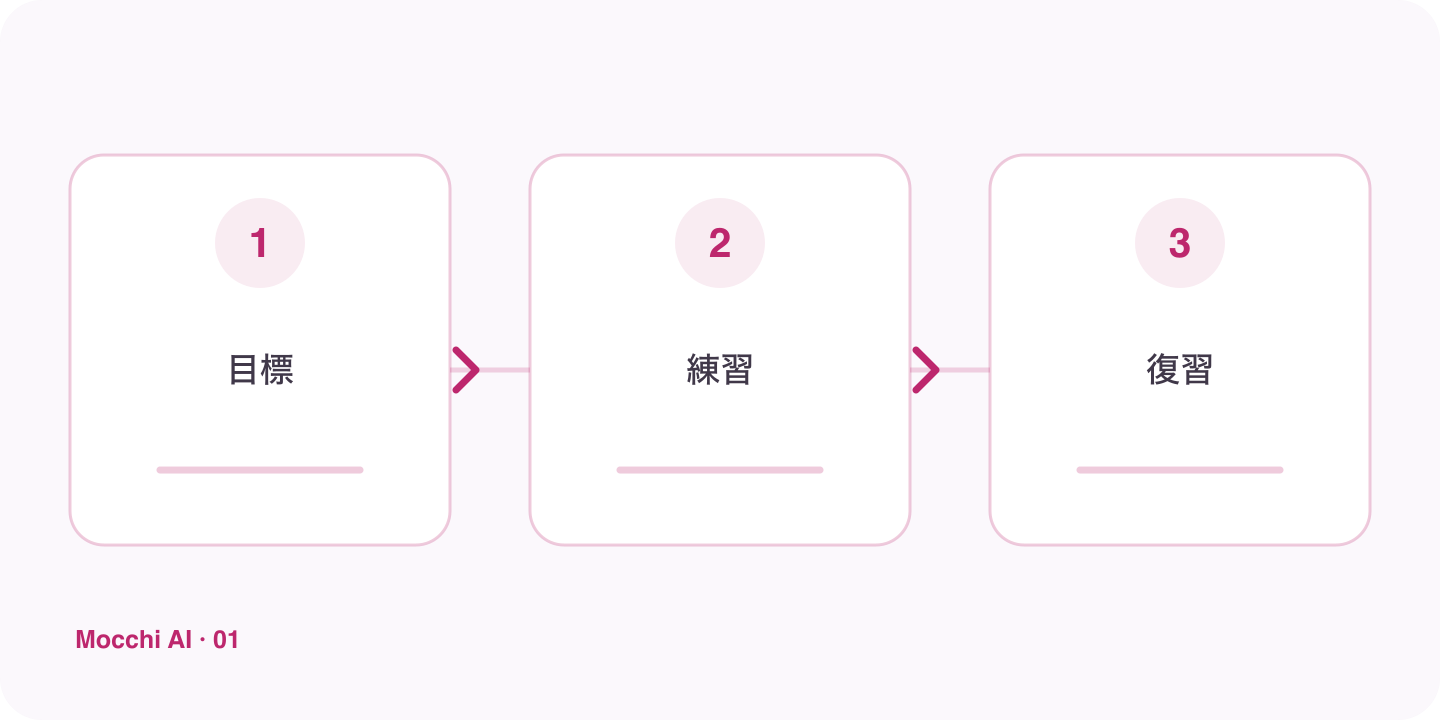
  1. 1

    Choose one clear goal

    Focus each session on a situation or skill you can actually use.

  2. 2

    Practice actively

    Say complete answers aloud instead of only reading or recognizing Japanese.

  3. 3

    Review and repeat

    Keep useful corrections and revisit the same skill until it feels natural.

FAQ

Frequently asked questions

Does Mocchi remember every message exactly?

Learning memory is selective context, not a guarantee of word-for-word recall. Restate important details when they affect a task, and correct the tutor if it uses an assumption that no longer fits.

What information is most useful to share?

Your approximate level, a concrete learning goal, preferred explanation language, available study time, and an example of a recurring mistake can all affect the lesson. You do not need to share private identifying details to get personalized practice.

How do I tell whether the memory is helping?

Look for a change in the task: relevant examples, an appropriate explanation length, or a follow-up on a weakness. A friendly greeting alone is not evidence that the practice is better matched to your needs.

Give Mocchi a useful starting point

Describe one goal and one difficulty, then see how a targeted exercise differs from an open-ended chat.