
What an audio course does well
The method behind Pimsleur is simple and strong. A narrator asks you, in your language, how to say something; you answer aloud in Japanese; a native speaker says it; and the same sentence returns minutes, days and weeks later, just when you are about to forget it. Because everything is sound, you learn the rhythm and pitch of Japanese from the start, without the English-letter habits that romaji can leave behind. And because you answer out loud, your mouth gets exercise, which many app learners never give it.
If you have finished a level, you probably own a few hundred polite sentences that come out with good pronunciation. That is a real asset, and nothing below asks you to stop. It asks you to add the half the audio format leaves out.
| Japanese | Romaji | Meaning |
|---|---|---|
| 聞くだけでなく話したい | Kiku dake de naku hanashitai | I want to speak, not only listen |
| 発音は自信があります。 | Hatsuon wa jishin ga arimasu. | I'm confident about my pronunciation. |
| でも、返事が聞き取れません。 | Demo, henji ga kikitoremasen. | But I can't catch the reply. |
From a recorded line to a live one in four steps
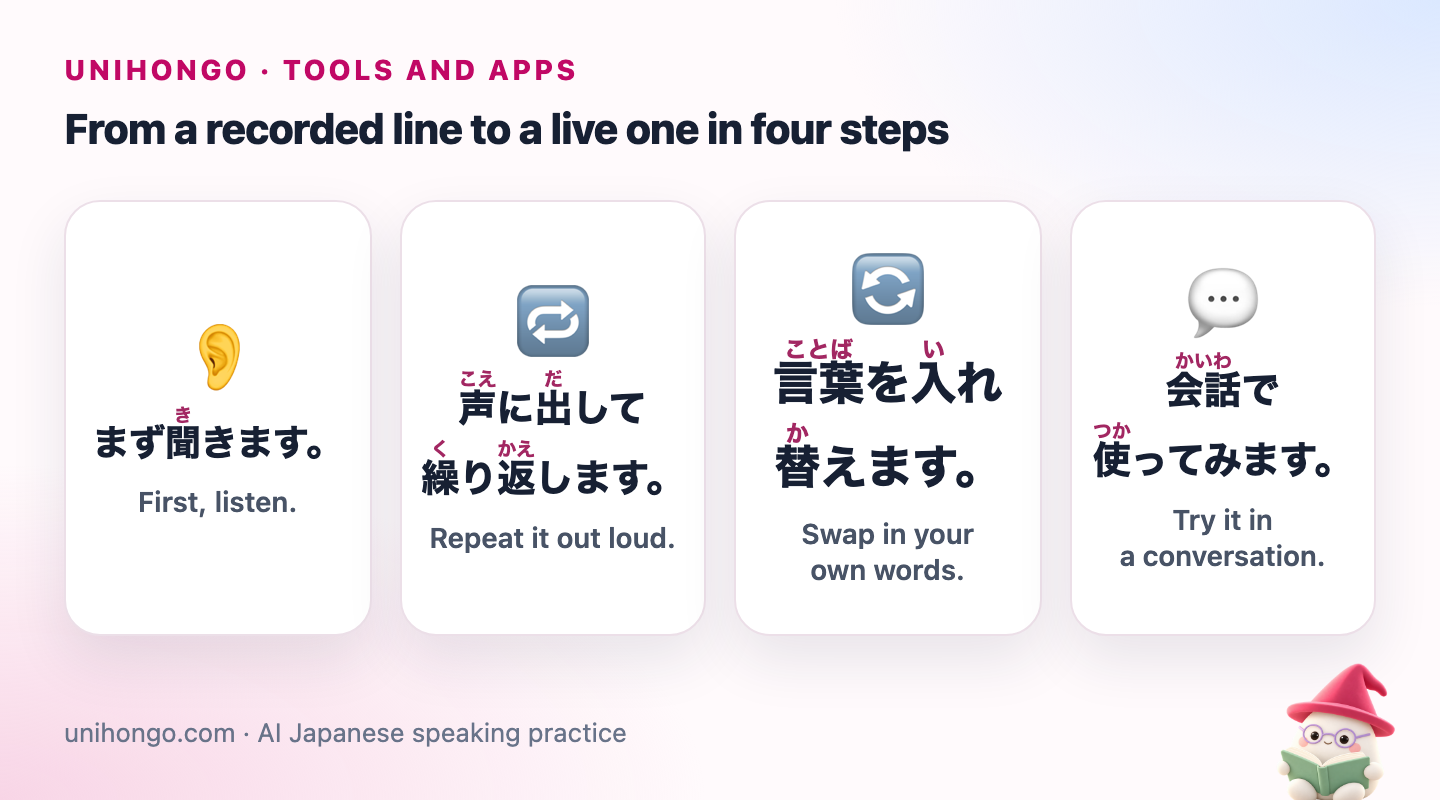
Every sentence an audio course gives you can be made conversational with the same four moves. Say them in Japanese to yourself as a checklist; they are the four cards below. The first two are what the course already makes you do. The last two are what you add.
| Japanese | Romaji | Meaning |
|---|---|---|
| まず聞きます。 | Mazu kikimasu. | First, listen. |
| 声に出して繰り返します。 | Koe ni dashite kurikaeshimasu. | Repeat it out loud. |
| 言葉を入れ替えます。 | Kotoba o irekaemasu. | Swap in your own words. |
| 会話で使ってみます。 | Kaiwa de tsukatte mimasu. | Try it in a conversation. |
Step three is where ownership begins. The course taught you kōhī o kudasai; when you can say ocha o kudasai and mizu o kudasai without thinking, you own the pattern, not just the sentence. Step four is where conversation begins: someone has to answer.
The gap: one direction, no corrections, one register
Three things are missing from any audio course, not because of poor design but because of the format. First, the direction: you always speak second, after a prompt, and never have to understand a reply you did not expect. Second, correction: the native speaker says the model sentence, but nobody hears yours, so a wrong vowel length or a dropped particle can harden for months. Third, register: the sentences are polite, which is right for strangers and wrong for friends.
The register point is worth seeing side by side. Here is the same meaning in the polite form the course teaches and in the casual form a friend would use.
| Japanese | Romaji | Meaning |
|---|---|---|
| すみません、駅はどこですか。 | Sumimasen, eki wa doko desu ka. | Excuse me, where is the station? (polite) |
| 駅、どこ? | Eki, doko? | Where's the station? (casual) |
| コーヒーをください。 | Kōhī o kudasai. | Coffee, please. (polite) |
| コーヒーがいい。 | Kōhī ga ii. | I'll have coffee. (casual) |
| 日本語が少し分かります。 | Nihongo ga sukoshi wakarimasu. | I understand a little Japanese. (polite) |
| 日本語、ちょっと分かる。 | Nihongo, chotto wakaru. | I get a bit of Japanese. (casual) |
Swap drills: one course sentence, ten of yours
Pick a sentence frame the course gave you and change one slot at a time. Below, the frame is X ga sukoshi dekimasu, I can do a little X, and then X wa doko desu ka, where is X. Say each line aloud, then invent two more of your own before reading on. The aim is speed: the frame should hold still while the word changes.
| Japanese | Romaji | Meaning |
|---|---|---|
| 日本語が少しできます。 | Nihongo ga sukoshi dekimasu. | I can speak a little Japanese. |
| 料理が少しできます。 | Ryōri ga sukoshi dekimasu. | I can cook a little. |
| 運転が少しできます。 | Unten ga sukoshi dekimasu. | I can drive a little. |
| トイレはどこですか。 | Toire wa doko desu ka. | Where is the toilet? |
| 出口はどこですか。 | Deguchi wa doko desu ka. | Where is the exit? |
| バス停はどこですか。 | Basutei wa doko desu ka. | Where is the bus stop? |
Then add the question back. Audio courses rarely make you ask the other person about themselves, yet that is half of any conversation: anata wa, and you? Or more naturally, with the person's name plus san.
Mini dialogue: the station question gets a real answer
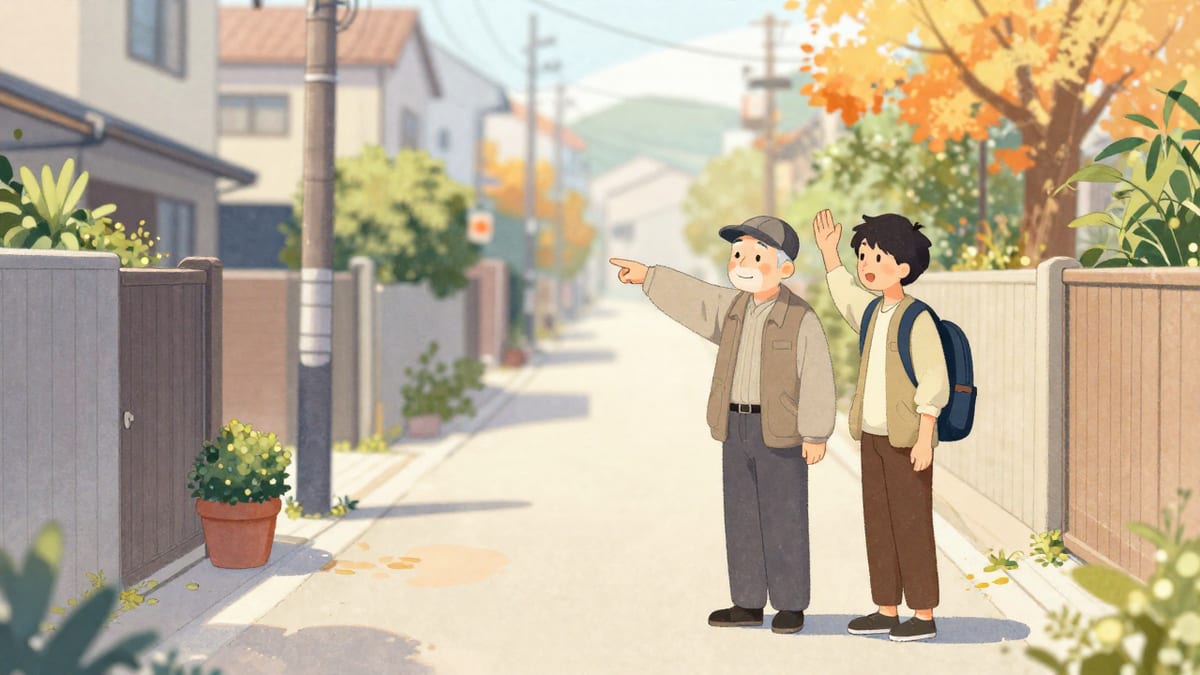
This is the moment audio learners dread: you ask the question perfectly and the answer is not on the recording. Here the passer-by gives real directions, and the learner survives by repeating the key part back and asking for the rest slowly. Both speakers are polite, which is right for strangers.
| Japanese | Romaji | Meaning |
|---|---|---|
| すみません、駅はどこですか。 | Sumimasen, eki wa doko desu ka. | You: Excuse me, where is the station? |
| 駅ですか。この道をまっすぐ行って、二つ目の信号を右です。 | Eki desu ka. Kono michi o massugu itte, futatsume no shingō o migi desu. | Passer-by: The station? Go straight along this road and turn right at the second light. |
| 二つ目の信号を右ですね。 | Futatsume no shingō o migi desu ne. | You: Right at the second light, is that correct? |
| はい。歩いて五分くらいですよ。 | Hai. Aruite gofun kurai desu yo. | Passer-by: Yes. It's about five minutes on foot. |
| すみません、もう少しゆっくりお願いします。 | Sumimasen, mō sukoshi yukkuri onegai shimasu. | You: Sorry, a little more slowly, please. |
| 歩いて、五分くらいです。 | Aruite, gofun kurai desu. | Passer-by: On foot, about five minutes. |
| 分かりました。ありがとうございます。 | Wakarimashita. Arigatō gozaimasu. | You: I understand. Thank you very much. |
The repeat-back line, futatsume no shingō o migi desu ne, does two jobs: it confirms what you understood and it buys you a second to process the rest. Use it shamelessly.
Mistakes audio-only learners make
| Japanese | Romaji | Meaning |
|---|---|---|
| そうですか。 | Sō desu ka. | I see. / Is that so? |
| 本当ですか。 | Hontō desu ka. | Really? |
| なるほど。 | Naruhodo. | Ah, that makes sense. |
| すみません、分かりません。 | Sumimasen, wakarimasen. | Sorry, I don't understand. |
- Speaking in full textbook sentences to friends. Watashi wa kōhī o nomimasu is correct and sounds like a recording. Friends say kōhī nomu, or just kōhī.
- Starting every sentence with watashi wa. Japanese drops the subject when it is obvious, which is most of the time.
- Not reacting. Audio courses rarely teach the small sounds that keep a conversation alive: hai, ē, sō desu ka, hontō desu ka. Without them, the other person thinks you have not understood.
- Asking a question and then panicking at the answer. Prepare the three rescue lines: mō ichido onegai shimasu, mō sukoshi yukkuri onegai shimasu, and sumimasen, wakarimasen.
- Never being corrected. If no one hears your Japanese, get something that does: a tutor, an exchange partner or an AI partner that gives corrections.
A weekly plan: audio in, speech out
You do not have to choose between the course and conversation. Keep the lesson a day, and attach a few minutes of output to it. The table is one rhythm that learners find sustainable; adjust the days, keep the shape. The key is that the audio lesson becomes the warm-up for speaking rather than the whole session, and that at least once a week someone or something hears you and answers.
| Japanese | Romaji | Meaning |
|---|---|---|
| 今日のレッスンの文を三つ言い換えます。 | Kyō no ressun no bun o mittsu iikaemasu. | I'll rephrase three sentences from today's lesson. |
| 週に一回、誰かと話します。 | Shū ni ikkai, dareka to hanashimasu. | Once a week, I talk with someone. |
| Day | Audio | Output |
|---|---|---|
| Monday to Friday | One lesson, while walking or commuting | Immediately after: swap three sentences, say the casual version of one |
| Wednesday | Replay an older lesson | Roleplay that lesson's scene with an AI partner; ask for corrections |
| Saturday | Rest from new lessons | A real conversation: exchange partner, tutor or a longer roleplay |
| Sunday | Listen to the week's lessons at natural speed | Record a one-minute self-introduction and compare with last week's |