
Start with the whole words
Look at each complete label and associate it with an action. Do not begin by collecting every possible reading of every character. The immediate task needs the two common words and a clear contrast.
| Japanese | Romaji | Meaning |
|---|---|---|
| 入口 | Iriguchi | Entrance |
| 出口 | Deguchi | Exit |
Retrieve before uncovering the answer
Cover the reading and meaning, then try to recall both. If you reverse the words, note that specific confusion. Mocchi’s /kanji or focused flashcards can help you inspect the contrast instead of starting an unrelated large list.
Interpret a short fictional instruction
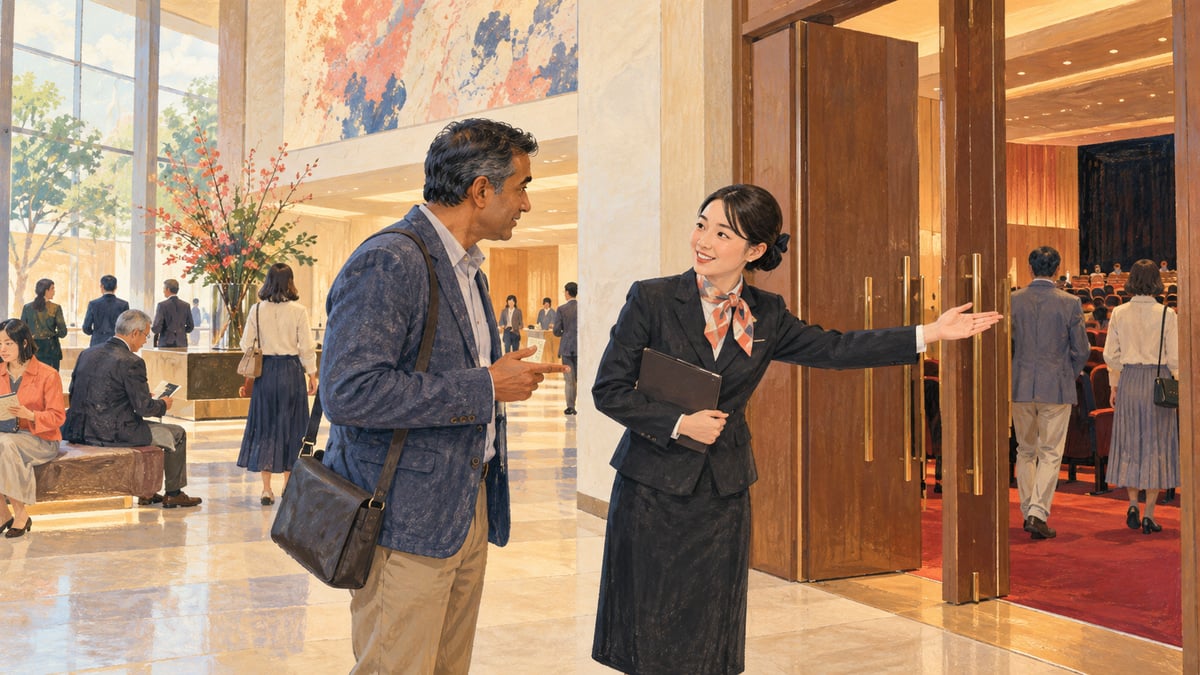
The instruction tells visitors which door to use. Read for the action and the destination together. The answer is the entrance; the exit is not an interchangeable second label for the same purpose.
| Japanese | Romaji | Meaning |
|---|---|---|
| 入口から入ってください。 | Iriguchi kara haitte kudasai. | Please enter through the entrance. |
Use the word in a meeting message
Now the word identifies where two fictional friends should meet. Cover the sample answer and make your own message. Check that you did not accidentally arrange to wait at the exit.
| Japanese | Romaji | Meaning |
|---|---|---|
| 入口で待っています。 | Iriguchi de matte imasu. | I am waiting at the entrance. |
Ask about a missing location
Recognizing the word does not tell you where the door is. Ask a suitable AI Sensei partner where the entrance is, then respond to the fictional explanation. Do not invent a floor or direction the exercise has not supplied.
Carry the word to a fresh task
Later, use entrance in a different meeting or reading task and retrieve exit separately. Mocchi can connect kanji review with relevant vocabulary and a small quiz. Compare current plans if you want ongoing practice across reading and conversation rather than treating a single correct card as mastery.