
What the freeze actually is
Producing a sentence in a second language consumes working memory: retrieving words, ordering them, conjugating, monitoring pronunciation. Anxiety consumes the same resource, mostly on monitoring how you are being perceived.
When both run at once, the total exceeds what is available and production stops. That is the freeze, and it explains why it happens to people who demonstrably know the material.
The practical consequence is that there are two separate fixes: reduce what the sentence costs, and reduce what the anxiety costs. Both work, and they work independently.
| Load source | Effect | What reduces it |
|---|---|---|
| Retrieving words | Slows production | Repetition to automaticity |
| Conjugating live | Slows production | Learning whole phrases |
| Monitoring pronunciation | Splits attention | Isolated sound drilling |
| Fear of judgement | Consumes capacity | Exposure, starting small |
| Not knowing the script | Unpredictability | Rehearsing the situation |
Most advice targets only the last row. The first three are often faster to fix and reduce the load just as much.
Make the sentences cheaper
A sentence you assemble costs far more than a sentence you retrieve whole. This is why learners who study grammar thoroughly can still freeze: they are building each utterance from parts, live, while nervous.
The countermeasure is to hold a set of complete sentences that come out without assembly. These are not phrasebook lines to recite; they are the frames you actually use, made automatic.
| Japanese | Romaji | Meaning |
|---|---|---|
| すみません、日本語を勉強しています。 | Sumimasen, Nihongo o benkyō shite imasu. | Excuse me, I am studying Japanese. |
| ゆっくり話していただけますか。 | Yukkuri hanashite itadakemasu ka. | Could you speak slowly? |
| ちょっと待ってください。 | Chotto matte kudasai. | Please wait a moment. |
| えっと、何と言うか…… | Etto, nan to iu ka…… | Er, how do I put it… |
| うまく言えないんですが、 | Umaku ienai n desu ga, | I cannot say it well, but… |
| もう一度言ってもいいですか。 | Mō ichido itte mo ii desu ka. | May I say that again? |
Practise without an audience first
The reason private practice works is not that it is comfortable. It is that it lets you build retrieval speed without the anxiety load running at the same time, so the sentences become cheap before you add the audience back.
This is where AI practice does something a language exchange cannot. Failing the same sentence eleven times in front of a person costs social capital; failing it eleven times alone costs nothing, and eleven is often what it takes.
In Unihongo's 3D classroom the situation still has a shape and someone still waits for your answer, which keeps mild pressure in the exercise, but nobody is forming an opinion of you. The pronunciation lab handles the sounds separately so you are not monitoring them mid-sentence, and the session report tells you afterwards what to fix instead of interrupting you to do it.
- Repeat the same exchange until the opening is instant.
- Practise being interrupted, not just clean runs.
- Fix sounds in isolation, not during conversation.
- Review errors after the session, never during.
- Stop while it still feels easy.
Then add people, gradually
Private fluency does not automatically survive an audience, so the second half is exposure. The mistake is making the first step too large: a conversation class, a work meeting, a party.
Graded exposure works better. Start with exchanges that are short, scripted, and cannot really fail, then extend.
| Step | Example | Why it works |
|---|---|---|
| Transaction | Buying a coffee | Fixed script, seconds long |
| Small question | Asking where something is | One exchange, clear success |
| Brief chat | Weather with a neighbour | Low stakes, familiar words |
| Extended chat | A colleague at lunch | Unpredictable but friendly |
| Group setting | A team meal | Multiple speakers, fast |
| Performance | A meeting or presentation | Highest load |
Move up a row only when the current one has stopped producing adrenaline. Rushing the sequence tends to reinforce the fear rather than reduce it.
What to do in the moment
Freezes will still happen. What matters is having something to do that is not standing silently, because silence is what makes the moment feel catastrophic to you and confusing to the other person.
Naming the problem in Japanese is almost always better received than going quiet. It also usually produces help, since the other person now knows what is happening.
| Japanese | Romaji | Meaning |
|---|---|---|
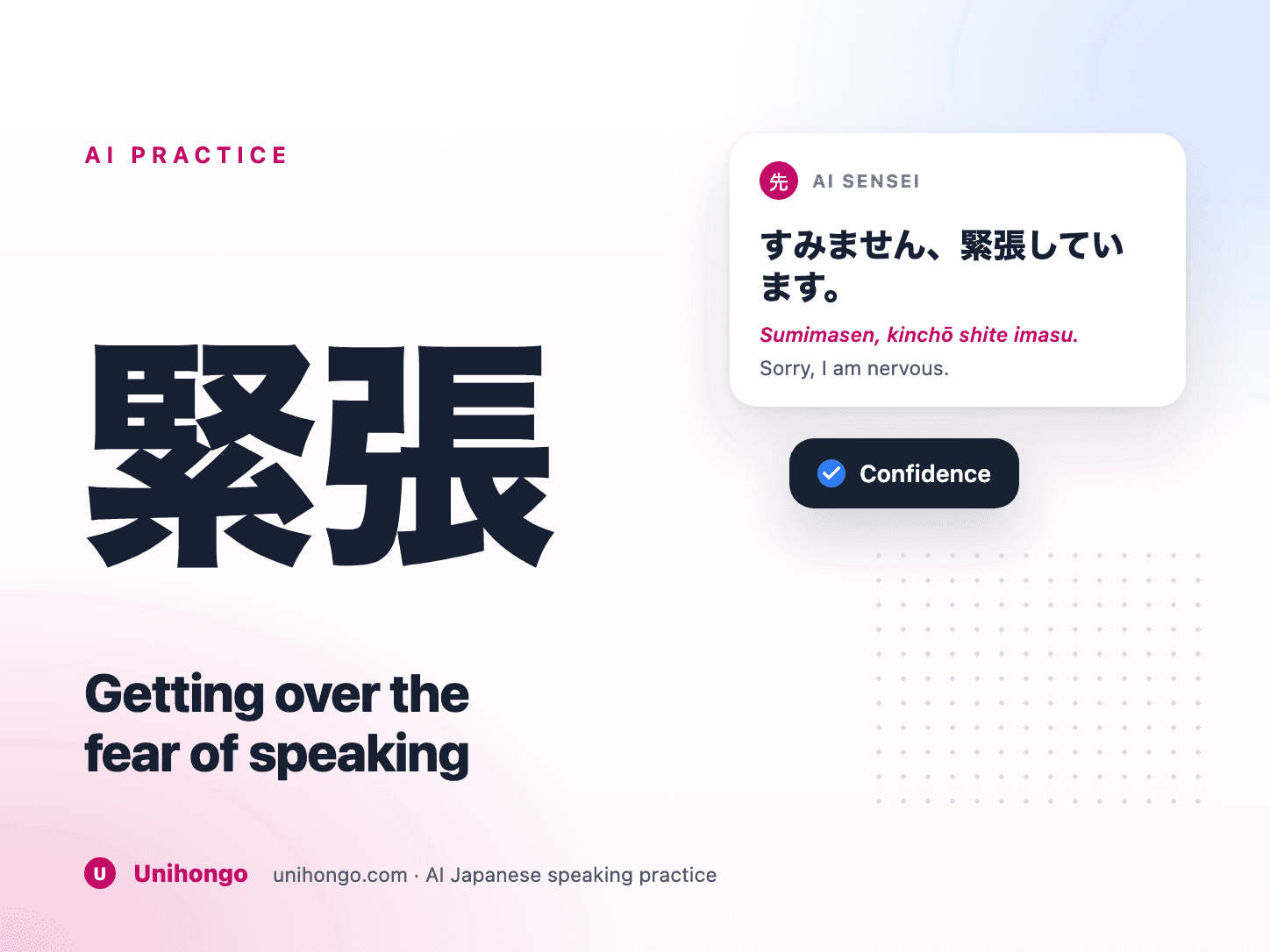
| すみません、緊張しています。 | Sumimasen, kinchō shite imasu. | Sorry, I am nervous. |
| 言葉が出てこなくて。 | Kotoba ga dete konakute. | The words are not coming out. |
| 日本語で何と言いますか。 | Nihongo de nan to iimasu ka. | How do you say it in Japanese? |
| 英語でもいいですか。 | Eigo de mo ii desu ka. | Is English all right too? |
| もう少し考えます。 | Mō sukoshi kangaemasu. | Let me think a little more. |
| すみません、最初からいいですか。 | Sumimasen, saisho kara ii desu ka. | Sorry, may I start again? |
What changes over time
The reliable pattern is that the anxiety does not vanish; the situations that trigger it move upward. What was terrifying in month one becomes unremarkable by month six, and the fear relocates to harder settings.
That is what progress looks like here, and recognising it prevents a common discouragement: feeling nervous before a meeting and concluding that nothing has improved, when a year earlier the same person could not order lunch.
Track the situations rather than the feeling. The list of things you now do without thinking is the real measure.
Nobody becomes a person who never hesitates. People become persons who hesitate and speak anyway, and that is entirely learnable.