
Define the destination before asking about the platform
Tell Mocchi the fictional destination and what information you need. Asking where a platform is and asking which platform serves a destination are different questions. Decide which gap you are trying to fill before choosing the sentence.
Use a small task rather than an entire journey. You might practise one destination, one platform answer and one confirmation. This gives the session a clear result and lets you identify the part that needs further work.
| Japanese | Romaji | Meaning |
|---|---|---|
| 何番線ですか。 | Nanbansen desu ka. | Which platform is it? |
Connect station words with the signs where they appear
Use /kanji or /vocab to study the words relevant to the exercise. Check complete-word readings, such as 出口 for an exit, and ask how the word functions in a short example. Do not assume that knowing one character’s reading settles the pronunciation of every station word.
Save a few useful items for flashcard review if they support your travel goals. Keep each card’s target clear. The purpose is to recognize and retrieve information you can use, not to create a large station deck before attempting the question.
| Japanese | Romaji | Meaning |
|---|---|---|
| 出口 | Deguchi | Exit |
| 改札 | Kaisatsu | Ticket gate |
Practise platform numbers as spoken information
Ask Mocchi for a short /quiz that changes the platform number. Read or hear the expression, identify the number and explain which part of the answer carries the information. If a pronunciation is unfamiliar, inspect the complete expression before trying it again.
Then remove the visible answer and practise a confirmation. A number can feel familiar when printed but still be difficult during an exchange. This small check helps you decide whether the next task should focus on reading, listening or producing the response.
Ask and confirm in AI Sensei conversation
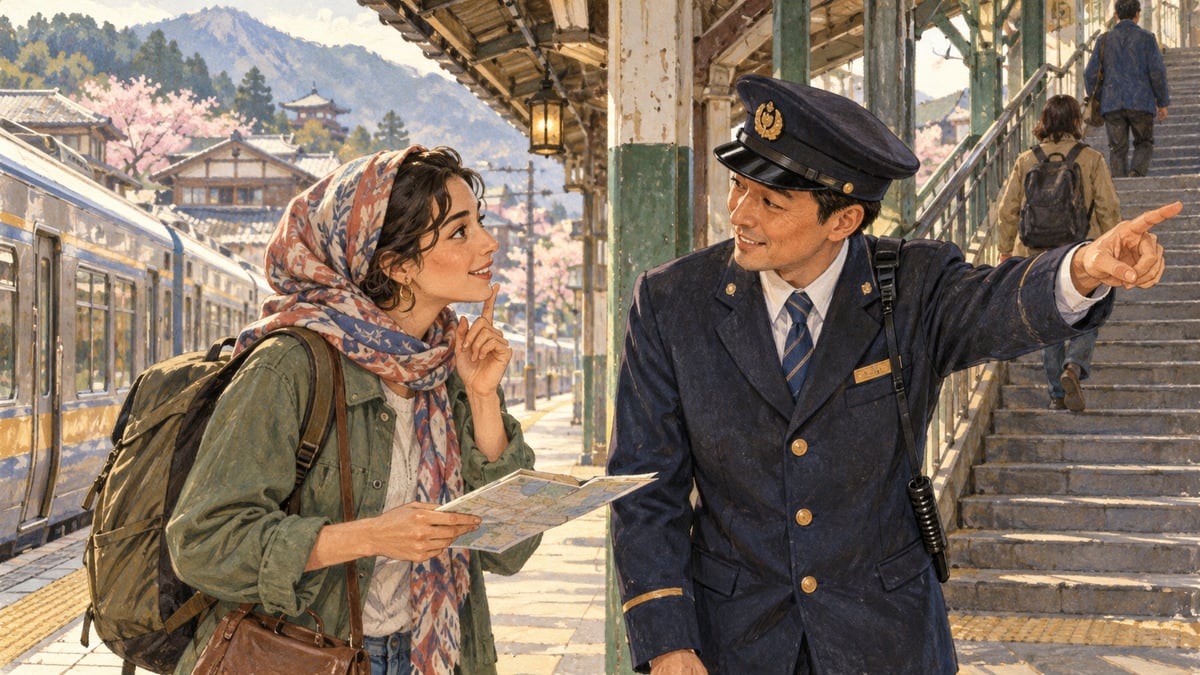
Use /kaiwa to prepare a suitable station or travel topic in AI Sensei. Ask the question, listen to the reply and repeat the important number as a check. Keep the original answer hidden so you are responding to what you heard.
If you are unsure, ask for repetition rather than continuing on an assumed answer. A short clarification keeps the exchange connected with the information you need. The conversation is complete when you can show what you understood and ask about the remaining uncertainty.
| Japanese | Romaji | Meaning |
|---|---|---|
| 三番線ですね。 | Sanbansen desu ne. | Platform three, right? |
| 三番線はどこですか。 | Sanbansen wa doko desu ka. | Where is platform three? |
Review the exact point where information was lost
After the exercise, identify whether the destination, platform number or direction caused the difficulty. Ask Mocchi about that specific example. If you confused two written words, compare them. If you missed the number, use a focused listening-and-confirmation task.
A useful review does not need to repeat the entire station lesson. /review can revisit a recorded weak point, while a small quiz can test one distinction with new details. Let the result of the conversation choose the supporting activity.
Transfer the routine to a new station question
Try a different fictional platform or ask about an exit after confirming the first answer. Keep the information gap clear and change the details enough that you cannot simply recite the previous exchange.
This is how connected tools support a practical situation. Kanji and vocabulary help with written information, quizzes check the distinction, and AI Sensei adds listening and response. Mocchi can keep those activities related to your goal rather than treating them as separate travel exercises.