

What Pingo AI is designed for
Pingo AI (pingo.ai) is a language learning app that its site offers on the App Store and Google Play. The site describes the core activity as learning a language by talking, through real conversations. The topics it names are everyday moments, upcoming trips, interviews and hobbies, with examples such as talking about your day and asking for directions. The site says the app teaches more than 25 languages and offers instruction in more than 15 native languages.
Three ideas appear repeatedly on the site. The first is a learning plan: you tell Pingo your goals and level, and it builds a plan around them. The second is correction during speech, described as being corrected in the moment while talking. The third is progression by level. Beginners have short interactive conversations, low-intermediate and intermediate learners have conversational roleplay, and advanced speakers have fast-paced roleplays, debates and professional scenarios.
The site also says Pingo remembers your level, mistakes, words and goals, so each session builds on the last. It describes a free trial and a paid plan called Pingo Pro. We do not quote its price here. See pingo.ai for current information.
How Pingo AI handles Japanese
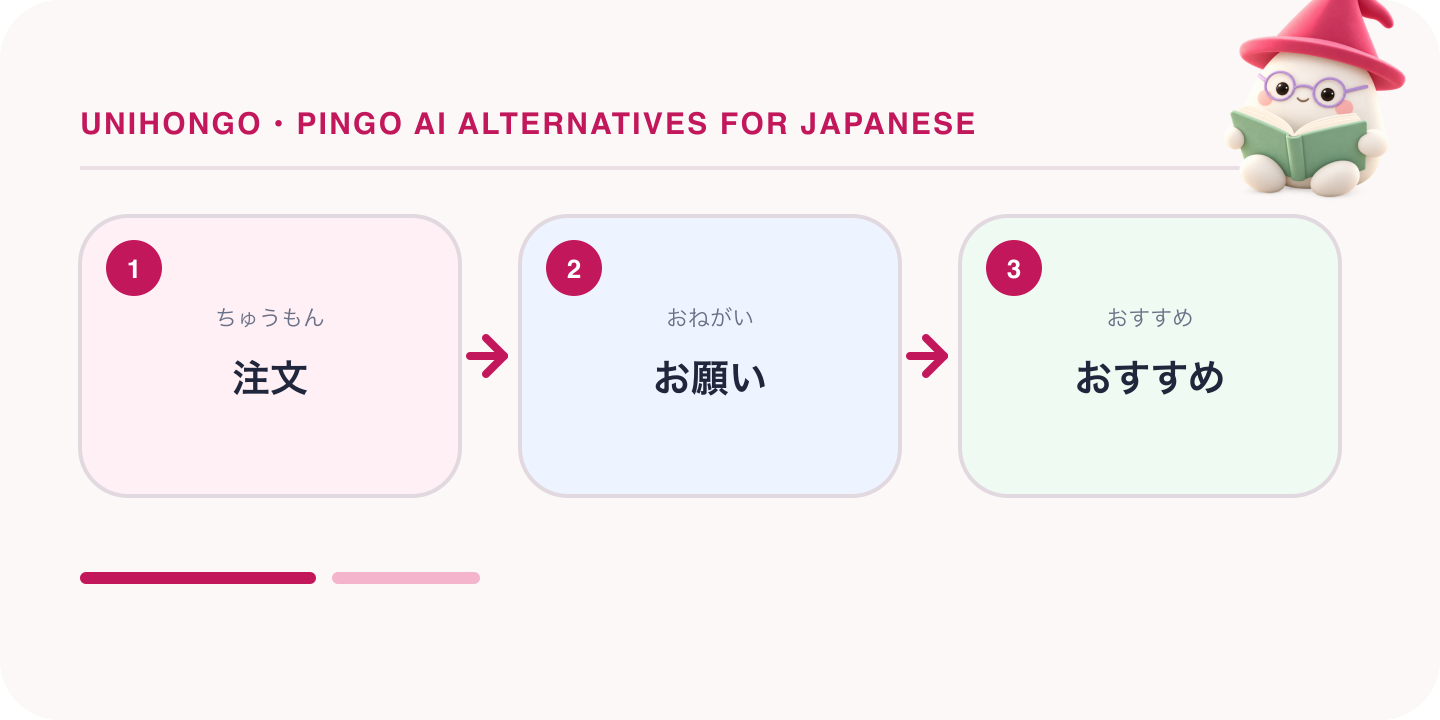
Pingo AI has a dedicated Japanese page, and it is specific about content. Beginners start with hiragana, katakana, basic greetings, numbers and the polite forms desu and masu. The roleplay examples are Japanese situations: ordering at an izakaya, asking for directions at a station, and chatting at a hanami picnic.
The feedback described on that page is also specific to Japanese. It names pronunciation, the particles wa, ga and o, and sentence structure. For advanced learners it names intonation, kanji choice and natural phrasing, together with keigo, business Japanese and storytelling. The page says Pingo adapts to your pace.
Who Pingo AI suits
Based on its own description, Pingo AI fits several kinds of learner well. If you recognise yourself in this list, you may not need an alternative at all.
- You practise mostly on a phone and want an app from the App Store or Google Play.
- You want the app to build a plan from your goals, so you do not choose each topic yourself.
- You study Japanese together with another language and want one app for both.
- Your first language is not English and you want instruction in your own language, if the app supports it.
- You want corrections while you talk, and an app that remembers your earlier mistakes.
Learners look for alternatives for ordinary reasons. Some want a tool made only for Japanese. Some want to practise on a computer. Some want a written report to study later, and some need grammar and kanji study, which is a different activity from conversation. The four alternatives below answer those four needs.
Unihongo: when you want a Japanese lesson, not a call
Unihongo (unihongo.com) is an AI Japanese tutor built for speaking practice, and Japanese is the only language it teaches. You talk by voice with an AI Sensei in an immersive 3D classroom. Most AI tutors present a chat screen or a voice call screen, so the classroom is the visible difference. You can choose among 8 teacher personalities, for example gentle, strict, funny or relaxed, and among 90 conversation topics across daily life, travel, work, culture and creative challenges.
Roleplay missions are graded by level and include cafes, convenience stores, hotels, clinics, job interviews and workplace calls. The AI plays the clerk, doctor or interviewer and stays in character. Pronunciation practice gives line-by-line scoring and coaching. AI session reports list corrections after a conversation, and a Review history stores recent sessions.
Several parts are free without an account: the Game Arcade at unihongo.com/games, Kana Dash for hiragana and katakana at unihongo.com/alphabet, and a kanji library of all 2,136 joyo kanji at unihongo.com/kanji. The Free plan needs only a free account. It includes 3 minutes of live conversation with the AI Sensei a day, 2 roleplay missions a day, 5 scored pronunciation lines a day and 2 AI session reports a day, and it keeps the 10 most recent sessions in Review. Three minutes is short. It suits a short daily speaking habit, not hour-long sessions, so plan one clear goal for each conversation. A second limit is important in this comparison: Unihongo runs in the browser, its Android app is in early access, and its iOS app is pending. A learner who needs a released phone app today should consider that.
Nora: when you want personas and stories
Nora (hellonora.ai) is an AI language tutor that lists eight languages, including Japanese. Its site describes AI-powered conversations, a real-time voice call mode, real-time feedback and pronunciation coaching as you speak. Learners talk with personas, and the Japanese page names three of them, Yuki, Kenji and Sakura, with an option to create your own. The site's FAQ describes Nora as built web-first: it runs in modern browsers, including mobile browsers on iPhone and Android.
For Japanese, the page describes transcripts with romaji and furigana, a built-in dictionary for word lookup, a vocabulary bank, and conversation that adapts from casual chat to keigo. A feature called Journeys is described as interactive stories in which your choices shape the story. Nora may suit a learner who is motivated by characters and narrative and who wants reading support on every line. The site offers a free trial. See hellonora.ai for current terms.
Langua: when you want reports and flashcards from conversation
Langua, from LanguaTalk (languatalk.com), is described on its site as an AI language coach, and Japanese is among its languages. It works on web, iOS and Android. The site emphasises human-like AI voices cloned from real native speakers and a large set of conversation topics, including roleplays, debates and chats based on your interests.
The site also describes several correction styles, written or verbal and subtle or explicit, with detailed feedback reports after each conversation. Words and phrases can be saved during a conversation and reviewed as spaced repetition flashcards, and transcripts allow you to translate any word. A call mode supports hands-free practice. Langua may suit a learner who wants conversation and vocabulary review in one product. See languatalk.com for current plans.
Kanshudo: when the need is grammar and kanji
Kanshudo (kanshudo.com) is a different kind of tool, and it belongs in this article for that reason. It is a study site for the Japanese language itself. Its site describes a large reference of kanji, words, grammar points and example sentences, with mnemonics for thousands of kanji. Study methods listed on the site include formal lessons, self study, games, quizzes, challenges and reading, with spaced repetition flashcards that track progress automatically. It also lists AI features named AI TeachMe and AI Sentence Correct.
The site says Kanshudo teaches all levels from absolute beginner to expert. It says Kanshudo can be used for free with a login, with monthly caps on some features, and that Pro access unlocks unlimited use. If the reason you are looking beyond a speaking app is that you cannot read, or that grammar explanations during conversation are too short for you, a study tool like Kanshudo answers that need better than another speaking app would. Many learners use one of each.
Pingo AI and the alternatives side by side
This table records only what each product's public site states as of September 2026. Where a cell says see their site, check that product's own pages for the current answer.
| Product | Designed for | Practice format | Feedback and review | Where it runs |
|---|---|---|---|---|
| Pingo AI | Spoken conversation in 25+ languages, with a plan built from your goals | Short interactive conversations and roleplay with an AI tutor | Corrections while talking, feedback on pronunciation and particles, transcripts | App Store and Google Play |
| Unihongo | Japanese speaking practice only | Voice conversation with an AI Sensei in a 3D classroom, roleplay missions graded by level | Line-by-line pronunciation scoring, session reports, Review history, free games | Browser. Android in early access, iOS pending |
| Nora | Conversation practice in eight languages | AI conversations with personas, voice call mode, Journeys stories | Real-time feedback, pronunciation coaching, romaji and furigana transcripts, vocabulary bank | Modern web browsers, including mobile browsers |
| Langua | AI language coach for many languages | Conversations, roleplays and debates with native-like voices, call mode | Choice of correction styles, feedback reports, flashcards from conversations | Web, iOS and Android |
| Kanshudo | Kanji, vocabulary, grammar and reading study | Lessons, quizzes, games and flashcards | Spaced repetition with automatic progress tracking, AI sentence correction | See their site |
The first four rows are speaking tools with different shapes. The last row is a study tool. Comparing them on one scale would be misleading, so use the table to find the row that matches your need.
A roleplay script to try in any app
Pingo AI's Japanese page mentions ordering at an izakaya and asking for directions at a station. Those are good tests for any tutor, because they are short and have a clear goal. Say the lines below in order and let the AI answer between them. The last sentence is a particle check: it uses wa, ga and o in one sentence, so you can see whether the app notices a particle mistake.
| Japanese | Romaji | Meaning |
|---|---|---|
| すみません、注文をお願いします。 | Sumimasen, chūmon o onegaishimasu. | Excuse me, I would like to order. |
| おすすめは何ですか。 | Osusume wa nan desu ka. | What do you recommend? |
| お会計をお願いします。 | Okaikei o onegaishimasu. | The bill, please. |
| 新宿駅へはどう行けばいいですか。 | Shinjuku-eki e wa dō ikeba ii desu ka. | How do I get to Shinjuku Station? |
| この電車は渋谷に止まりますか。 | Kono densha wa Shibuya ni tomarimasu ka. | Does this train stop at Shibuya? |
| 私は魚が好きですが、今日は肉を食べます。 | Watashi wa sakana ga suki desu ga, kyō wa niku o tabemasu. | I like fish, but today I will eat meat. |
Repeat the script the next day with changed details: a different station, a different dish. If the second attempt is faster, the practice is working, whichever app you chose.
Limits to keep in mind
No product here covers all of Japanese. Unihongo is a speaking tutor. It is not a structured reading course or a kanji SRS course, and it does not replace JLPT reading practice. The JLPT has no speaking section, so exam preparation needs reading and listening material in addition to any speaking app. An AI tutor also cannot replace a human teacher's judgement about culture and about what is appropriate with a particular person.
This comparison reflects public websites as of September 2026. Features, platforms and plans change, and a feature we could not confirm may exist. Check each product's own site before you decide, and use free trials or free plans to test the same short script in each one.