
Two exchange apps, one idea
Both HelloTalk and Tandem connect you with native speakers who want to learn your language. You message, exchange voice notes, correct each other and, when it clicks, call. Both have large Japanese communities because many Japanese learners want English practice, which is good news if English is your language and slightly less good if it is not: say so in your profile, and you will still find partners who want to practise your language or simply like talking to foreigners in Japanese.
The right question is not which app is better but how to be a partner people keep. That comes down to etiquette, scheduling and fairness, and to having the Japanese to handle all three.
| Japanese | Romaji | Meaning |
|---|---|---|
| 一緒に練習しませんか | Issho ni renshū shimasen ka | Shall we practise together? |
| 言語交換の相手を探しています。 | Gengo kōkan no aite o sagashite imasu. | I'm looking for a language exchange partner. |
| 日本語で話す友達がほしいです。 | Nihongo de hanasu tomodachi ga hoshii desu. | I'd like a friend to speak Japanese with. |
Opening and keeping an exchange going
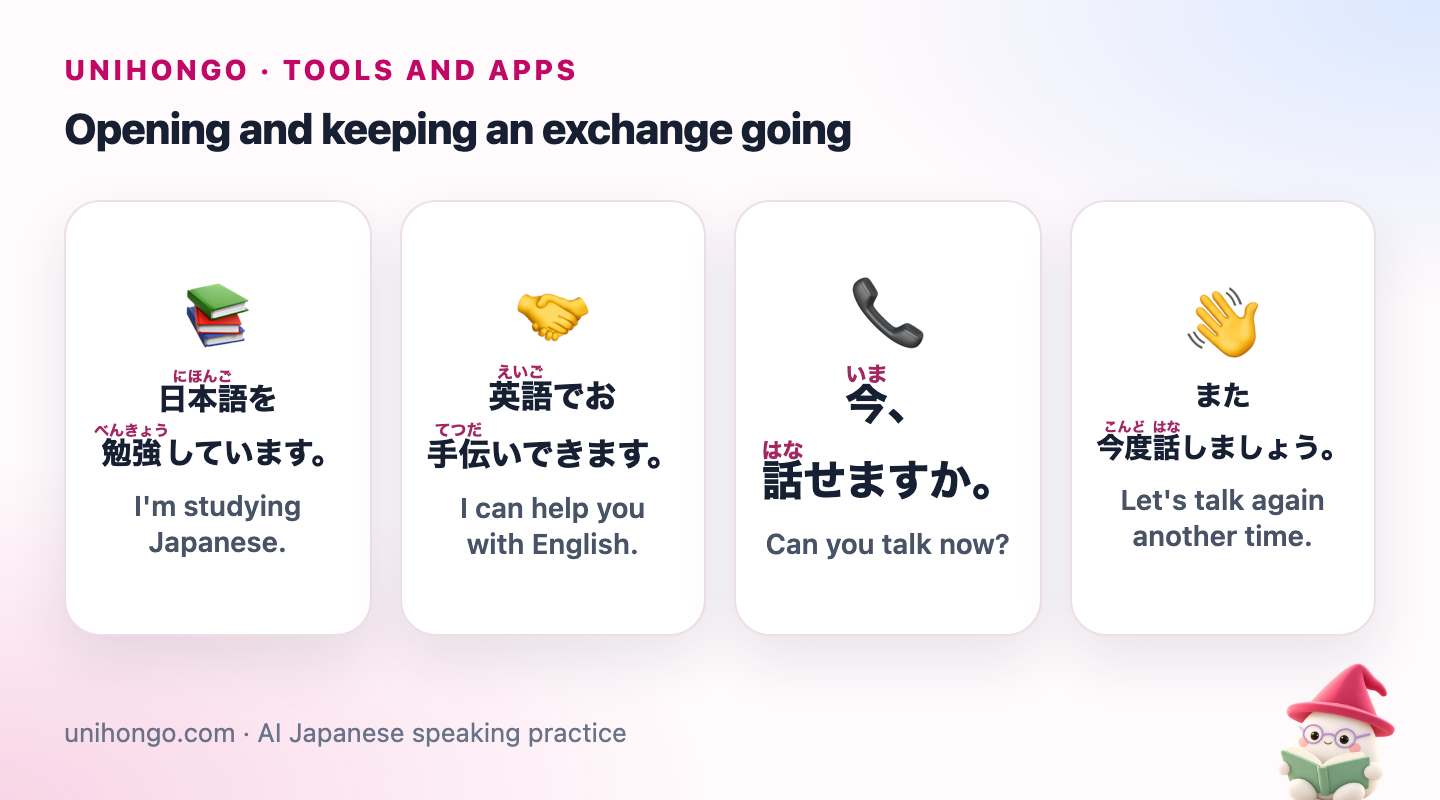
The first message decides whether you get a reply. Keep it short, polite and specific: what you study, what you can offer, when you can talk. The four cards are the skeleton of a first message and of every follow-up: what you are doing, what you offer, the live question, the kind goodbye.
| Japanese | Romaji | Meaning |
|---|---|---|
| 日本語を勉強しています。 | Nihongo o benkyō shite imasu. | I'm studying Japanese. |
| 英語でお手伝いできます。 | Eigo de otetsudai dekimasu. | I can help you with English. |
| 今、話せますか。 | Ima, hanasemasu ka. | Can you talk now? |
| また今度話しましょう。 | Mata kondo hanashimashō. | Let's talk again another time. |
| 初めまして。マリアです。スペインに住んでいます。 | Hajimemashite. Maria desu. Supein ni sunde imasu. | Nice to meet you. I'm Maria. I live in Spain. |
| 日本語を一年勉強しています。 | Nihongo o ichinen benkyō shite imasu. | I have been studying Japanese for a year. |
| よかったら、一緒に練習しませんか。 | Yokattara, issho ni renshū shimasen ka. | If you like, shall we practise together? |
Exchange etiquette: the English-for-Japanese trade
The silent killer of exchanges is an unspoken imbalance. One partner's language is more comfortable for both, so every call drifts into it. Usually that language is English. The fix is to make the split explicit and timed: fifteen minutes in Japanese, fifteen in English, and someone says when to switch. Agreeing this in Japanese is itself good practice.
Correction etiquette matters too. Ask how much correction your partner wants and tell them how much you want. In Japanese culture, correcting a friend's speech uninvited can feel harsh, so many partners will not correct you unless you ask clearly. Ask clearly.
| Japanese | Romaji | Meaning |
|---|---|---|
| 最初の十五分は日本語で話しましょう。 | Saisho no jūgofun wa Nihongo de hanashimashō. | Let's speak Japanese for the first fifteen minutes. |
| 今から英語に変えましょうか。 | Ima kara eigo ni kaemashō ka. | Shall we switch to English now? |
| 直してもらえますか。 | Naoshite moraemasu ka. | Could you correct me? |
| 遠慮なく直してください。 | Enryo naku naoshite kudasai. | Please correct me freely. |
| こう言うと、もっと自然ですよ。 | Kō iu to, motto shizen desu yo. | If you say it like this, it's more natural. |
| 今日もありがとう。 | Kyō mo arigatō. | Thanks again for today. (casual) |
| Habit | Why it helps | What to say |
|---|---|---|
| Agree a timed split | Stops drift into the easier language | Saisho no jūgofun wa Nihongo de hanashimashō |
| Ask for corrections explicitly | Partners hold back out of politeness | Enryo naku naoshite kudasai |
| Correct gently and when asked | Keeps the exchange friendly | Kō iu to motto shizen desu yo |
| Thank at the end | Signals you value their time | Kyō mo arigatō |
Time zones and keeping it alive
Japan is far ahead of Europe and the Americas, so one of you is always tired. Say times in Japan time to avoid confusion, offer two options, and be forgiving about slow replies because you will need the same forgiveness. The sentences below handle proposing, confirming and apologising, which are most of what scheduling requires.
| Japanese | Romaji | Meaning |
|---|---|---|
| 日本時間の夜九時はどうですか。 | Nihon jikan no yoru kuji wa dō desu ka. | How about nine in the evening, Japan time? |
| 週末なら大丈夫です。 | Shūmatsu nara daijōbu desu. | The weekend works for me. |
| 土曜日か日曜日、どちらがいいですか。 | Doyōbi ka nichiyōbi, dochira ga ii desu ka. | Saturday or Sunday, which is better? |
| 返事が遅くなってすみません。 | Henji ga osoku natte sumimasen. | Sorry for the slow reply. |
| ごめん、今日は無理になった。 | Gomen, kyō wa muri ni natta. | Sorry, today has become impossible. (casual) |
| 来週、また話そう。 | Raishū, mata hanasō. | Let's talk again next week. (casual) |
Note the shift to casual forms in the last two lines. Exchange partners usually move to casual speech after the first call or two; follow their lead rather than announcing it.
When an AI partner complements exchange partners
Exchange gives you what no software can: a real person with a real life, who laughs at the right moment and tells you how things are at their office. It also has three built-in limits. Partners sleep when you are awake. Partners get bored if you ask to rerun the same convenience store scene five times. And partners are friends, so you may hold back from asking for the tenth correction. None of that is a flaw in the people; it is the shape of a friendship.
An AI conversation partner takes exactly those hours and those repetitions. Unihongo's AI Sensei, for example, is a voice partner in an immersive 3D classroom that is awake at any hour, will play the same clerk or coworker as many times as you want, and gives corrections during the conversation plus a session report afterwards. It is Japanese-only, so it is not for the English half of your exchange. A sensible pattern is to rehearse the week's topics with the AI partner, then bring the polished version to your human partner and talk about something that matters to both of you.
| Japanese | Romaji | Meaning |
|---|---|---|
| 練習してから、本番で話します。 | Renshū shite kara, honban de hanashimasu. | I practise first, then speak for real. |
| 同じ場面を何回も練習したいです。 | Onaji bamen o nankai mo renshū shitai desu. | I want to practise the same scene many times. |
| 夜中でも練習できます。 | Yonaka demo renshū dekimasu. | I can practise even in the middle of the night. |
Mini dialogue: a first voice call
Here is a first call between a learner and a Japanese partner, in which they greet each other, agree the language split and set a rhythm. Both begin politely, as new acquaintances do; the partner softens towards the end, which is the signal to relax.

| Japanese | Romaji | Meaning |
|---|---|---|
| もしもし、聞こえますか。 | Moshimoshi, kikoemasu ka. | You: Hello, can you hear me? |
| はい、聞こえます。初めまして、健太です。 | Hai, kikoemasu. Hajimemashite, Kenta desu. | Partner: Yes, I can. Nice to meet you, I'm Kenta. |
| 初めまして、サラです。今日はありがとうございます。 | Hajimemashite, Sara desu. Kyō wa arigatō gozaimasu. | You: Nice to meet you, I'm Sara. Thank you for today. |
| こちらこそ。どうやって進めましょうか。 | Kochira koso. Dō yatte susumemashō ka. | Partner: Likewise. How shall we go about it? |
| 最初の十五分は日本語で、その後は英語でどうですか。 | Saisho no jūgofun wa Nihongo de, sono ato wa eigo de dō desu ka. | You: How about Japanese for the first fifteen minutes, then English? |
| いいですね。じゃあ、日本語からいきましょう。 | Ii desu ne. Jā, Nihongo kara ikimashō. | Partner: Sounds good. Then let's start with Japanese. |
| 間違えたら、遠慮なく直してください。 | Machigaetara, enryo naku naoshite kudasai. | You: If I make a mistake, please correct me freely. |
| 了解。サラさんも、僕の英語、直してね。 | Ryōkai. Sara-san mo, boku no eigo, naoshite ne. | Partner: Got it. And you correct my English too, okay? (casual) |
Mistakes that end exchanges early
| Japanese | Romaji | Meaning |
|---|---|---|
| 日本語の時間です。 | Nihongo no jikan desu. | It's Japanese time. |
| しばらく忙しくなります。 | Shibaraku isogashiku narimasu. | I'll be busy for a while. |
| 十分だけ、電話で話しませんか。 | Juppun dake, denwa de hanashimasen ka. | Shall we talk on the phone, just for ten minutes? |
- Treating the partner as a free tutor. Asking question after question about grammar without giving anything back drains the exchange. Give as much as you take, and keep grammar questions for a tutor or an AI partner.
- Letting every call drift into English. Agree the split, set a timer, and be the one who says Nihongo no jikan desu, it's Japanese time.
- Sending long voice notes and expecting detailed corrections. Short notes, one or two sentences, get corrected; long ones get a thumbs up.
- Disappearing without a word. If you need to stop, say so: shibaraku isogashiku narimasu, I'll be busy for a while. Partners remember that, and they remember silence too.
- Never meeting by voice. Chat is comfortable, but speaking is the goal. Propose a short call early, even ten minutes.