
Why you freeze: recognition is not retrieval
A spaced-repetition review is a recognition task with a cue. The kanji is on the screen; your job is to recall its reading and meaning. Thousands of these build a fast, accurate recognition network, which is why you can read a menu or a news headline. Speaking has no cue. Someone asks what you did yesterday, and you must find the word for went, choose the past form, attach the place with the right particle and say it, in about a second, while they look at you. That is retrieval from meaning to sound, and no amount of recognition practice builds it directly.
There is good news in this. Your knowledge is real, and once the retrieval direction is practised, it comes online quickly. Kanji-strong learners who start speaking commonly progress faster than beginners, because every word they retrieve is one they already know how to read and pronounce. The plan below is designed for that profile.
| Japanese | Romaji | Meaning |
|---|---|---|
| 知っている言葉で話そう | Shitte iru kotoba de hanasō | Let's speak with the words we know (casual) |
| 漢字は読めますが、話すのは苦手です。 | Kanji wa yomemasu ga, hanasu no wa nigate desu. | I can read kanji, but speaking is my weak point. |
| 言葉が出てきません。 | Kotoba ga dete kimasen. | The words won't come out. |
| 頭の中では分かっています。 | Atama no naka dewa wakatte imasu. | In my head, I understand it. |
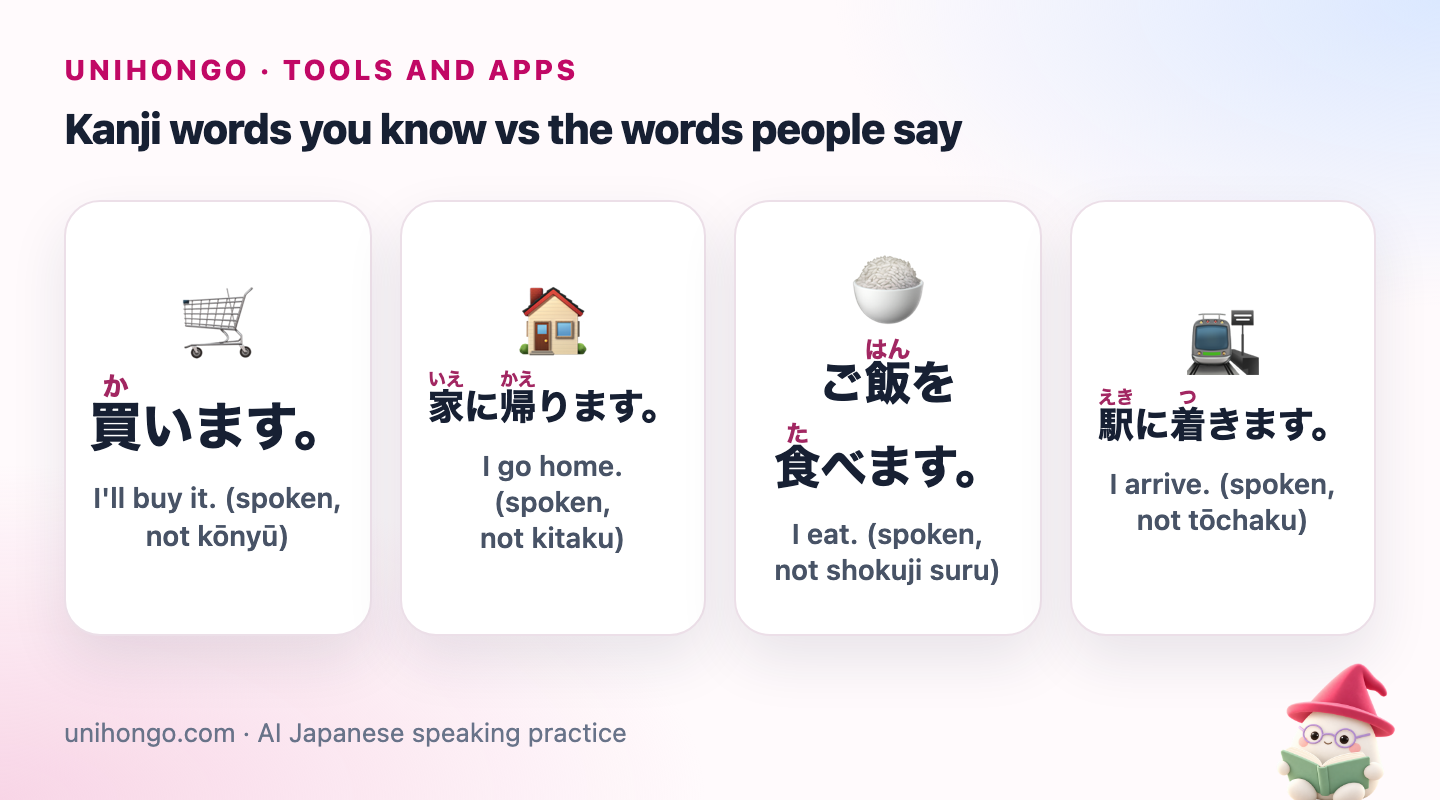
Kanji words you know vs the words people say
Here is a trap specific to kanji-first learners. Reviews are full of two-kanji compounds, because that is what written Japanese uses: kōnyū (purchase), kitaku (returning home), shokuji (a meal), tōchaku (arrival). All correct, all common in writing and formal speech, and all slightly odd when a friend asks what you did and you answer in them. Everyday speech prefers plain verbs: kau, ie ni kaeru, gohan o taberu, tsuku. The cards show the spoken versions; the compounds in brackets are the ones you probably know from reviews.
| Japanese | Romaji | Meaning |
|---|---|---|
| 買います。 | Kaimasu. | I'll buy it. (spoken, not kōnyū) |
| 家に帰ります。 | Ie ni kaerimasu. | I go home. (spoken, not kitaku) |
| ご飯を食べます。 | Gohan o tabemasu. | I eat. (spoken, not shokuji suru) |
| 駅に着きます。 | Eki ni tsukimasu. | I arrive. (spoken, not tōchaku) |
| 昨日、新しい靴を買いました。 | Kinō, atarashii kutsu o kaimashita. | Yesterday I bought new shoes. |
| 仕事の後、すぐ家に帰りました。 | Shigoto no ato, sugu ie ni kaerimashita. | After work I went straight home. |
| Written or formal (you know it) | Spoken (say this) | Where the formal one is fine |
|---|---|---|
| kōnyū suru | kau | Shop notices, receipts, business talk |
| kitaku suru | ie ni kaeru | Announcements, formal messages |
| shokuji suru | gohan o taberu | Invitations, restaurants, polite contexts |
| tōchaku suru | tsuku | Train and flight announcements |
| shiyō suru | tsukau | Instructions, manuals |
Retrieval-first: speak before you check
The core drill reverses the direction of a review. Instead of seeing a word and recalling its meaning, you hear or think a meaning and produce the word aloud, then check. Three versions, from easy to hard: say a sentence for each word in today's reviews; answer simple questions about your day; describe what is around you. In each case, speak first and check second. Being wrong aloud and then fixing it is the exercise, and your reviews will then confirm what you already fixed.
Here is a question set for the second version. Cover the answers, speak, then compare.
| Japanese | Romaji | Meaning |
|---|---|---|
| 今日は何をしましたか。 | Kyō wa nani o shimashita ka. | Q: What did you do today? |
| 仕事の後で、スーパーに行きました。 | Shigoto no ato de, sūpā ni ikimashita. | A: After work I went to the supermarket. |
| 何を買いましたか。 | Nani o kaimashita ka. | Q: What did you buy? |
| 野菜と牛乳を買いました。 | Yasai to gyūnyū o kaimashita. | A: I bought vegetables and milk. |
| それから、どうしましたか。 | Sorekara, dō shimashita ka. | Q: And then what did you do? |
| 家に帰って、晩ご飯を作りました。 | Ie ni kaette, bangohan o tsukurimashita. | A: I went home and made dinner. |
Grammar from reviews into your mouth: one point a day
Grammar reviews give you a point, a meaning and example sentences, and ask you to fill a blank. To speak, take one point per day and give it a question that calls for it, then answer aloud with your own content. Below are four N4 to N3 points as spoken sentences about this very problem, which is a good way to make them memorable.
| Japanese | Romaji | Meaning |
|---|---|---|
| 毎日話すようにしています。 | Mainichi hanasu yō ni shite imasu. | I make a point of speaking every day. |
| 読めるのに、話せません。 | Yomeru no ni, hanasemasen. | Even though I can read, I can't speak. |
| 話せば話すほど、楽になります。 | Hanaseba hanasu hodo, raku ni narimasu. | The more I speak, the easier it gets. |
| 間違えても気にしないことにします。 | Machigaete mo ki ni shinai koto ni shimasu. | I'll decide not to worry about mistakes. |
| 復習ばかりしていました。 | Fukushū bakari shite imashita. | I was doing nothing but reviews. |
Each of these points probably has a card in your queue. The sentence you just said aloud is now the example you will remember, instead of the one on the card.
Mini dialogue: a kanji-strong learner at an izakaya
An izakaya is a good first speaking scene for readers: you can read the menu, the exchanges are short, and the staff are used to repeating themselves. Here the learner orders, asks what a dish is, and reacts. Notice the plain spoken verbs and the small reaction words; both are what readers tend to lack. The staff use polite shop language; the learner stays polite too.

| Japanese | Romaji | Meaning |
|---|---|---|
| ご注文はお決まりですか。 | Gochūmon wa okimari desu ka. | Staff: Have you decided on your order? |
| はい。生ビールを一つと、枝豆をお願いします。 | Hai. Nama bīru o hitotsu to, edamame o onegai shimasu. | You: Yes. One draught beer and edamame, please. |
| かしこまりました。 | Kashikomarimashita. | Staff: Certainly. |
| すみません、これは何ですか。 | Sumimasen, kore wa nan desu ka. | You: Excuse me, what is this? |
| 鶏の唐揚げです。人気ですよ。 | Tori no karaage desu. Ninki desu yo. | Staff: It's fried chicken. It's popular. |
| へえ、おいしそうですね。それもお願いします。 | Hē, oishisō desu ne. Sore mo onegai shimasu. | You: Oh, that sounds good. I'll have that too. |
| はい、ありがとうございます。 | Hai, arigatō gozaimasu. | Staff: Yes, thank you. |
Kore wa nan desu ka is the sentence that turns a reader into a speaker: you can read karaage, but asking about it out loud and reacting to the answer is conversation. Use it even when you know the answer.
Mistakes kanji-strong learners make when they start speaking
| Japanese | Romaji | Meaning |
|---|---|---|
| でも、時間がなかったんです。 | Demo, jikan ga nakattan desu. | But I didn't have time, you see. |
| だから、今日は早く来ました。 | Dakara, kyō wa hayaku kimashita. | So I came early today. |
| なるほど。 | Naruhodo. | I see what you mean. |
| そうなんですか。 | Sō nan desu ka. | Oh, is that so? |
- Speaking in written Japanese. Shikashi (however) and sono tame (therefore) are fine in essays; in speech people say demo and dakara. The same goes for the compounds in the table above.
- Building long, correct sentences slowly. Listeners prefer three short sentences now to one perfect sentence in twelve seconds.
- Forgetting aizuchi. Readers rarely practise the small sounds, hai, ē, sō desu ne, naruhodo, that tell the speaker you are following. Without them, Japanese speakers slow down or switch to English.
- Saying the on-reading when the kun-reading is the word. You know 食 as shoku, but the verb is taberu. In speech, verbs and adjectives nearly always use kun readings.
- Waiting to be ready. There is no review level at which speaking becomes easy. It becomes easy by speaking.
A six-week retrieval plan
Keep your daily reviews exactly as they are. The plan adds ten to fifteen minutes of speaking and changes nothing else. Measure at the start and end with the same two-minute recording about your week.
| Japanese | Romaji | Meaning |
|---|---|---|
| 復習は続けます。それに、毎日話します。 | Fukushū wa tsuzukemasu. Sore ni, mainichi hanashimasu. | I'll keep the reviews. And I'll speak every day. |
| 六週間後に、もう一度録音します。 | Rokushūkan go ni, mō ichido rokuon shimasu. | In six weeks I'll record myself once more. |
| Weeks | Daily speaking | Goal |
|---|---|---|
| 1 to 2 | Say a sentence for ten review words; answer five questions about your day aloud | Words arrive in under five seconds |
| 3 to 4 | One grammar point a day as five spoken answers; one short roleplay with a partner who replies | Forms arrive without the card |
| 5 | Two roleplays a day in predictable scenes: ordering, greeting, small talk | The first three seconds stop freezing |
| 6 | A five-minute free conversation on three days; record one | Compare with the week-one recording |