
Help Mocchi Turn Recurring Japanese Mistakes Into Review

A recurring Japanese mistake becomes a useful review target when you record why the choice was wrong. Tell Mocchi which clue you missed and ask it to revisit that decision in a fresh context, rather than simply repeating the corrected sentence.

Mocchi links a learner's original answer to a missed Japanese clue and a new review question
What you need to know

Help Mocchi Turn Recurring Japanese Mistakes Into Review

A list of wrong answers is easy to accumulate and difficult to learn from. Some errors come from vocabulary you did not know; others come from a grammar distinction, a misread question, or a correct idea expressed with the wrong form. These need different follow-up activities. Use Mocchi's review support to connect a mistake to a short explanation and another attempt. The aim is to recognize the relevant clue when the surface details change.

Keep the original question and your first answer.

Name the clue that should have guided the choice.

Separate an unknown word from a grammar error.

Review with a new context before claiming improvement.

Save enough context to understand the error later

A useful mistake record contains the prompt, your answer, a corrected answer, and the reason for the difference. Without the prompt, a correction can look arbitrary. Without your first answer, you lose the chance to understand the reasoning that led you astray. Keep the record short enough to revisit, but preserve the part of the situation that makes one form appropriate.

For example, 'I missed a particle question' is too broad to guide a lesson. 'I used に for an action happening at a place' identifies a specific decision. Ask Mocchi to explain that distinction and to show a destination example separately so you can see when the other option is actually useful.

A correction should reveal the deciding clue

Compare 公園で走ります, 'I run in the park,' with 公園に行きます, 'I go to the park.' The location is the same, but its role changes. The running happens there; the going has that place as its destination. If you miss the contrast, the review target is the role of the place in the event, not memorizing one noun with a fixed particle.
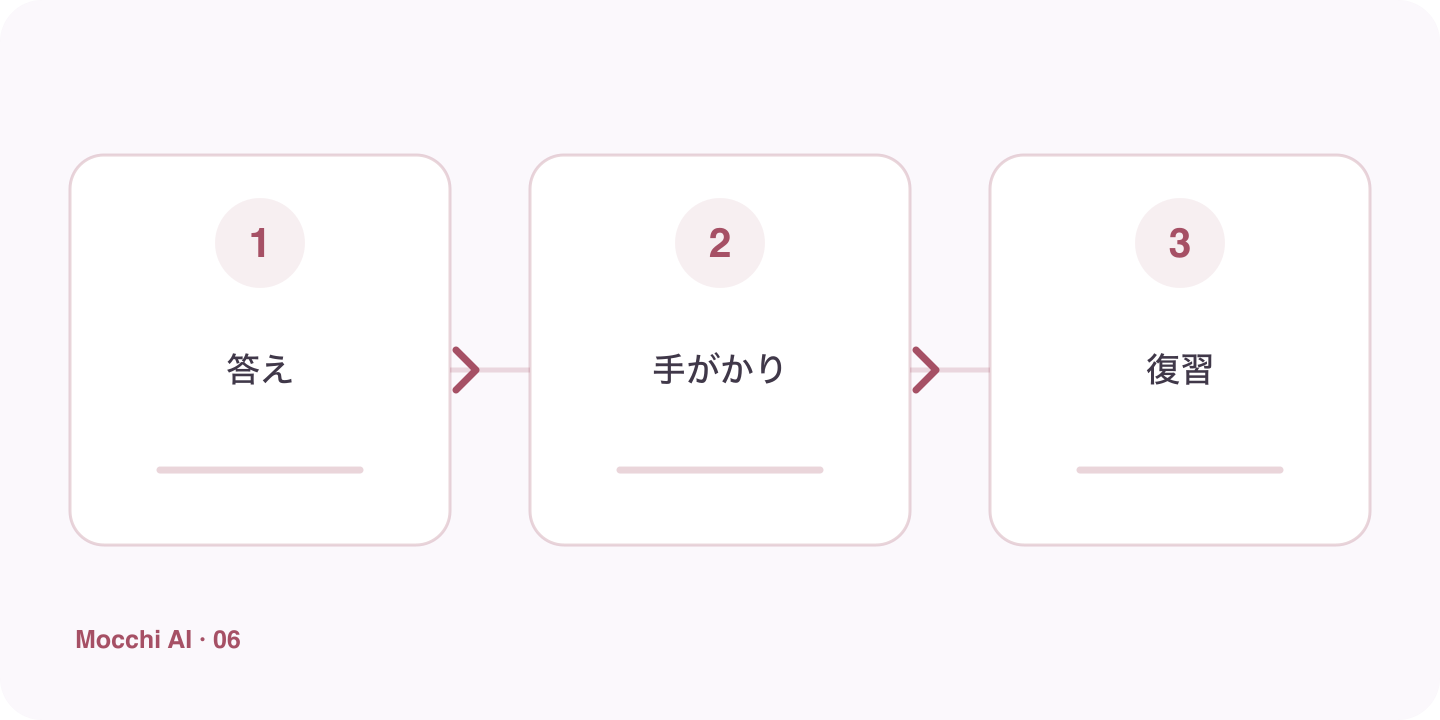
An answer, a contextual clue, and a fresh retrieval task form a three-step mistake review loop
Record the decision that failed, then test it with a changed example rather than the original answer.
JapaneseRomajiMeaning
公園で走ります。Kōen de hashirimasu.I run in the park.
公園に行きます。Kōen ni ikimasu.I go to the park.

Diagnose vocabulary and grammar separately

Before repeating a grammar drill, check whether an unknown verb caused the mistake. If you did not know that the verb expressed movement, you may have lacked the information needed to choose the particle. Learn the verb in a short phrase, then return to the grammar contrast. This prevents you from doing many apparently similar exercises while leaving the actual obstacle untouched.

Ask for mixed examples after the first success

Once a simple pair makes sense, mix the target with a familiar alternative. If every new question requires the same particle, you can guess the pattern of the exercise without reading the sentence. A small mixed set asks you to decide each time. Explain the clue in one sentence before checking the answer, especially when you feel tempted to rely on which option appeared most recently.

Use delayed recall as the final check

A clear explanation can make a mistake feel solved during the lesson. Test it again after a gap, with a different example and no open notes. If you need a hint, record that honestly and shorten the next practice step. Improvement is not the absence of mistakes in one session; it is having a more reliable way to notice and use the clue when attention is also on the message.

Key points

A practical way to improve

Take one recent quiz mistake and explain your original reasoning to Mocchi. Ask which word or relationship should have changed the answer. Write that clue in a short note, then request two new questions that use different nouns or verbs. Answer them without opening the original correction. Finish by stating when the original wrong option would have been appropriate, if there is such a context.

  1. 1

    Choose one clear goal

    Focus each session on a situation or skill you can actually use.

  2. 2

    Practice actively

    Say complete answers aloud instead of only reading or recognizing Japanese.

  3. 3

    Review and repeat

    Keep useful corrections and revisit the same skill until it feels natural.

FAQ

Frequently asked questions

Should I review every mistake immediately?

Prioritize mistakes that recur, change the meaning, or block your current goal. A rare unfamiliar word may need a separate vocabulary note, while a repeated particle error may deserve a short sequence of contrast questions.

What if I answer correctly only because I remember the question?

Ask for a new situation with different surface details. Explain your reason before seeing the answer. Familiarity with an old layout can hide the fact that the underlying language decision is still uncertain.

Can Mocchi choose a weak point for me?

Mocchi can use available learning context and practice results to suggest review. You can improve the choice by naming the situations that still cause trouble and correcting a suggestion that no longer reflects your needs.

Give an old mistake a new test

Bring Mocchi one answer you got wrong and turn its explanation into a small retrieval exercise.