
What structured lessons and community corrections give you
A structured course app does something valuable that free-form practice does not: it decides for you. Today's lesson is this grammar point, these ten words, this short dialogue, and tomorrow's builds on it. For learners who otherwise drift, that order is worth a lot. Busuu adds a community layer: write a few sentences, submit them, and a Japanese speaker corrects them. That is genuine human feedback, and reading a native speaker's rewrite of your own sentence teaches more than a textbook example.
So nothing here says stop. It says notice the tempo. Every exercise in a course app lets you think as long as you like, and every correction comes later. Conversation allows neither.
| Japanese | Romaji | Meaning |
|---|---|---|
| すぐ答えられるようになりたい | Sugu kotaerareru yō ni naritai | I want to be able to answer right away |
| 書けば分かります。 | Kakeba wakarimasu. | If I write it, I understand. |
| 話すと、時間がかかります。 | Hanasu to, jikan ga kakarimasu. | When I speak, it takes time. |
What real-time speaking adds
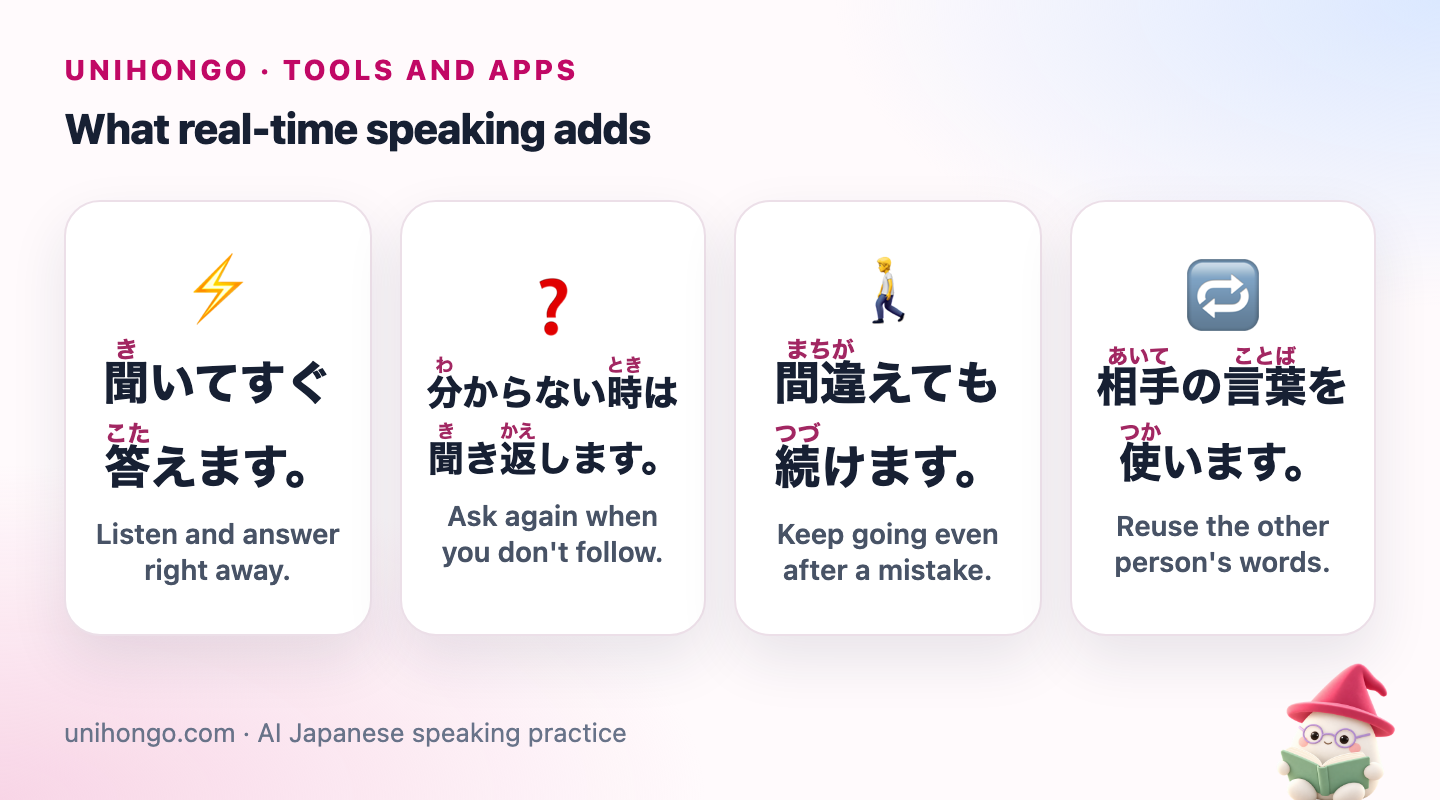
Four skills exist only under time pressure, and written exercises cannot train them. The cards below name them as Japanese sentences you can say to yourself before any conversation. They are the whole method of this post.
| Japanese | Romaji | Meaning |
|---|---|---|
| 聞いてすぐ答えます。 | Kiite sugu kotaemasu. | Listen and answer right away. |
| 分からない時は聞き返します。 | Wakaranai toki wa kikikaeshimasu. | Ask again when you don't follow. |
| 間違えても続けます。 | Machigaete mo tsuzukemasu. | Keep going even after a mistake. |
| 相手の言葉を使います。 | Aite no kotoba o tsukaimasu. | Reuse the other person's words. |
The fourth skill is the secret of fluent-sounding beginners. If the clerk says hotto to aisu, dochira ni shimasu ka, hot or iced, you do not need to invent anything: hotto de onegai shimasu. Half of conversation is handing the other person's words back with a small change.
Written correction vs spoken correction
Both kinds of feedback matter, and they fix different things. Seeing the difference tells you what to ask for from each tool.
| Japanese | Romaji | Meaning |
|---|---|---|
| この文は自然ですか。 | Kono bun wa shizen desu ka. | Is this sentence natural? |
| もっといい言い方はありますか。 | Motto ii iikata wa arimasu ka. | Is there a better way to say it? |
| 発音はどうでしたか。 | Hatsuon wa dō deshita ka. | How was my pronunciation? |
| 今の答え、遅かったですか。 | Ima no kotae, osokatta desu ka. | Was my answer just now too slow? |
| 直してもらえますか。 | Naoshite moraemasu ka. | Could you correct me? |
| Aspect | Written correction (community, tutor by message) | Spoken correction (tutor live, AI partner) |
|---|---|---|
| What it fixes | Grammar, word choice, kanji | Pronunciation, pitch, particles dropped under pressure, pauses |
| When it arrives | Hours or days later | Within the conversation or right after it |
| What you had time for | To think and look things up | To speak within a second or two |
| Best for | Accuracy | Fluency and confidence |
Fillers and rescue lines that buy you two seconds
Real-time speaking is not about thinking faster; it is about keeping the channel open while you think. Japanese has its own fillers, and using them does two things: it keeps the other person from switching to English, and it makes you sound like someone who is speaking Japanese slowly rather than someone who is not speaking at all. Learn these as sounds, not as vocabulary.
A word of caution on frequency. One ēto per sentence is natural; three in a row sounds like panic. The goal is to replace the silent freeze with one short Japanese sound, then speak. If you still have nothing after the filler, use a rescue line instead: ask them to repeat, or ask how to say the thing you are reaching for. Both keep the conversation in Japanese and both are far better than switching languages.
| Japanese | Romaji | Meaning |
|---|---|---|
| えーと… | Ēto... | Um... (thinking) |
| そうですね… | Sō desu ne... | Let me see... (thinking) |
| 何と言えばいいかな。 | Nan to ieba ii ka na. | How should I put it... |
| ちょっと待ってください。 | Chotto matte kudasai. | Please wait a moment. |
| つまり… | Tsumari... | In other words... |
| もう一度お願いします。 | Mō ichido onegai shimasu. | Once more, please. |
| それは、日本語で何と言いますか。 | Sore wa, Nihongo de nan to iimasu ka. | How do you say that in Japanese? |
Sō desu ne also means yes, that's right, when said quickly. Drawn out, with a thoughtful tone, it is the filler. Both uses are extremely common.
Alternatives by what they add
None of these replaces a structured course; each adds a kind of practice the course format does not include. Pick by the tempo you are missing. If your week has no moment when a reply arrives within seconds, add the type that gives you that first.
- Another structured course (LingoDeer, a textbook with audio): adds a different explanation of the same grammar. Fits when you want more structure, not more speaking.
- A human tutor from a marketplace (italki, Preply): adds live spoken correction and a person's judgement. Fits when you can book a weekly slot and want someone to plan with you.
- A language exchange app (HelloTalk, Tandem): adds real people and real-time chat or calls, in exchange for your language. Fits when you enjoy social practice and have patience for schedules.
- A general AI assistant with voice (ChatGPT): adds an open-ended partner on any topic. Fits when you want flexibility and will instruct it to stay in Japanese and correct you.
- A Japanese-only AI conversation partner (Unihongo): adds spoken roleplay with objectives and corrections at any hour, without booking. The AI Sensei can play a café clerk, a coworker or a friend, speak more slowly on request, and switch between casual and polite; the session report then lists corrections, vocabulary and grammar. It is Japanese-only. Fits when real-time speaking with feedback is exactly the missing piece.
Mini dialogue: a café order that goes off-script
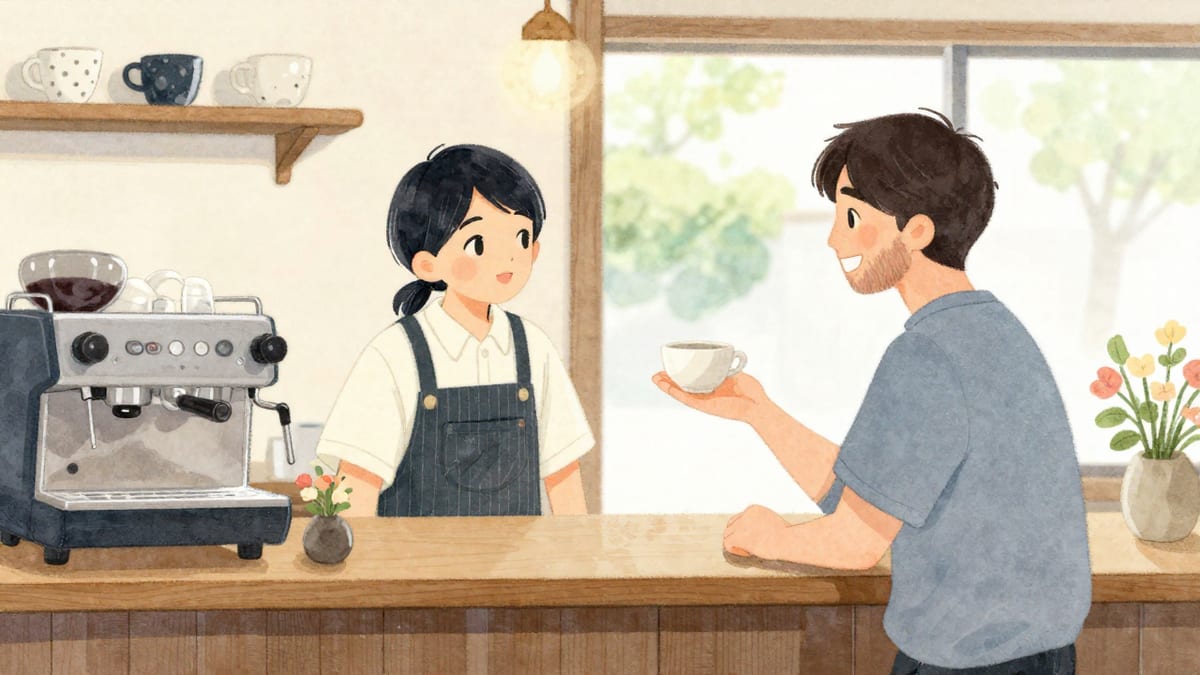
Here is the scene where tempo matters. The order itself is easy; the follow-up question is the test. Watch the learner use a filler, ask back, and reuse the clerk's words. Everyone is polite, which is normal in a shop.
| Japanese | Romaji | Meaning |
|---|---|---|
| カフェラテを一つお願いします。 | Kaferate o hitotsu onegai shimasu. | You: One café latte, please. |
| サイズはどうなさいますか。 | Saizu wa dō nasaimasu ka. | Clerk: What size would you like? |
| えーと…すみません、サイズは何がありますか。 | Ēto... Sumimasen, saizu wa nani ga arimasu ka. | You: Um... Sorry, what sizes do you have? |
| ショートとトールがございます。 | Shōto to tōru ga gozaimasu. | Clerk: We have short and tall. |
| じゃあ、トールでお願いします。 | Jā, tōru de onegai shimasu. | You: Then tall, please. |
| ミルクは豆乳に変更できますが、いかがですか。 | Miruku wa tōnyū ni henkō dekimasu ga, ikaga desu ka. | Clerk: We can change the milk to soy; would you like that? |
| そうですね…はい、豆乳でお願いします。 | Sō desu ne... Hai, tōnyū de onegai shimasu. | You: Let me see... yes, soy milk, please. |
| 店内でお召し上がりですか。 | Tennai de omeshiagari desu ka. | Clerk: Will you be having it here? |
| はい、店内で。 | Hai, tennai de. | You: Yes, here. |
Dō nasaimasu ka and omeshiagari desu ka are honorific shop language; you only need to understand them, never to produce them. Your side stays at the onegai shimasu level throughout.
A ten-minute daily routine
Attach this to the lesson you already do. Ten minutes is enough if every minute is spoken.
| Japanese | Romaji | Meaning |
|---|---|---|
| 二秒で答えます。 | Nibyō de kotaemasu. | I answer within two seconds. |
| 間違えても、止まりません。 | Machigaete mo, tomarimasen. | Even if I make a mistake, I don't stop. |
| Minutes | Activity | Skill |
|---|---|---|
| 1 to 2 | Say today's lesson dialogue aloud at natural speed | Mouth warm-up |
| 3 to 5 | Answer five questions about the lesson within two seconds each, fillers allowed | Answer fast |
| 6 to 9 | A short roleplay with a partner that replies: tutor, exchange partner or AI | Ask back, keep going, reuse words |
| 10 | Read the corrections and say each corrected sentence once | Spoken correction |