
Begin with the word you actually encountered
Imagine seeing 駅 near a route map. Ask /kanji about the character and /vocab about a relevant word or topic. Check the reading of 駅 as a complete word: eki. Then connect the meaning with the place you are talking about. You do not need a long list of compounds before you can begin using this one item.
Ask Mocchi for a short sentence that makes the role of the word clear. Explain the sentence back in your own words. If another unfamiliar element makes it difficult, simplify that element while keeping the vocabulary target. This prevents a small word-learning task from becoming several unrelated grammar problems.
| Japanese | Romaji | Meaning |
|---|---|---|
| 駅 | Eki | Station |
| 駅は近いです。 | Eki wa chikai desu. | The station is nearby. |
Save a card with a useful retrieval target
When a vocabulary card is available, save the item if you expect to use it again. /create-flashcards can also help prepare cards from chosen words or the current conversation. Inspect the suggested content before accepting it. The card should prompt a clear piece of knowledge rather than bundle several difficult facts into one answer.
During /review-flashcards, try retrieving the answer before revealing it. Notice whether you remember the meaning but not the reading, or the reading but not how the word fits a sentence. That distinction tells you what to practise next. A correct recognition response does not automatically solve a production difficulty.
Build a sentence that serves your intention
Now decide what you need to communicate. Saying that the station is nearby and asking where it is have different purposes. Write the question yourself, then ask Mocchi to check whether it expresses the information gap you intended. Keep the rest of the sentence familiar so the target word stays central.
Change one detail after receiving feedback. Ask about a different place or change the location description. This checks whether you can reuse the pattern instead of recognizing a single example. If you cannot explain the change, ask for a smaller comparison before adding more vocabulary.
| Japanese | Romaji | Meaning |
|---|---|---|
| 駅はどこですか。 | Eki wa doko desu ka. | Where is the station? |
Use the word during a spoken exchange
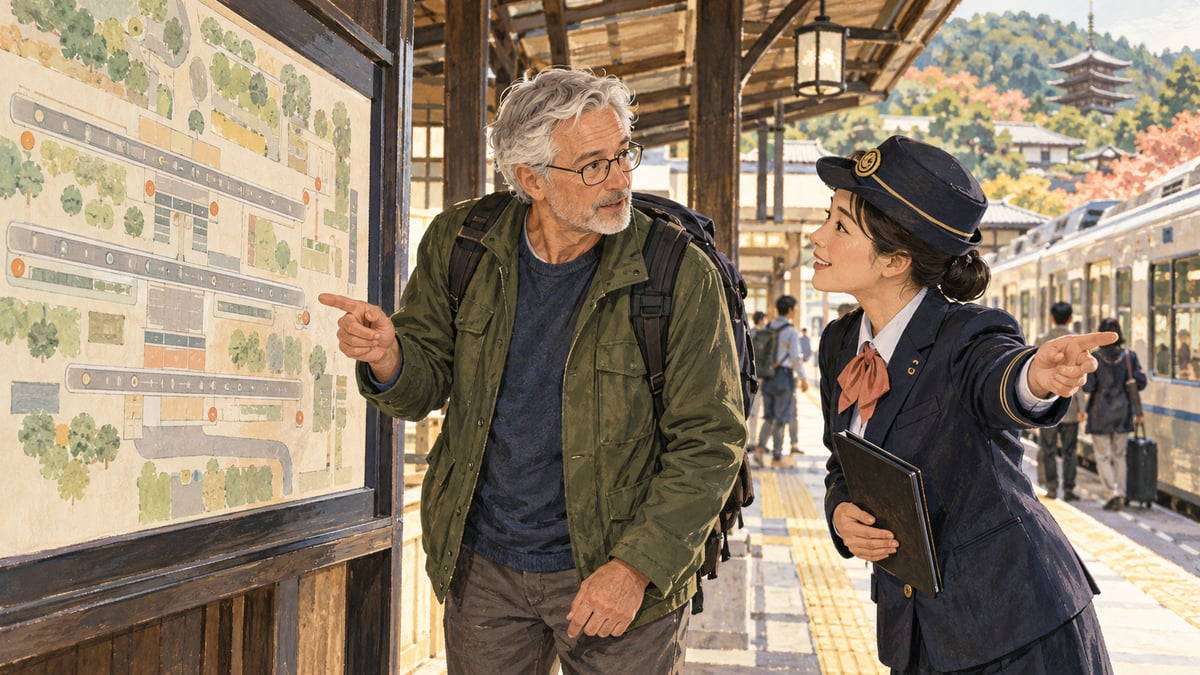
Ask /kaiwa for a suitable AI Sensei directions activity. Start with your question and listen to the answer. The scene and voiced teacher give the task a conversational setting, but the success check is practical: did you obtain the information you needed, and could you respond to it?
Avoid reading the whole exchange from a script. You can keep a short support note nearby, then reduce that support in another round. If the reply contains a new word, use a clarification instead of abandoning the task. This is where the vocabulary item becomes part of an exchange rather than a standalone answer.
| Japanese | Romaji | Meaning |
|---|---|---|
| ここから近いですか。 | Koko kara chikai desu ka. | Is it near here? |
| ゆっくりお願いします。 | Yukkuri onegai shimasu. | Slowly, please. |
Choose the next tool from the actual difficulty
If the word disappeared when you needed it, return to recall practice. If you remembered it but could not form the question, use a focused grammar explanation or sentence correction. If the reply was the difficult part, review a short answer and try another listening-and-response exchange. Each result points toward a different next step.
Use /quiz when you want a small check in a changed context, or /review when a weak point needs another explanation and practice. The value is not in opening every feature. It is in choosing a tool that addresses the gap you observed during the task.
Repeat with a different destination and less support
Later, try a related task without reopening the original card or sentence. Ask about a library, an exit or a meeting place that is appropriate for your level. You are checking whether the learning sequence produced something you can transfer, not whether you can repeat yesterday’s example exactly.
Keep 駅 in your vocabulary routine if it remains useful, and add other words gradually. One complete path from reading to conversation can teach you how to handle the next word more deliberately. Mocchi provides study guidance; flashcards and quizzes support recall; AI Sensei gives you an opportunity to respond aloud.