
The three roles every study setup has to fill
Instead of asking which product is better, ask which of three jobs it does. The first is the core sequence: the thing that decides what you learn this month and in what order, and that has an end you can reach. The second is the speaking outlet: a place where you produce Japanese out loud for another party, with the pressure of a reply. The third is the review system: whatever brings old material back before you lose it. A setup missing any one of these will stall in a predictable way.
Most people who feel stuck are missing the same role. They have a core and a review system and no outlet, so recognition grows for months while production stays at zero. The fix is not a better book or a better app. It is filling the empty column.
| Role | What it does | What usually fills it |
|---|---|---|
| Core sequence | Decides the order, explains the grammar, and has a finish line | A beginner textbook series, or one structured course you complete |
| Speaking outlet | Forces production out loud under the pressure of a reply | A conversation partner, a tutor, a class, or AI speaking practice |
| Review system | Returns old vocabulary and patterns before they fade | A spaced flashcard deck, a drill app, or vocabulary games |
Notice that no single product fills all three columns well, and that any product claiming to is usually strong in one and thin in the others. Choose deliberately per column and you stop feeling guilty for not finishing everything.
What a textbook series actually gives you
A textbook series is a tested sequence. Someone decided that te-form comes after masu-form, that counters arrive before conditionals, and that a chapter's vocabulary is chosen to make its grammar sayable. That ordering is invisible when it works, and it is the single hardest thing for a self-taught learner to reproduce. A book also explains, at length, in your own language, with the exceptions marked. When you meet a pattern you half remember, a book is something you can look backwards in.
The second gift is exercises that build. A good chapter moves from substitution drills to controlled production to a short free task, so difficulty rises in steps you can survive. The third gift is quiet but decisive: a book has a last page. Finishing chapter twenty five is a real event with a date, and a finish line changes how people behave over months in a way that an endless feed never does.
- A defined order, so you never have to decide what comes next
- Explanations in full sentences, with the exceptions and the register noted
- Exercises that escalate from recognition to production within one chapter
- A visible endpoint you can plan a year around
- A stable reference you can search backwards when a pattern reappears
What a textbook cannot do for you
A book cannot hear you. Every sentence you say while studying alone is unverified, which is how learners arrive at intermediate grammar with a fossilised pronunciation habit they have repeated ten thousand times. A book also gives you audio you listen to rather than audio you answer, and the difference matters, because comprehension without a response deadline is a much easier skill than the one a real conversation demands.
It cannot correct you either. The answer key checks the exercise it set, not the sentence you improvised about your own weekend. And a book will not notice when you stop opening it. Motivation with a textbook is entirely on you, which is exactly why so many people own one whose bookmark has not moved since spring.
What a drill app is good at
A drill app wins on habit. It arrives with you, it fits into three minutes on a train, and it removes the friction of deciding what to review. Spacing is the second win: a decent app schedules the words you are about to forget rather than the words you already know, which is a genuinely hard thing to do by hand with paper cards. Over months that spacing is why app users often have larger passive vocabularies than book-only learners at the same stage.
Portability is not a small point either. Fifteen minutes of review spread through a day is time you were never going to spend at a desk, so it is added time rather than borrowed time. Used as a review system alongside a core, an app is one of the most efficient tools a learner has.
Where drill apps quietly fail
The most common failure is the missing sequence. A stream of exercises can feel like progress while never building a coherent grammar picture, because the units are chosen to be answerable rather than to teach a system. You end up knowing many isolated facts and being unable to say why one of them is wrong. Depth is the related gap: an app rarely has room to explain when a pattern is rude, when it is regional, or why a native speaker would choose the other option.
Then there is production. Choosing the right tile from four options is recognition wearing the costume of speech. Streaks are the last trap. A streak measures attendance, not learning, and defending a streak with the easiest available exercise at midnight is a habit that can run for a year without moving your Japanese.
- No coherent grammar sequence, so gaps stay invisible until they block you
- Little room for register, nuance, or the exceptions that matter in speech
- Multiple choice trains recognition, not retrieval under time pressure
- Streak pressure rewards showing up rather than working at the right difficulty
- Little transfer to conversation unless you say the answers out loud
Say your textbook chapter out loud
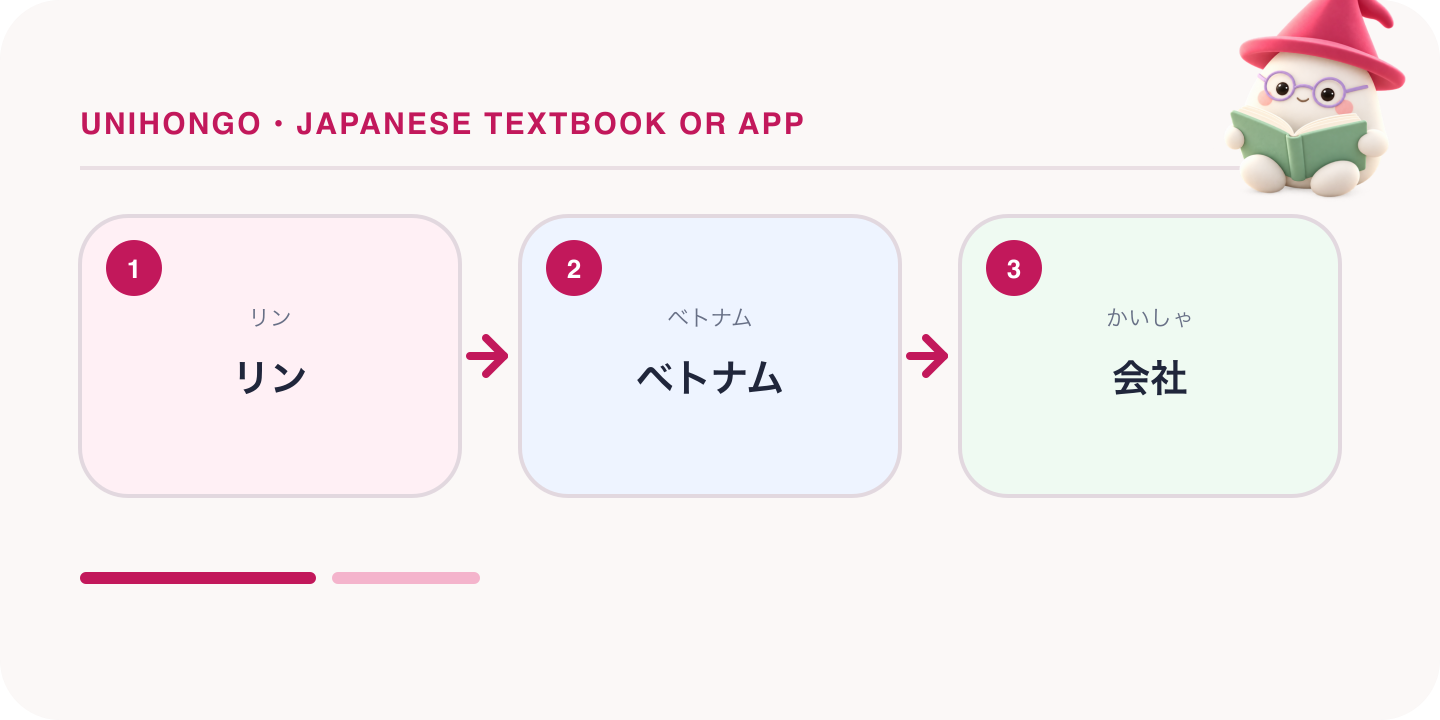
These are the kinds of sentences a first beginner chapter prints: a self introduction, a couple of noun sentences, a question and its answer. The test is not whether you understand them. It is whether you can produce them at conversational speed without reading. Say each line, then say the version with your own facts substituted, then say the expected reply. If the reply is the part you cannot do, that is your missing outlet showing itself.
| Japanese | Romaji | Meaning |
|---|---|---|
| はじめまして。リンです。 | Hajimemashite. Rin desu. | Nice to meet you. I am Rin. |
| ベトナムから来ました。 | Betonamu kara kimashita. | I am from Vietnam. |
| 会社員です。 | Kaishain desu. | I am a company employee. |
| よろしくお願いします。 | Yoroshiku onegai shimasu. | Pleased to meet you. |
| お名前は何ですか? | O-namae wa nan desu ka? | What is your name? |
| ご出身はどちらですか? | Go-shusshin wa dochira desu ka? | Where are you from? |
| これは何ですか? | Kore wa nan desu ka? | What is this? |
| それは私の教科書です。 | Sore wa watashi no kyōkasho desu. | That is my textbook. |
| この漢字の読み方が分かりません。 | Kono kanji no yomikata ga wakarimasen. | I do not know how to read this kanji. |
| 毎朝七時に起きます。 | Maiasa shichi-ji ni okimasu. | I get up at seven every morning. |
| 今日は何時まで勉強しますか? | Kyō wa nan-ji made benkyō shimasu ka? | Until what time will you study today? |
| 十時まで勉強します。 | Jū-ji made benkyō shimasu. | I will study until ten. |
| 昨日、図書館で本を読みました。 | Kinō, toshokan de hon o yomimashita. | Yesterday I read a book at the library. |
| この本は面白いです。 | Kono hon wa omoshiroi desu. | This book is interesting. |
| 週末は何をしますか? | Shūmatsu wa nani o shimasu ka? | What will you do at the weekend? |
| 友達とご飯を食べます。 | Tomodachi to gohan o tabemasu. | I will eat with a friend. |
A useful rule: if you hesitated on more than two of those, do not start the next chapter. Reread nothing, and instead say the chapter's dialogue three more times from memory. Rereading feels like study and moves nothing.
Talking about your own study in Japanese
Learners rarely practise the sentences they will actually need in a lesson or a language exchange, which are sentences about studying itself. These lines let you tell a teacher where you are, ask for a repeat without embarrassment, and negotiate the pace. Learn them early and every future lesson gets more useful, because you can steer it instead of enduring it.
| Japanese | Romaji | Meaning |
|---|---|---|
| 日本語を独学で勉強しています。 | Nihongo o dokugaku de benkyō shite imasu. | I am studying Japanese on my own. |
| 教科書の五課まで終わりました。 | Kyōkasho no go-ka made owarimashita. | I have finished up to chapter five of the textbook. |
| アプリで単語を復習しています。 | Apuri de tango o fukushū shite imasu. | I review vocabulary with an app. |
| 文法は分かりますが、話せません。 | Bunpō wa wakarimasu ga, hanasemasen. | I understand the grammar, but I cannot speak. |
| もう一度お願いします。 | Mō ichido onegai shimasu. | Once more, please. |
| もう少しゆっくり話していただけますか? | Mō sukoshi yukkuri hanashite itadakemasu ka? | Could you speak a little more slowly? |
| この文は自然ですか? | Kono bun wa shizen desu ka? | Is this sentence natural? |
| どちらの言い方がいいですか? | Dochira no iikata ga ii desu ka? | Which way of saying it is better? |
| 毎日三十分ぐらい勉強しています。 | Mainichi sanjuppun gurai benkyō shite imasu. | I study about thirty minutes every day. |
| 来年の春に試験を受けます。 | Rainen no haru ni shiken o ukemasu. | I will take the exam next spring. |
| 漢字を覚えるのが難しいです。 | Kanji o oboeru no ga muzukashii desu. | Memorising kanji is difficult. |
| 会話の練習がしたいです。 | Kaiwa no renshū ga shitai desu. | I want to practise conversation. |
| アプリだけでは話せるようになりません。 | Apuri dake de wa hanaseru yō ni narimasen. | You will not become able to speak with an app alone. |
| 今週は五課を復習します。 | Konshū wa go-ka o fukushū shimasu. | This week I will review chapter five. |
| 教科書を最後まで終わらせたいです。 | Kyōkasho o saigo made owarasetai desu. | I want to finish the textbook to the end. |
| 少しずつ続けています。 | Sukoshi zutsu tsuzukete imasu. | I am keeping at it little by little. |
How to combine a textbook with daily speaking
The combination that works for most working adults is small and repeatable. One chapter every week or two from the core book, a short daily review pass in whichever app or deck you already open, and two or three speaking sessions a week that use only what the current chapter contains. The constraint is the important part: speak inside your chapter, not above it, so the session is production practice rather than a rescue mission.
Order matters within a session too. Read the chapter dialogue aloud first, then close the book and improvise around the same situation, then check the two or three things you got wrong. Checking first turns the session into copying. Checking afterwards turns it into retrieval, and retrieval is what makes the pattern available next time under pressure.
- Pick one core book and write its final chapter number somewhere you see it
- Study one chapter per week, or one per fortnight if your weeks are unreliable
- Review daily for ten minutes using only that book's vocabulary, not a new list
- Speak two or three times a week, restricted to the current chapter's patterns
- Keep one page of your own mistakes and reuse the corrected sentence next session
- Never start a new chapter while you still need the book open to say the old one
Signs your core is failing you
Cores fail in recognisable ways, and each way points at a specific fix rather than at more effort. Run this list once a month. If two or more apply, change the format, because continuing to grind an unsuitable core is the most common way people spend a year and end up back at the introduction chapter.
- Your bookmark has not moved in three weeks and you have not decided to stop
- You finish exercises correctly but cannot say a sentence about your own day
- You are opening the app only to protect a streak, at the easiest setting available
- Every session starts with revising chapter one because you never felt ready to continue
- You own three cores and have finished none of them
- You cannot say what you will be able to do when the book ends
The remedy is usually a downgrade in scope rather than a new purchase. Halve the chapter size, keep the same book, and add one speaking session. A core that is slightly too easy and gets finished beats a core that is correct and abandoned.
Choosing well for four common situations
If you are starting from zero with an hour a week, buy one beginner textbook series, work through it slowly, and add a short speaking session rather than a second study tool. If you already have a decent passive vocabulary from a drill app but freeze when spoken to, stop adding words entirely for a month and spend that time speaking; your review system is fine and your outlet is missing.
If you are preparing for a proficiency exam, keep the textbook as the core because the exam follows a sequence, and use the app for the exam's vocabulary lists. If you are travelling in eight weeks, invert the whole thing: skip the sequence, learn the twenty situations you will meet, and rehearse them aloud until they are automatic. A finish line that close deserves a different core.