
Teach Mocchi Your Preferred Language for Japanese Lessons

The best explanation language is one that lets you understand the Japanese decision you are practicing. Tell Mocchi which language you prefer, and distinguish that preference from how much translation you need in each exercise.

Mocchi links Japanese examples to a learner's chosen explanation language and a later independent answer
What you need to know

Teach Mocchi Your Preferred Language for Japanese Lessons

A Vietnamese-speaking beginner and a German-speaking advanced reader may both want explanations in their own language, but they need different amounts of support around Japanese text. One may need a meaning after every short example; the other may need help only with an unfamiliar expression. Treat language choice and difficulty as separate settings. This gives you a way to increase Japanese exposure without turning every lesson into a struggle to understand the tutor's instructions.

Choose a language you understand comfortably.

Specify whether translations should be immediate or delayed.

Keep Japanese examples in normal Japanese script.

Check understanding by changing a detail yourself.

Separate three different language choices

There is the language of the app's menus, the language used to explain a point, and the Japanese you are learning. These choices often match your preferences in different ways. A learner can use a Spanish interface, request Spanish grammar explanations, and still read Japanese examples without romaji. Saying which layer should change prevents a broad request such as 'more Japanese' from removing support you still need.

Tell the tutor what you want to do with the explanation. 'Explain the difference briefly in Korean, then test me in Japanese' is a usable teaching instruction. 'Speak my language' does not say whether the examples, quiz prompts, answer options, or follow-up discussion should change.

Use one familiar sentence as a bridge

Start with something concrete, such as 今日は忙しいです: 'I am busy today.' The word order and omitted subject may differ from the language you normally speak. Ask for the meaning and the role of each part, then change today to tomorrow. This lets you test whether you understood the Japanese structure instead of merely matching an entire sentence to its translated equivalent.
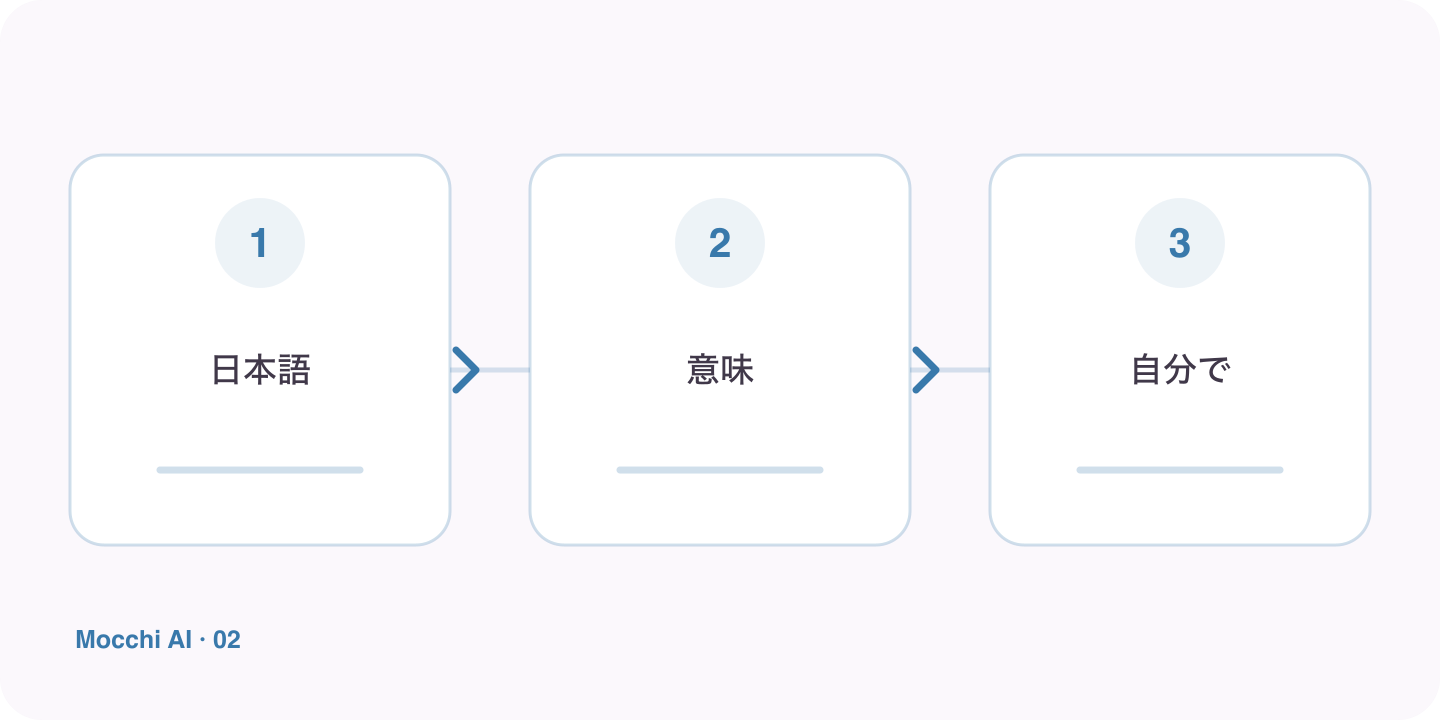
A Japanese sentence is supported by an explanation before the learner answers a new example without translation
Use your familiar language to understand the point, then remove that support for a small retrieval check.
JapaneseRomajiMeaning
今日は忙しいです。Kyō wa isogashii desu.I am busy today.
明日は忙しいです。Ashita wa isogashii desu.I will be busy tomorrow.

Delay the translation when recognition becomes too easy

If you always read the familiar-language line first, the Japanese may become decorative. Change the sequence rather than removing translation forever. Try reading the Japanese, making a prediction, and revealing the explanation afterward. When the prediction is wrong, identify the exact clue you missed. A single word, tense ending, or particle is a better review target than a vague note that the whole sentence was difficult.

Reduce support in one dimension at a time

Do not simultaneously increase vocabulary, lengthen sentences, remove translations, and add time pressure. You will not know which change made the task difficult. Keep the topic and sentence length steady while you hide the meaning of one example. Once that is manageable, change another condition. The objective is a clearer view of your Japanese understanding, not the appearance of an advanced lesson.

Use feedback to keep the preference current

A useful preference is specific enough to guide the next response but flexible enough to change. Tell Mocchi when an explanation contains too much terminology, when a translation hides an important contrast, or when you would prefer a short comparison in your first language. If an explanation still seems inconsistent, ask for a simpler example and consult a trusted reference rather than assuming that a fluent translation makes every linguistic claim correct.

Key points

A practical way to improve

Choose one grammar point you recently studied. Ask Mocchi to explain it in your preferred language, using two short Japanese examples. Read the first translation, cover the second one, and predict its meaning. Then request one question with the translation hidden until you answer. Finish by explaining the difference in your own words; use whichever language lets you state the reasoning accurately.

  1. 1

    Choose one clear goal

    Focus each session on a situation or skill you can actually use.

  2. 2

    Practice actively

    Say complete answers aloud instead of only reading or recognizing Japanese.

  3. 3

    Review and repeat

    Keep useful corrections and revisit the same skill until it feels natural.

FAQ

Frequently asked questions

Should beginners avoid their own language completely?

Not necessarily. A clear explanation in a familiar language can make an unfamiliar Japanese pattern understandable. You can then practice the pattern in Japanese without keeping the translation visible at every step.

Is changing the site language the same as changing my level?

No. The interface and explanation language concern how information is presented; your Japanese level concerns the material you can understand or use. State both when you need a lesson adjusted.

Can I ask for fewer translations later?

Yes. Request that Mocchi translate only difficult expressions or wait until you have attempted an answer. Make the change for one short exercise first so you can tell whether it improves concentration or simply adds confusion.

Choose support that helps you think

Ask Mocchi for familiar-language explanations and a small Japanese-only check, rather than changing every part of the lesson at once.