
Why visual novels suit learners
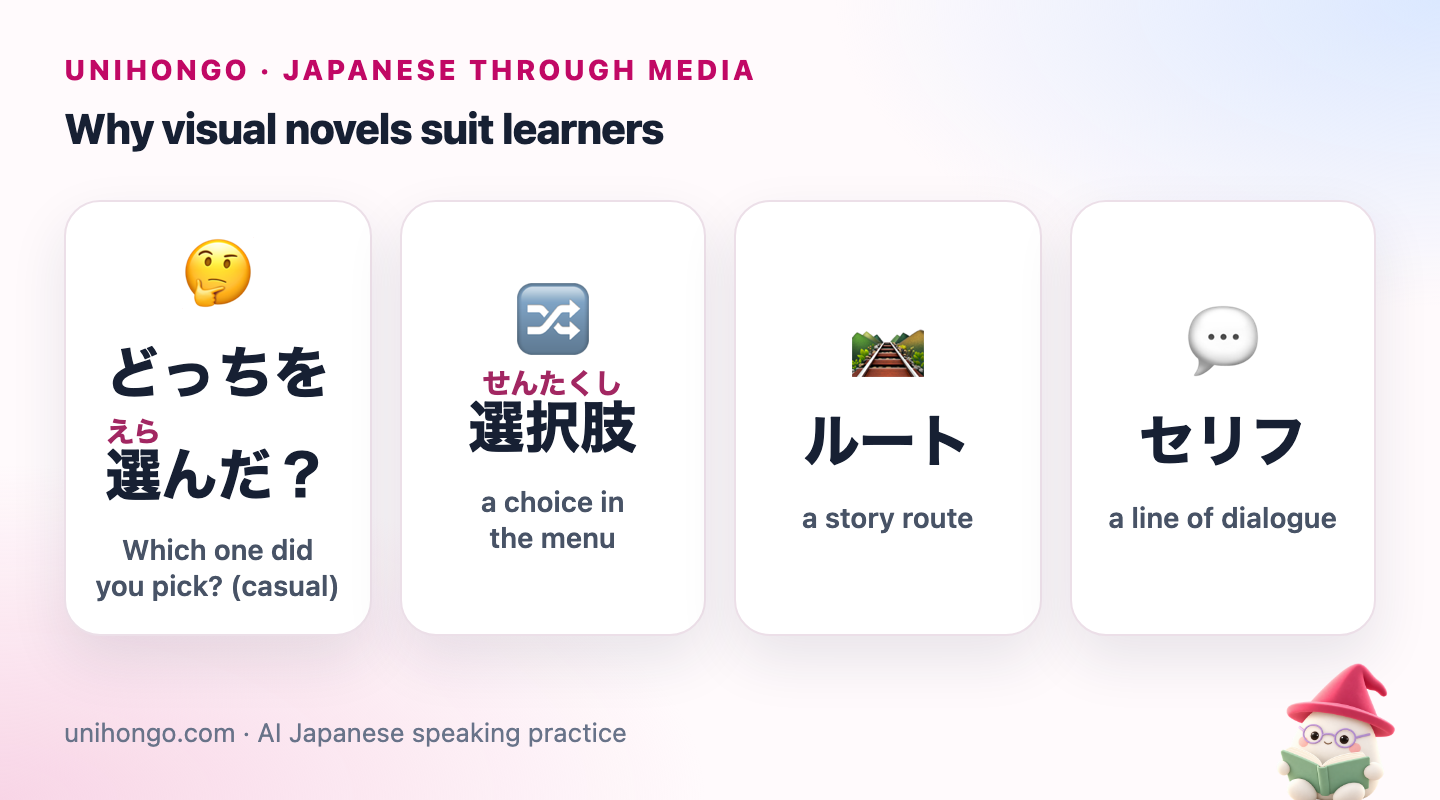
In a visual novel, text appears one line at a time over a scene. You press a button to continue, so the game waits for you. In many titles, most characters are voiced, and the voice plays as each line appears. That gives you a written script and a native recording for every line, a combination that is rare in other media. These four words are what players talk about most.
| Japanese | Romaji | Meaning |
|---|---|---|
| どっちを選んだ? | Dotchi o eranda? | Which one did you pick? (casual) |
| 選択肢 | sentakushi | a choice in the menu |
| ルート | rūto | a story route |
| セリフ | serifu | a line of dialogue |
Serifu is used for lines in any script: plays, anime, films and games. Meiserifu (名セリフ) is a famous or memorable line, and fans often quote them to each other.
Choosing a title at your level
Visual novels range from gentle slice-of-life stories to dense mysteries and science fiction. Before you commit dozens of hours, check four things.
| Level | Good fit | Watch out for |
|---|---|---|
| Lower intermediate | Short, all-ages, slice-of-life titles | Long games you may abandon |
| Intermediate | School life, romance, light mystery | Slang and role language |
| Upper intermediate | Mystery and drama with long routes | Dense narration and rare kanji |
| Advanced | Science fiction and historical settings | Technical and archaic vocabulary |
- Age rating. Many visual novels are made for adults. Check the rating on the store page and choose all-ages titles if that suits you.
- Voice acting. Fully voiced titles are best for listening. In many games the protagonist is not voiced, which is normal.
- Furigana. Some titles add readings above difficult kanji, a huge help for intermediate learners.
- Genre. Everyday school or workplace stories teach useful vocabulary; fantasy and science fiction add many invented terms.
The interface vocabulary
Playing with the interface in Japanese is easy practice in itself. Most of these words are katakana loanwords, which helps.
| Japanese | Meaning | Learning use |
|---|---|---|
| bakkurogu | backlog of past lines | Reread and replay recent lines |
| boisu saisei | voice replay | Hear a line again for shadowing |
| ōto | auto mode | Advances text at a set pace: good for listening |
| kidoku sukippu | skip read text | Skips only lines you have already seen |
| bunki | branch point | Where the story splits |
| baddo endo | bad ending | A route that ends badly |
Auto mode is underrated for learning. Set it to a comfortable speed and the game becomes a listening exercise with a script.
Text hookers: useful, but use them carefully
Text hookers are tools that copy each line of game text to your clipboard, so a dictionary tool can show definitions instantly. Many learners rely on them, and they do save time. The risk is that you stop reading and start hovering: every word gets looked up, and none get remembered.
A balanced approach: read the line first and guess. Replay the voice. Only then look up words that block the meaning or that appear repeatedly. Play legally purchased copies, and check that any tool you use is compatible with the game's terms.
| Japanese | Romaji | Meaning |
|---|---|---|
| まず、辞書を使わずに読みます。 | Mazu, jisho o tsukawazu ni yomimasu. | First, I read without a dictionary. |
| 何回も出てくる言葉だけ調べます。 | Nankai mo dete kuru kotoba dake shirabemasu. | I only look up words that keep appearing. |
Shadowing voiced lines, and speech to leave in the game
Pick lines from ordinary characters: a classmate, a parent, a shopkeeper, a teacher. Replay the line from the backlog, say it with the actor, and repeat until your rhythm matches. Lines with clear emotion, such as surprise or apology, are easiest to imitate.
Avoid shadowing characters who speak in role language, called yakuwarigo (役割語). These speech styles instantly signal a character type in fiction, but in real conversation they sound like a costume.
| Japanese | Romaji | Meaning |
|---|---|---|
| ごめん、遅くなった! | Gomen, osoku natta! | Sorry, I'm late! (casual, natural) |
| え、本当に? | E, hontō ni? | Huh, really? (casual, natural) |
| それ、どういう意味? | Sore, dō iu imi? | What do you mean by that? (casual) |
| Role language | Character type | Natural alternative |
|---|---|---|
| ~desu wa, ~desu no | Rich young lady | ~desu, ~desu yo |
| ~ja, washi | Old sage or professor | ~da, watashi |
| ~de gozaru, sessha | Samurai | ~desu, watashi |
| ore-sama | Arrogant rival | ore or boku, with friends only |
| ~nya | Cat-like character | Plain endings |
Narration and dialogue: two kinds of Japanese
Visual novels mix two very different styles. The narration, often the protagonist's inner voice, is written in the plain style of a novel, with da, datta and the explanatory no da. The dialogue between characters is spoken Japanese, full of contractions and sentence-final particles. Learning to switch between them is excellent practice, because you need both: the narrative style to tell stories, and the spoken style to talk.
Many protagonists narrate with ore or boku, the casual male first-person pronouns. In your own retelling, use watashi or simply drop the pronoun, which is often the most natural choice in Japanese.
| Japanese | Romaji | Meaning |
|---|---|---|
| その日、俺は初めて彼女と話した。 | Sono hi, ore wa hajimete kanojo to hanashita. | Narration: That day, I spoke to her for the first time. |
| それが、すべての始まりだった。 | Sore ga, subete no hajimari datta. | Narration: That was the start of everything. |
| あの、これ、落としましたよ。 | Ano, kore, otoshimashita yo. | Dialogue: Um, you dropped this. |
| あ、ありがとう。助かった! | A, arigatō. Tasukatta! | Dialogue: Oh, thanks. You saved me! |
Notice the difference: the narration has no particles like yo or ne and no hesitation, while the dialogue starts with ano and ends with yo. If your retelling of a story sounds stiff, you may be mixing narrative style into conversation. When speaking to a friend, add ne, yo and n da to bring it to life.
Talk about your route: which choice and why
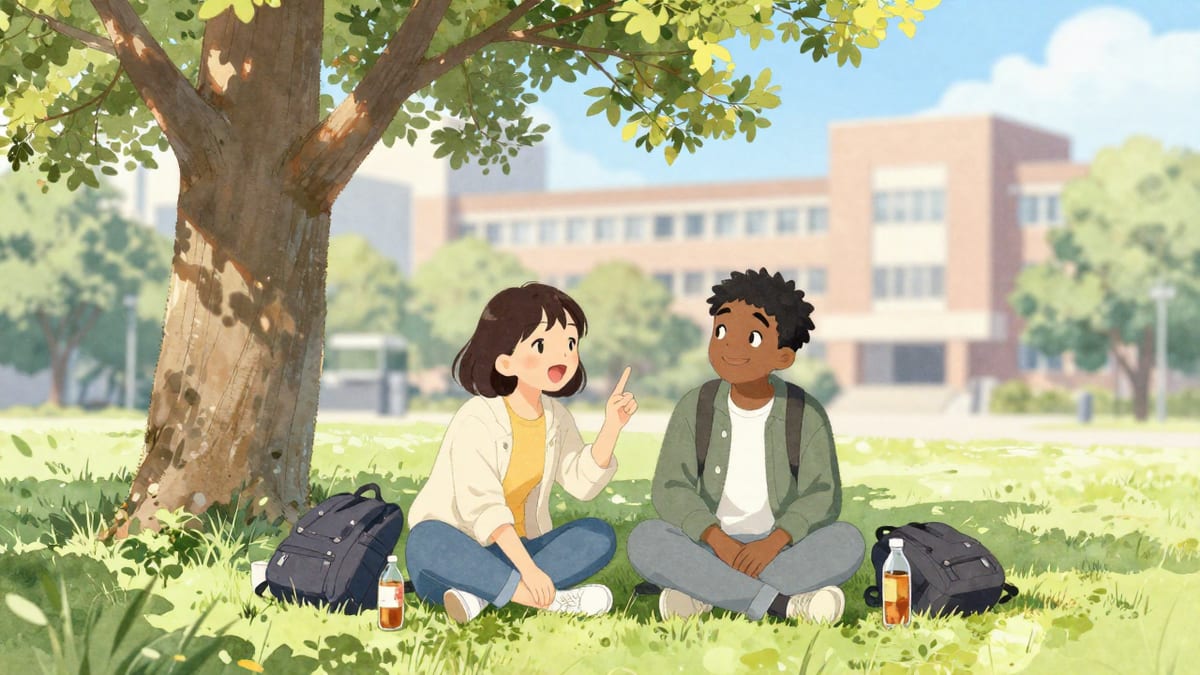
The natural conversation about visual novels is about choices. Fans compare which option they picked, which route they are on and which ending they reached. Here is a casual exchange between two friends playing the same game.
| Japanese | Romaji | Meaning |
|---|---|---|
| 三章の選択肢、どっちを選んだ? | Sanshō no sentakushi, dotchi o eranda? | Friend: Which option did you pick in chapter three? |
| 屋上に行くほうを選んだ。 | Okujō ni iku hō o eranda. | You: I picked going to the rooftop. |
| なんで? | Nande? | Friend: Why? |
| 幼なじみのルートに入りたかったから。 | Osananajimi no rūto ni hairitakatta kara. | You: Because I wanted the childhood friend's route. |
| あ、それ、ちょっと切ない話だよ。 | A, sore, chotto setsunai hanashi da yo. | Friend: Oh, that one's a bit heartbreaking. |
| え、マジで?ネタバレしないで! | E, maji de? Netabare shinaide! | You: Wait, really? No spoilers! |
For a more formal retelling, for example to a teacher, switch to the polite past tense and explain your reason with kara desu.
Retelling a scene politely
Retelling forces you to use vocabulary you have only read. Keep it short: what the route is about, the choice, your reason and the result.
| Japanese | Romaji | Meaning |
|---|---|---|
| このルートでは、主人公が転校生と事件を調べます。 | Kono rūto de wa, shujinkō ga tenkōsei to jiken o shirabemasu. | In this route, the hero investigates a case with a transfer student. |
| 私は、先生に相談するほうを選びました。 | Watashi wa, sensei ni sōdan suru hō o erabimashita. | I chose to talk to the teacher. |
| 一人で行くのは危ないと思ったからです。 | Hitori de iku no wa abunai to omotta kara desu. | Because I thought going alone was dangerous. |
| 結局、ハッピーエンドになりました。 | Kekkyoku, happī endo ni narimashita. | In the end, I got the happy ending. |
- Use ... hō o erabimashita (I chose the option of...) for decisions between two paths.
- Use the present tense for the story and the past tense for what you did as a player.
- Common mistake: reading for months without speaking. Retell one scene after every session.