
Why short videos are where learners meet Japanese now
Short videos are made to be understood quickly by people scrolling with half their attention. That has two effects. Creators use big captions and clear visual setups, which helps you. And they talk fast, cut pauses, and lean on the latest slang, which challenges you. These four words come up constantly in Japanese short-video culture.
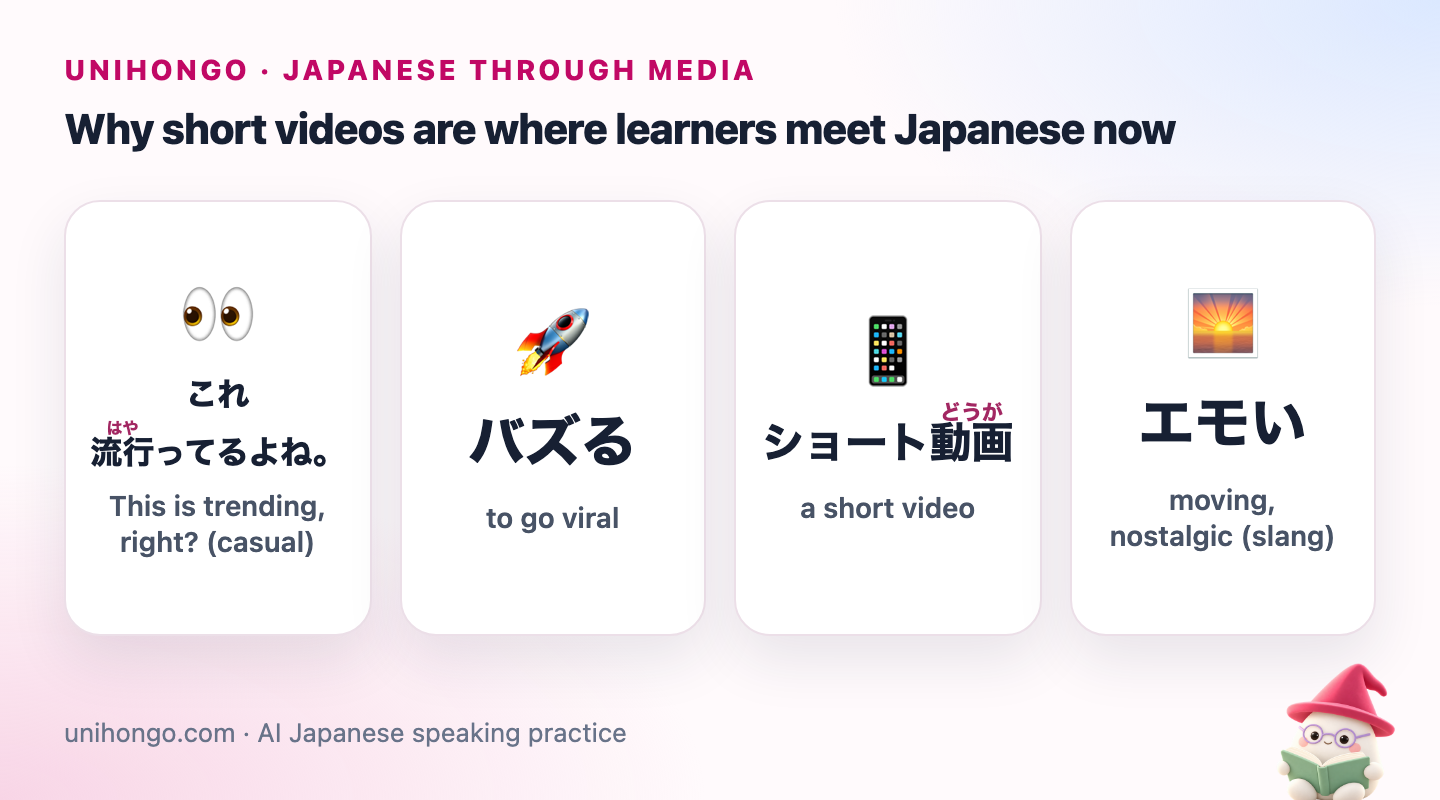
| Japanese | Romaji | Meaning |
|---|---|---|
| これ流行ってるよね。 | Kore hayatteru yo ne. | This is trending, right? (casual) |
| バズる | bazuru | to go viral |
| ショート動画 | shōto dōga | a short video |
| エモい | emoi | moving, nostalgic (slang) |
Hayatteru is the casual contraction of hayatte iru, from hayaru, to be popular or in fashion. It works for songs, dances, foods and phrases. Bazuru is about one post exploding in views; hayaru is about something spreading widely over time.
Which formats actually help
Not every clip is good input. Music-only dances teach you nothing, and rapid-fire memes are hard to follow. These formats give you the most language per second.
| Format | Japanese name | What you learn |
|---|---|---|
| Street interviews | gaitō intabyū | Ordinary people answering real questions |
| Day-in-the-life vlogs | ichinichi no nagare, rūtin | Daily-life verbs and narration |
| Relatable skits | aruaru | Office, school and family situations |
| Cooking clips | ryōri dōga | Imperatives, quantities, food words |
| Short explainers | kaisetsu dōga | One word or rule, explained in Japanese |
Aruaru (あるある) means a situation everyone recognises, from aru, to exist: it happens, it happens. Aruaru skits about the first week at a Japanese company or about living with parents are full of natural, polite and casual speech side by side.
Trend words and catchphrases
Short videos spread new words quickly. Some last for years, many vanish within months. Learn the stable core first, and treat the rest as listening material. For fuller lists, see our Japanese slang and yearly buzzword guides.
| Japanese | Romaji | Meaning |
|---|---|---|
| この動画、めっちゃバズってる。 | Kono dōga, metcha bazutteru. | This video is going crazy viral. |
| 私の推しが出てる! | Watashi no oshi ga deteru! | My fave is in this! |
| この景色、エモい。 | Kono keshiki, emoi. | This view gives me all the feels. |
| それな。 | Sore na. | Exactly. / So true. (slang) |
| わかる。 | Wakaru. | I know, right? (casual) |
Oshi (推し) is the person or character you support most, your fave. It can be an idol, an actor, an anime character or a creator. Metcha (very) started in western Japan and is now heard everywhere among younger speakers.
When not to use them: all of these are casual. With a teacher, a client or a new colleague, say sugoku ninki desu ne (it's really popular) instead of bazutteru, and sō desu ne instead of sore na.
Captions: help, not a crutch
Japanese short videos often have captions burned into the video, written by the creator, plus optional automatic captions from the app. Creator captions are usually accurate but may skip words or add jokes. Automatic captions can get names, slang and fast speech wrong.
Use captions as a check, not a script. On your first watch, read along. On the second, look away and listen. On the third, pause just before each caption appears and say what you think it will be.
| Japanese | Romaji | Meaning |
|---|---|---|
| 字幕なしで聞いてみる。 | Jimaku nashi de kiite miru. | I'll try listening without captions. |
| 今のところ、もう一回。 | Ima no tokoro, mō ikkai. | That part again, please. |
| 速すぎて聞き取れない。 | Hayasugite kikitorenai. | It's too fast to catch. |
Turn a 30-second clip into one minute of speech
The clip is input; your speaking is the output. Use the same four-part frame every time, so it becomes automatic: what the video is, what happens, why it is popular, and what you think.
| Japanese | Romaji | Meaning |
|---|---|---|
| この動画では、猫がお風呂を怖がっています。 | Kono dōga de wa, neko ga ofuro o kowagatte imasu. | In this video, a cat is scared of the bath. |
| でも、最後は気持ちよさそうに寝ちゃいます。 | Demo, saigo wa kimochiyosasō ni nechaimasu. | But at the end it falls asleep looking happy. |
| ギャップがかわいいから、バズったんだと思います。 | Gyappu ga kawaii kara, bazutta n da to omoimasu. | I think it went viral because the contrast is cute. |
| 私も、見るたびに笑ってしまいます。 | Watashi mo, miru tabi ni waratte shimaimasu. | I laugh every time I watch it, too. |
- Kono dōga de wa... In this video...
- Describe what happens in two short sentences, in the present tense.
- Explain why it is popular with ... kara, bazutta n da to omou.
- Give your opinion with watashi wa ... to omou, and one reason.
Gyappu, from the English gap, is a common word for an endearing contrast, such as a tough-looking person who loves cute things. It appears a lot when people explain why a clip is charming.
Comments: your first output to real people
The comment section under a Japanese clip is a low-pressure place to write your first real messages to native speakers. Comments are short, friendly and often formulaic, so you can learn the patterns quickly. Many creators reply, and other viewers may like your comment, which is a small but real reward for using Japanese.
Keep comments kind and specific. Polite desu and masu are safe when you address a creator you do not know, while casual comments are common between viewers. Saying where you are from is welcome on many accounts, and creators often enjoy hearing that their videos help learners.
| Japanese | Romaji | Meaning |
|---|---|---|
| 何回も見ちゃいます。 | Nankai mo michaimasu. | I can't stop rewatching this. |
| 字幕、ありがたいです! | Jimaku, arigatai desu! | Thanks so much for the captions! |
| これ、どこのお店ですか? | Kore, doko no omise desu ka? | Which shop is this? |
| 続き、待ってます! | Tsuzuki, mattemasu! | Looking forward to the next part! |
| 日本語の勉強になります。 | Nihongo no benkyō ni narimasu. | This really helps my Japanese study. |
Benkyō ni narimasu literally means it becomes study, and it is a polite way to say that something was informative. It is a compliment you can also use with teachers and colleagues after they explain something.
Mistake to avoid: copying aggressive or sarcastic comments you see under viral clips. Online slang can be harsh, and from a learner it may read as rude rather than funny.
Mini dialogue: explain a trending clip
Here is a casual exchange between two friends. One shows a clip, the other asks about it, and the first explains why it is trending. This is exactly the conversation you can practise after every clip you save.

| Japanese | Romaji | Meaning |
|---|---|---|
| ねえ、これ見た? | Nē, kore mita? | You: Hey, have you seen this? |
| まだ。何の動画? | Mada. Nan no dōga? | Friend: Not yet. What's the video? |
| 会社員のあるあるなんだけど、すごく流行ってるんだ。 | Kaishain no aruaru nan da kedo, sugoku hayatteru n da. | You: It's an office-worker relatable skit, and it's really trending. |
| へえ、どこが面白いの? | Hē, doko ga omoshiroi no? | Friend: Oh, what's funny about it? |
| 月曜日の朝の顔が、みんな同じなんだよ。 | Getsuyōbi no asa no kao ga, minna onaji nan da yo. | You: Everyone's Monday-morning face is the same. |
| わかる!それはバズるね。 | Wakaru! Sore wa bazuru ne. | Friend: So true! No wonder it went viral. |
Common mistakes with short-video Japanese
- Scrolling instead of studying. Twenty clips half-watched teach less than one clip watched three times and explained aloud.
- Using trend slang at work. Bazuru is widely understood, but sore na, metcha and emoi sound too casual in polite settings.
- Learning dead trends. If a phrase only appears in one month's clips, do not drill it.
- Trusting automatic captions. Check surprising words with the creator's caption or a dictionary.
- Copying exaggerated creator voices. Many creators perform a character; use ordinary interviewees as speaking models.