
Four reactions, four very different feelings
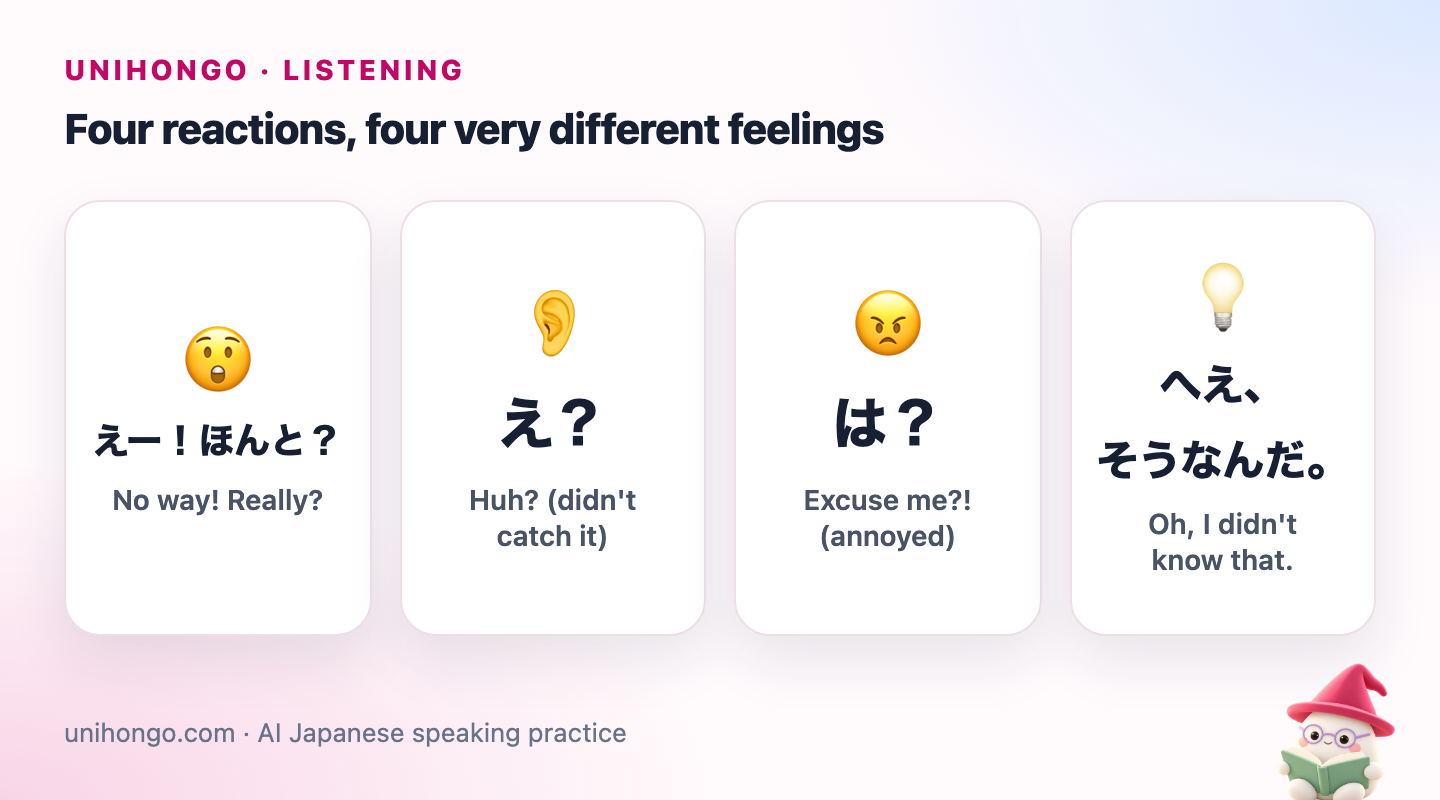
Japanese has a set of short sounds that do the job of whole sentences: what?, no way!, are you serious?, oh, interesting. The four below are the ones learners ask about most. They look tiny, but each carries a clear attitude.
| Japanese | Romaji | Meaning |
|---|---|---|
| えー!ほんと? | Ē! Honto? | No way! Really? |
| え? | E? | Huh? (didn't catch it) |
| は? | Ha? | Excuse me?! (annoyed) |
| へえ、そうなんだ。 | Hē, sō na n da. | Oh, I didn't know that. |
Pitch is the meaning: a quick map
In these reactions, the melody does almost all the work. A sound that rises usually asks something or shows surprise. A sound that falls usually shows understanding, disappointment or tiredness. A sound cut off short with a small catch, written with a small tsu (っ), shows a sudden reaction. Read the table with your voice, not just your eyes.
| Sound | Pitch shape | Typical meaning | Safe with a boss? |
|---|---|---|---|
| e? | Short, rising | Huh? I didn't catch that / mild surprise | Yes, if you follow it with a polite request |
| e! | Very short, sharp, with a catch | Startled: wait, what? | Yes |
| ē! | Long, rising or rising-falling | No way! Really? | Yes, when the news is good |
| ē... | Long, flat or falling | Aww / do I have to? | Avoid: sounds like complaining |
| ha? | Short, sharp rise | Excuse me?! (irritated) | No |
| hā | Long, falling, with a breath | A sigh, or a vague I see | Avoid the sigh |
| hē | Rising or rise-fall | Oh, interesting | Yes; hē, sō na n desu ne |
E, ē and e!: from huh? to no way!
Short e? with a modest rise is what you say when a word slipped past you, or when something is a little surprising. Make it sharper and add a catch, e! (えっ), and you sound startled. Stretch it into a long ē! that climbs and you are delighted or amazed: no way!
The long version has a second life. A flat or falling ē... is the sound of a child asked to tidy up: aww, do I have to? Adults use it jokingly with friends, but at work it sounds like a complaint.
| Japanese | Romaji | Meaning |
|---|---|---|
| え?今なんて言った? | E? Ima nante itta? | Huh? What did you just say? |
| え、もう終わり? | E, mō owari? | Wait, it's over already? (short, sharp) |
| えー、すごい! | Ē, sugoi! | No way, that's amazing! |
| えー、また残業? | Ē, mata zangyō? | Aww, overtime again? |
Ha? and hā: why one sounds hostile
Ha? with a short, sharp rise means something like excuse me?!, what did you just say? or are you serious?. It suggests the other person said something unreasonable, stupid or offensive. That is why it appears so often in anime arguments, and why it feels like a slap in real life. Even between friends it can start a fight unless the tone is clearly joking. A longer, lower hā? is even stronger.
A falling hā with a breath is quite different. Often it is a sigh of tiredness. Some older speakers also use a soft, falling hā as a vague, polite yes, I see when listening to a long explanation. Learners rarely need to produce either.
| Japanese | Romaji | Meaning |
|---|---|---|
| は?意味わかんない。 | Ha? Imi wakannai. | Huh?! That makes no sense. (rude) |
| はあ…疲れた。 | Hā... tsukareta. | Sigh... I'm tired. |
| はい? | Hai? | Yes? / Pardon? (polite, gentle tone) |
Hai? with a gentle rise is the polite cousin: yes? or pardon? It is safe with a customer or a teacher, though a sharp hai? can also sound irritated. Tone, again, decides.
A!, o!, hē and fūn: noticing and showing interest
A! (あっ) is the sound of noticing or remembering: oh! I forgot my umbrella. A long, falling ā shows that something finally makes sense: ah, I see. O! (おっ) is a pleasant little surprise, often at something good you just spotted; it is used by everyone, perhaps a little more often by men.
Hē is the classic interest reaction. Said brightly, it means huh, I didn't know that and encourages the speaker to keep going. Fūn (ふーん) is trickier: a flat fūn can sound like I don't care, so use it with a warm voice or avoid it.
| Japanese | Romaji | Meaning |
|---|---|---|
| あ、傘忘れた! | A, kasa wasureta! | Oh! I forgot my umbrella! |
| あー、なるほど。 | Ā, naruhodo. | Ah, I see. |
| お、いいね! | O, ii ne! | Oh, nice! |
| ふーん、そう。 | Fūn, sō. | Hmm, okay. (can sound cold) |
Scenario: your friend has big news
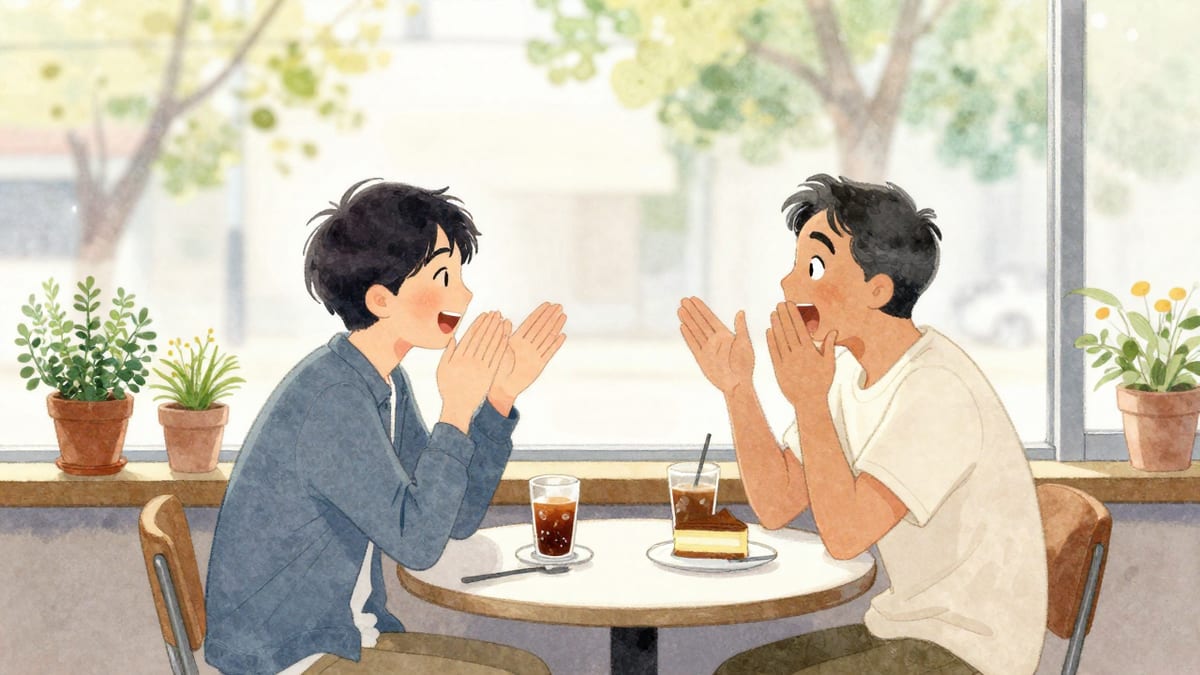
Your friend Sota sits down at the café, smiles, and announces that he is moving to Okinawa next month. You want to react like a friend: surprised, happy, curious. Notice that ha? would be a disaster here: it would sound as though you think the plan is ridiculous.
| Japanese | Romaji | Meaning |
|---|---|---|
| 実は来月、沖縄に引っ越すんだ。 | Jitsu wa raigetsu, Okinawa ni hikkosu n da. | Sota: Actually, I'm moving to Okinawa next month. |
| えー!ほんと? | Ē! Honto? | You: No way! Really? |
| うん、仕事でね。 | Un, shigoto de ne. | Sota: Yeah, for work. |
| へえ、いいなあ!海の近く? | Hē, ii nā! Umi no chikaku? | You: Wow, lucky you! Near the sea? |
| そう、歩いて五分。 | Sō, aruite gofun. | Sota: Yes, a five-minute walk. |
| えー、絶対遊びに行く! | Ē, zettai asobi ni iku! | You: No way, I'm definitely coming to visit! |
Follow the sound with a word
A one-sound reaction is only the first half of a good response. Japanese listeners usually add a short line straight after it, and that line tells the speaker how you feel about the news. Ē! followed by sugoi is delight; ē followed by sore wa taihen datta ne is sympathy. Without the follow-up, even a friendly ē can leave the speaker unsure.
Uso! (literally a lie) is a very common way of saying no way! and is not an accusation. Maji de? means seriously? and is slangy and young. With older people or in polite conversation, hontō desu ka? is the safe version.
| Japanese | Romaji | Meaning |
|---|---|---|
| うそ! | Uso! | No way! (not an accusation) |
| マジで? | Maji de? | Seriously? (slangy) |
| よかったね! | Yokatta ne! | That's great news! |
| それは大変だったね。 | Sore wa taihen datta ne. | That must have been tough. |
| 本当ですか。 | Hontō desu ka. | Really? (polite) |
Safe alternatives when you did not hear
Learners often use e? as a full request, repeating it until the speaker gives up. A short e? is fine as a first reaction, but follow it with words. With friends, a casual line is enough; with a teacher, a clerk or a boss, use a polite request.
| Japanese | Romaji | Meaning |
|---|---|---|
| え、なに?もう一回言って。 | E, nani? Mō ikkai itte. | Huh, what? Say it again. (casual) |
| すみません、もう一度お願いします。 | Sumimasen, mō ichido onegaishimasu. | Sorry, could you say that again? |
| もう少しゆっくりお願いします。 | Mō sukoshi yukkuri onegaishimasu. | A little more slowly, please. |
- Friends: e, nani? or mō ikkai itte.
- Polite: sumimasen, mō ichido onegaishimasu.
- When the speed is the problem: mō sukoshi yukkuri onegaishimasu.
- Never ha? to anyone you are not already joking with.