
It is not speed
The universal learner description of natural Japanese is that it is too fast. That is almost always the wrong diagnosis, and it leads to the wrong remedy, which is listening to more material hoping the speed becomes manageable.
What is actually happening is that the signal has changed shape. Sounds at word boundaries have merged, some vowels have dropped, particles have been absorbed into the words before them, and common phrases have contracted well beyond what their written forms show.
The test is simple: slow the recording down. If a slowed version is still hard, speed was not the problem, and what you need is to learn which reductions occur rather than to listen harder.
Particles disappear into the word before
The single biggest source of lost boundaries is the particle. A particle is one mora, unstressed, and it attaches acoustically to the word before it, so the boundary a learner is listening for is simply not there.
Worse, in casual speech particles are frequently dropped altogether, so you are listening for a boundary marker that has been deleted.
| Japanese | Romaji | Meaning |
|---|---|---|
| これはなに | kore wa nani | Often heard as one unit |
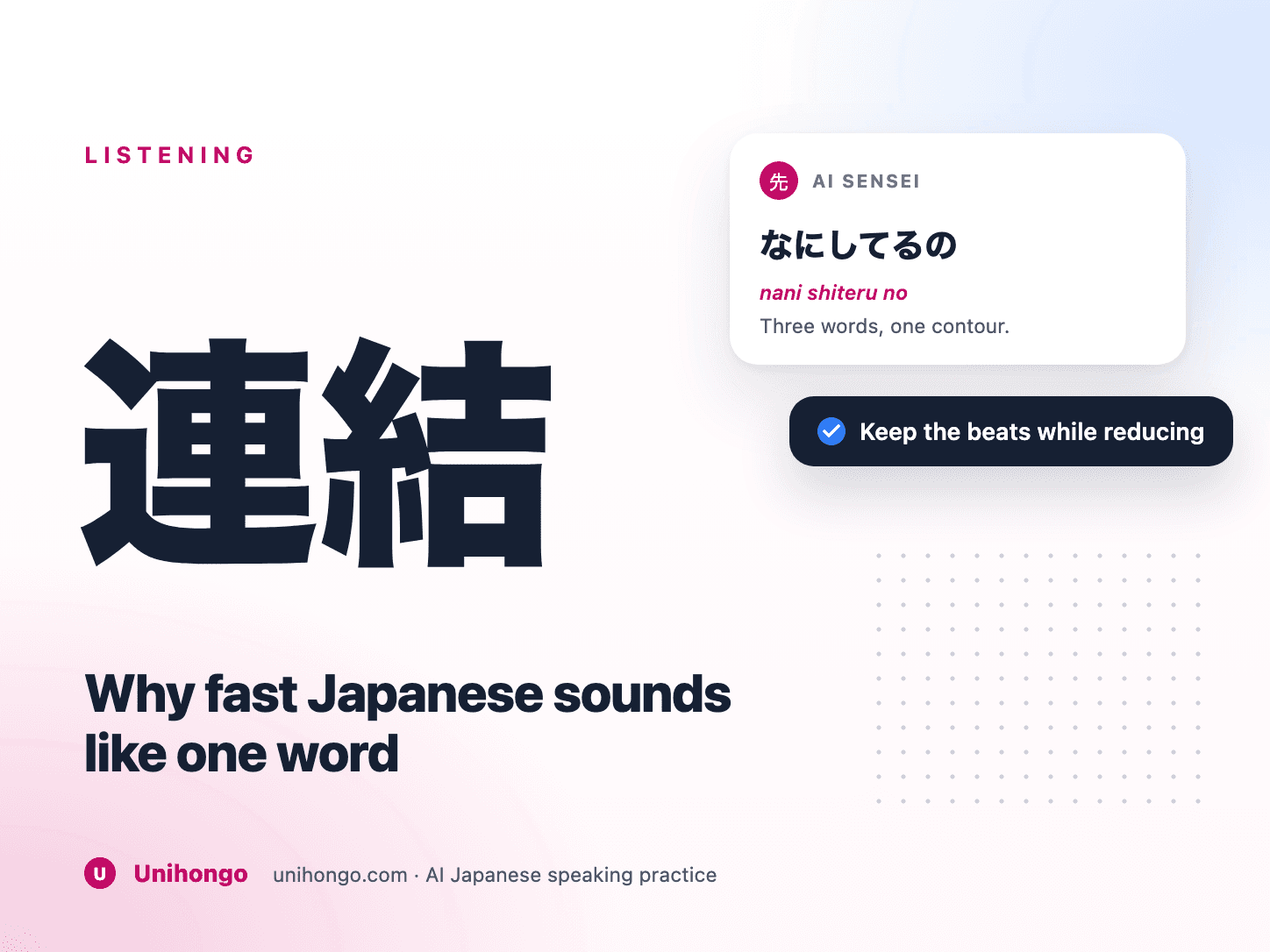
| なにしてるの | nani shiteru no | Three words, one contour |
| どこいくの | doko iku no | The particle is dropped |
| ごはんたべた | gohan tabeta | The particle is dropped |
| それでいいよ | sore de ii yo | Runs together completely |
| わたしのじゃない | watashi no ja nai | Contracted and merged |
Listening for words is the wrong unit. Listen for phrases, because the phrase is what has a single pitch contour and a boundary you can actually hear.
The contractions that carry most of it
A small number of contractions account for a large proportion of the difficulty, because they occur in almost every sentence. Learning these twenty or so forms does more for listening than hundreds of hours of general exposure.
These are not slang. Most appear in ordinary polite conversation, and several are so standard that the full forms sound stilted in speech.
| Full form | Contracted | Meaning |
|---|---|---|
| ている | てる | Progressive |
| ておく | とく | Do in advance |
| てしまう | ちゃう | Do completely, regrettably |
| なくては | なくちゃ | Have to |
| ければ | きゃ | If |
| という | って | Quoting |
| のだ | んだ | Explanatory |
The first one alone accounts for an enormous share of the gap between textbook listening and real listening, because the progressive is everywhere.
Sounds that vanish
Beyond the standard contractions, individual sounds drop in predictable places. Devoiced vowels between voiceless consonants can disappear entirely in fast speech, and the r of some common endings weakens or vanishes.
These are worth knowing about rather than memorising, because recognising the pattern is enough for your ear to start filling the gap.
| Japanese | Romaji | Meaning |
|---|---|---|
| です | desu | The final u is often silent |
| ます | masu | The final u is often silent |
| わからない | wakaranai | Often heard as wakannai |
| すみません | sumimasen | Often heard as suimasen |
| ところ | tokoro | Often heard as toko |
| ちがう | chigau | Often heard as chau in some regions |
Producing it is how you learn to hear it
The most effective way to start hearing reduced forms is to produce them. Once your mouth makes the contraction, your ear knows what to expect, and forms that were previously inaudible become obvious.
This is counterintuitive, since listening feels like the skill in question, but it is consistently the faster route. Ten minutes producing contractions does more than an hour of passive listening.
- Take one contraction, such as the progressive, and use only that form for a week.
- Say full and contracted versions back to back so the mapping is explicit.
- Shadow a short natural line, copying the reductions rather than the spelling.
- Transcribe what you actually hear, then compare it with the script.
- Do not chase new material; repeat one short segment many times.
Keeping the beats while you reduce
There is a trap in this for learners. Contracting is a change of form, not a licence to compress the rhythm, and a learner who has just discovered reduced speech often produces something that has lost its mora timing along with its full forms.
That is worth checking, because it is exactly the kind of error that sounds fine to the person making it. Unihongo's pronunciation lab scores a line against a native model, so a contracted form that has also lost a beat shows up rather than passing as natural.
The other half is exposure to speech that was never adjusted for you, which is where these forms actually live. Regular spoken sessions in the immersive 3D classroom keep you producing them under real time pressure, and the report catches the ones that came apart.
Learn to hear all of these before you produce all of them. Comprehension of reduced speech is the urgent half; producing it is optional polish.