

What you will hear in an easy news item
An easy news item is between forty seconds and two minutes long. It opens with a headline sentence that packs the topic, the actor and the event into one line, usually ending in a noun or a plain verb. The body has three to six sentences, each on its own line, with difficult words followed by a short explanation. It usually ends with a quotation from someone involved, introduced by to hanashite imasu, or with a statement of what will happen next, ending in yotei desu or koto ni shite imasu.
The reading is slow, roughly two thirds of normal news speed, with a clear pause at every full stop. The announcer adds no emotion, so intonation does the structural work: a slight rise on the topic particle wa, a fall at the end of each sentence. Hear those two signals and you can segment the item without understanding every word.
| Japanese | Romaji | Meaning |
|---|---|---|
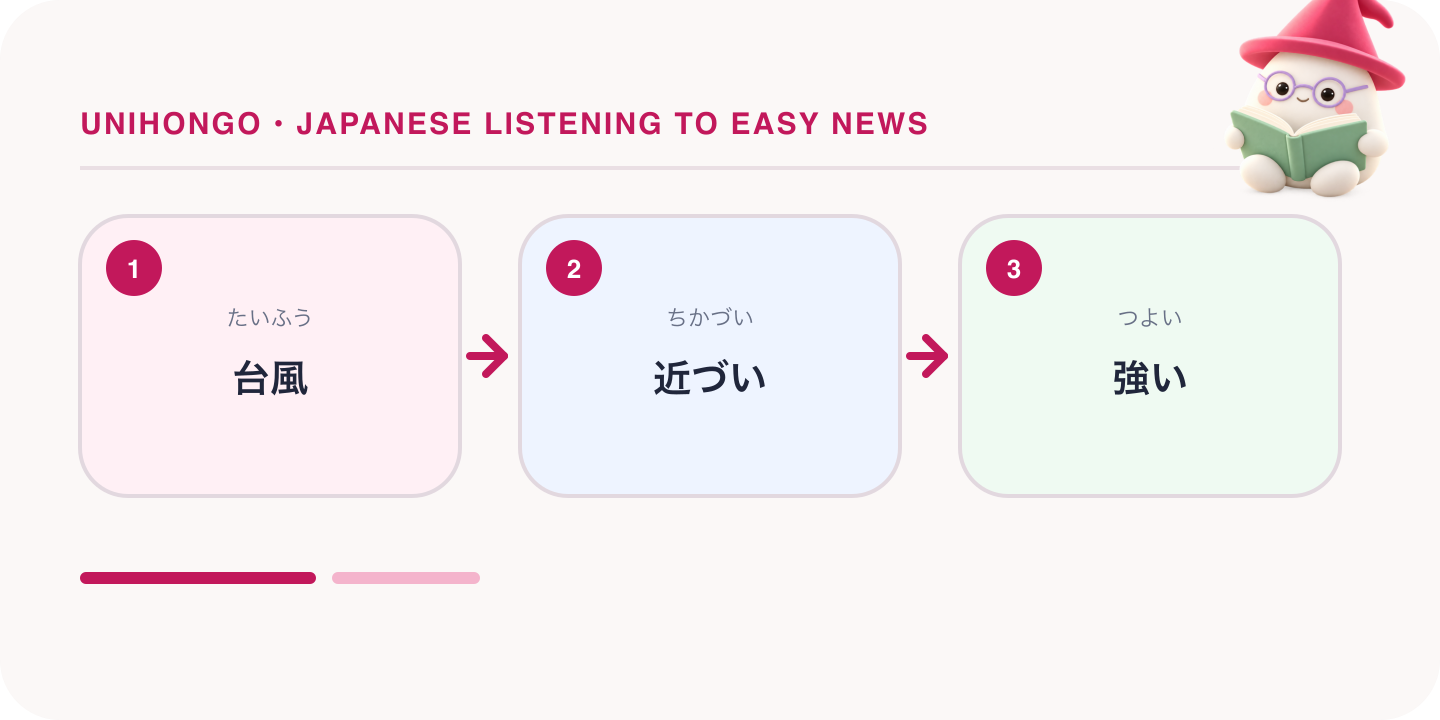
| 大きな台風が九州に近づいています。 | Ōkina taifū ga Kyūshū ni chikazuite imasu. | A large typhoon is approaching Kyūshū. |
| 気象庁は、強い雨に注意するように言っています。 | Kishōchō wa, tsuyoi ame ni chūi suru yō ni itte imasu. | The weather agency is telling people to be careful of heavy rain. |
| この会社は、新しいロボットを作りました。 | Kono kaisha wa, atarashii robotto o tsukurimashita. | This company has made a new robot. |
| 来月から、料金が高くなります。 | Raigetsu kara, ryōkin ga takaku narimasu. | From next month, the fee will go up. |
| 市は、来年の春に新しい図書館を開く予定です。 | Shi wa, rainen no haru ni atarashii toshokan o hiraku yotei desu. | The city plans to open a new library next spring. |
| 参加した人は「とても楽しかった」と話していました。 | Sanka shita hito wa 'totemo tanoshikatta' to hanashite imashita. | A participant said it was great fun. |
The structure of a news item
Japanese news, easy or not, follows a fixed order that you can use as a listening map. Knowing the map means you always know what kind of information is arriving, which halves the load on your working memory.
- Headline: topic plus event in one sentence, often ending in a noun or a plain verb
- Lead: who did what, where, and when, in one or two sentences with wa and ga
- Background: what the thing is or why it matters, with the explanation of any hard word
- Detail: numbers, dates, places and comparisons with last year
- Voice: a quotation from an official, a participant or an expert
- Outlook: what will happen next, ending in yotei desu, mitōshi desu or koto ni narimashita
Numbers almost always sit in the detail section, so if numbers are your weakness, brace for them after the background sentence. Quotations are marked by a change in register: the plain or casual form inside the quote, then to hanashite imasu after it.
Weather and disaster items add a fixed safety line near the end, chūi shite kudasai, please be careful, or ki o tsukete kudasai. Political and business items end with a date for the next step. Sports and culture items end with the quotation. Learn which ending to expect from the topic and you will rarely be surprised.
Headline vocabulary to pre-learn
Easy news reuses a small set of nouns and verbs. Learn these before you start and you will recognise most headlines on the first hearing. The readings are the ones the announcer uses, so say them aloud with the pitch you hear.
| Word | Reading | Meaning in news |
|---|---|---|
| 政府 | seifu | the government |
| 発表する | happyō suru | to announce |
| 調査 | chōsa | a survey or investigation |
| 事故 | jiko | an accident |
| 地震 | jishin | an earthquake |
| 避難 | hinan | evacuation |
| 注意 | chūi | caution, warning |
| 増える | fueru | to increase |
| 減る | heru | to decrease |
| 予定 | yotei | plan, schedule |
| 始まる | hajimaru | to begin |
| 会社 | kaisha | a company |
Alongside these, learn the names you will hear every week: the weather agency, kishōchō; the prime minister, sōri daijin; a city office, shiyakusho; and the police, keisatsu. Names are the hardest words to catch because you cannot guess them from context.
Sample lines from typical stories
The lines below are in the style of easy news, one from each common topic. Cover the romaji and English, listen to yourself read the Japanese, and identify which part of the structure each line belongs to: headline, lead, detail, voice or outlook.
| Japanese | Romaji | Meaning |
|---|---|---|
| 去年、日本に来た外国人は前の年より増えました。 | Kyonen, Nihon ni kita gaikokujin wa mae no toshi yori fuemashita. | The number of foreigners who came to Japan last year rose compared with the previous year. |
| 地震があった地域では、まだ電気が使えないところがあります。 | Jishin ga atta chiiki de wa, mada denki ga tsukaenai tokoro ga arimasu. | In the area hit by the earthquake, there are still places without electricity. |
| この祭りは、四百年以上前から続いています。 | Kono matsuri wa, yonhyaku-nen ijō mae kara tsuzuite imasu. | This festival has continued for over four hundred years. |
| 警察は、事故の原因を調べています。 | Keisatsu wa, jiko no gen'in o shirabete imasu. | The police are investigating the cause of the accident. |
| 専門家は「早く病院に行ってください」と話しています。 | Senmonka wa 'hayaku byōin ni itte kudasai' to hanashite imasu. | An expert says to go to hospital quickly. |
| 新しいサービスは、来週の月曜日に始まります。 | Atarashii sābisu wa, raishū no getsuyōbi ni hajimarimasu. | The new service starts next Monday. |
| この薬は、子どもも飲むことができます。 | Kono kusuri wa, kodomo mo nomu koto ga dekimasu. | Children can take this medicine too. |
The sound features that still make it hard
Even slow, clear news has traps. The first is long pre-noun modifiers. A sentence like jishin ga atta chiiki puts a whole clause before the noun chiiki, so you hear an event, then discover it was only describing a place. In English the order is reversed. Train yourself to hold clauses in suspension until a noun arrives to attach them to.
The second is dense Sino-Japanese vocabulary. Words like chōsa, hinan and happyō are short, have many homophones and carry no obvious sound clue. They are easy to read because the kanji disambiguate, and easy to mishear because the sounds do not. The fix is to learn them by ear in context, not as a list.
The third is numbers and dates, which come in the detail section at the same slow speed but with no extra help. A guide on this site about catching numbers and prices fast covers the sound changes in depth. The fourth is proper names: a town you have never heard of sounds like a string of random syllables, and the announcer will not explain it. Accept that names will slip past you on the first listen and pick them up from the script.
| Japanese | Romaji | Meaning |
|---|---|---|
| 去年の同じ月と比べて、二割ぐらい増えました。 | Kyonen no onaji tsuki to kurabete, ni-wari gurai fuemashita. | Compared with the same month last year, it rose by about twenty percent. |
| 三月十一日に、大きな地震がありました。 | San-gatsu jū-ichi-nichi ni, ōkina jishin ga arimashita. | There was a large earthquake on the eleventh of March. |
| 日本で働く外国人は、二百万人以上になりました。 | Nihon de hataraku gaikokujin wa, nihyaku-man-nin ijō ni narimashita. | Foreigners working in Japan now number over two million. |
A step-by-step daily drill
The drill below takes ten to fifteen minutes with one item. It moves from full support to none, and the last step, shadowing, is what turns recognition into fluent listening. Do it every day with a fresh item and keep old ones for review at the weekend.
- Read the headline only and predict the story in one sentence, in English or Japanese
- Listen once without the script and write who, what and where, even if you are guessing
- Read the script silently, checking your guesses and looking up at most three words
- Listen a second time while reading along, following the announcer's pauses with your finger
- Listen a third time without the script and note anything you now catch that you missed first time
- Shadow the item: play it and speak a fraction behind the announcer, matching pauses and pitch
- Retell the story aloud in three sentences without looking at anything
The retelling is the step most people skip and the one that matters most. If you cannot retell a story you have heard three times, you have been recognising words rather than understanding a message.
Moving to normal news
The step from easy news to the normal bulletin is mostly a step in speed and vocabulary density, not in structure. The same who, what, where map applies, the same closing patterns appear, and the same names recur. The vocabulary changes in one predictable way: easy news explains, normal news assumes. Where easy news says a place where people go when it is dangerous, normal news says hinanjo. Learn the compressed forms and the two registers converge.
Use the same story in both formats. Easy news items are usually simplified from a bulletin broadcast the same day, so find the original, listen to it after you have mastered the easy version, and notice how the sentences were compressed. Then try a new normal news item cold with the drill above. Expect your first-listen comprehension to fall sharply and recover within a few weeks.
A related article on this site covers reading Japanese news, headline grammar and the written conventions. This one stops at the ear: once you can follow a bulletin by sound, that reading guide will help you go faster through the text.
| Japanese | Romaji | Meaning |
|---|---|---|
| ニュースを聞いて、だいたいわかりました。 | Nyūsu o kiite, daitai wakarimashita. | I listened to the news and understood most of it. |
| この言葉は、やさしいニュースではどう説明していましたか。 | Kono kotoba wa, yasashii nyūsu de wa dō setsumei shite imashita ka. | How did the easy news explain this word? |
| 普通のニュースは、まだ速すぎます。 | Futsū no nyūsu wa, mada hayasugimasu. | The normal news is still too fast for me. |
| 同じニュースを両方で聞き比べています。 | Onaji nyūsu o ryōhō de kikikurabete imasu. | I'm comparing the same story in both versions. |
When it stops working
The commonest failure is boredom. Easy news covers disasters, politics and business, and if none of those interests you, motivation dies in a fortnight. Choose the items you would read in your own language and skip the rest. Another is plateauing: you understand every item but the normal news still sounds like noise. That means you have outgrown the format and should move up.
A subtler problem is script dependence. If you always read first, you are practising reading with audio in the background. Do the blind listen before opening the script, every time, and write your guesses down, because committing to a guess is what makes the correction stick. And if a story is about a topic you know nothing about in any language, skip it: background knowledge is half of comprehension.
| Japanese | Romaji | Meaning |
|---|---|---|
| この話題はよく知らないので、別のニュースにします。 | Kono wadai wa yoku shiranai node, betsu no nyūsu ni shimasu. | I don't know much about this topic, so I'll pick a different story. |
| 先に聞いてから、原稿を読みます。 | Saki ni kiite kara, genkō o yomimasu. | I'll listen first, then read the script. |
| やさしいニュースは簡単になってきました。 | Yasashii nyūsu wa kantan ni natte kimashita. | Easy news has started to feel easy. |