
Why answering teaches your ears more than replaying
When you listen to a recording you control the outcome. You can rewind, read the transcript, or decide that the gist was close enough. Nothing checks you. In a conversation the check is built in: if you misheard the time, you agree to the wrong time and the other person corrects you. That immediate consequence turns a vague feeling of comprehension into information you can act on, which is why interactive listening tends to move faster than hours of background audio.
There is a second effect. Because you must answer, you cannot translate. Translation is a luxury of paused audio, and it collapses the moment someone is looking at you. Regular spoken exchanges force your brain to work from Japanese chunks directly, and that shift, not vocabulary, is what makes natural speed stop feeling fast. An AI tutor is useful here simply because you can create the same pressure ten times a day, with infinite patience on the other side.
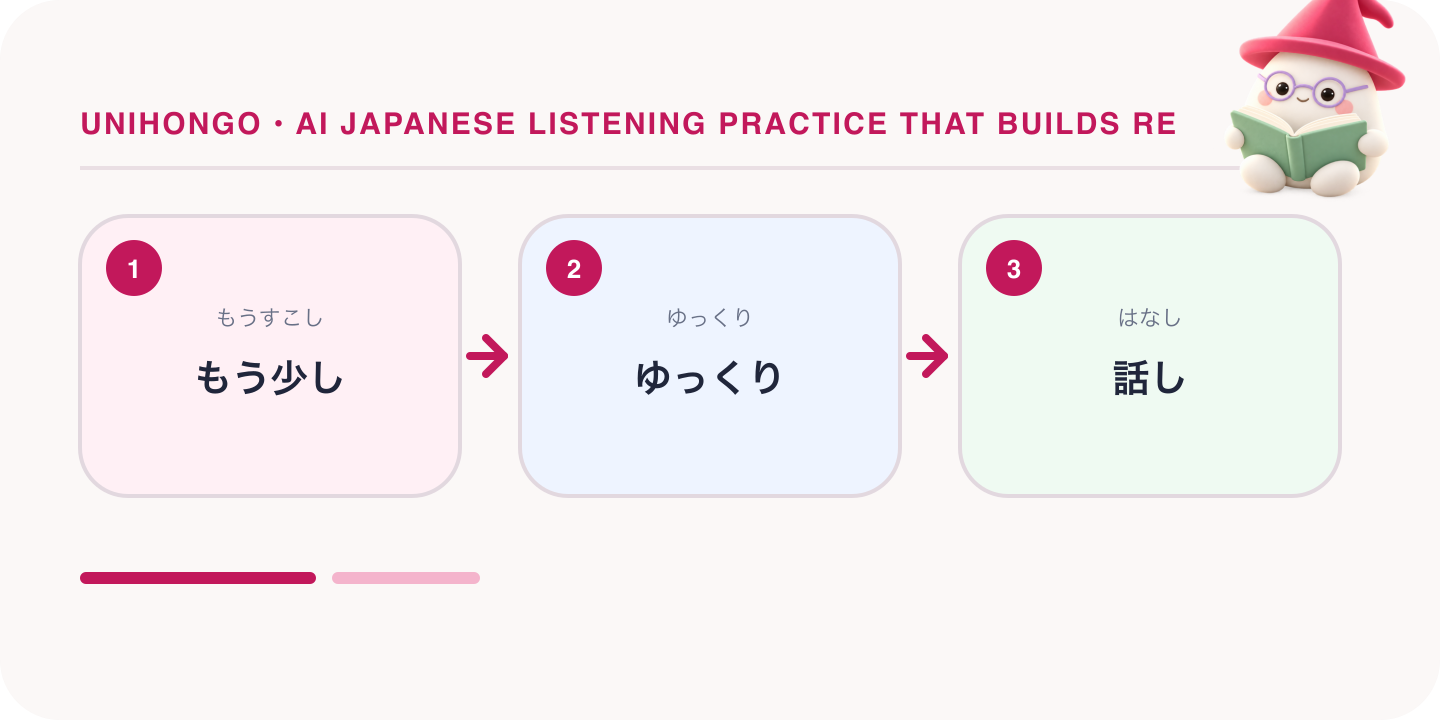
Use speed as a deliberate setting
Most learners have one speed request and use it constantly: please speak slowly. That helps on day one and holds you back by month three, because slow speech removes the contractions, the linked sounds, and the swallowed particles that make real Japanese hard. Decide the speed before the session starts and say so in Japanese, then stay with it. Slow speech is for decoding a grammar pattern you have not met before. Natural speed is where the actual training happens.
Faster than natural is a stress test, not a punishment. Ask for it for two or three minutes at the end of a session on a topic you already handle well, such as ordering food or explaining your weekend. You will miss more, and that is the point: when you return to natural speed, it sounds noticeably slower. Use fast passages sparingly, because practising in permanent panic teaches you to guess rather than listen.
| Japanese | Romaji | Meaning |
|---|---|---|
| もう少しゆっくり話していただけますか。 | Mō sukoshi yukkuri hanashite itadakemasu ka. | Could you speak a little more slowly? |
| 普通のスピードでお願いします。 | Futsū no supīdo de onegaishimasu. | Please use normal speed. |
| 今日は速めでお願いします。 | Kyō wa hayame de onegaishimasu. | Please go a bit faster today. |
| ゆっくりでなくて大丈夫です。 | Yukkuri de nakute daijōbu desu. | You do not need to slow down for me. |
| 短い文でお願いします。 | Mijikai bun de onegaishimasu. | Please use short sentences. |
| 同じ速さでもう一度お願いします。 | Onaji hayasa de mō ichido onegaishimasu. | Once more at the same speed, please. |
| 最後の三分だけ速くしてください。 | Saigo no sanpun dake hayaku shite kudasai. | Please speed up for the last three minutes only. |
Notice that the last request matters as much as the first. Asking for the same sentence again at the same speed is a real listening exercise, while asking for it slowly gives you a different, easier sentence. Say onaji hayasa de mō ichido onegaishimasu at least twice per session and only fall back to yukkuri when a second pass at full speed still leaves you blank.
The ask-again loop is the exercise, not the failure
Learners treat a repeat request as an apology. Reframe it as a tool with a dial. A vague please say that again gives you the whole sentence back and no new information. A specific request tells your partner what to fix, and it also tells you what you did hear, which is the more useful half. Say which part you lost, name the word you think you caught, or ask for easier vocabulary, and the second attempt becomes a targeted drill instead of a rerun.
These are also the phrases that save you in Japan, so they deserve real rehearsal rather than a place on a list. Practise them until they arrive without thought, because you will need them at precisely the moment when thinking is hardest: a station announcement, a pharmacist asking about symptoms, a host explaining tomorrow's plan.
| Japanese | Romaji | Meaning |
|---|---|---|
| すみません、もう一度お願いします。 | Sumimasen, mō ichido onegaishimasu. | Sorry, once more please. |
| 最後のところがよく聞こえませんでした。 | Saigo no tokoro ga yoku kikoemasen deshita. | I could not hear the last part clearly. |
| 「予約」の後は何と言いましたか。 | Yoyaku no ato wa nan to iimashita ka. | What did you say after yoyaku? |
| もっと簡単な言葉で言ってもらえますか。 | Motto kantan na kotoba de itte moraemasu ka. | Could you say that in easier words? |
| 今の言葉の意味を教えてください。 | Ima no kotoba no imi o oshiete kudasai. | Please tell me what that word means. |
| ゆっくり、区切って言ってください。 | Yukkuri, kugitte itte kudasai. | Please say it slowly, with pauses. |
| 数字だけもう一度お願いします。 | Sūji dake mō ichido onegaishimasu. | Just the number once more, please. |
| つまり、七時に集合ということですか。 | Tsumari, shichi-ji ni shūgō to iu koto desu ka. | So you mean we meet at seven? |
| 半分わかりました。前半をお願いします。 | Hanbun wakarimashita. Zenhan o onegaishimasu. | I understood half of it. Could you repeat the first part? |
A tutor will usually answer a specific request with a rebuilt sentence rather than the same one: hai, mō ichido iimasu ne. Kin'yōbi no yoru, shichi-ji ni eki de aimashō. Confirm what you now understand with tsumari before moving on, because a confirmed detail is worth more than a polite nod. The confirmation habit is also what stops a small mishearing from becoming a missed train.
Shadowing inside a live conversation
Shadowing with recordings works well, but it happens outside any real exchange, so the sentences you copy are never the sentences you need. Doing it live fixes that. When your partner says something you found difficult, stop the flow, repeat the sentence aloud immediately, then continue the conversation. You are copying the rhythm of a line that just mattered to you, which makes it far more likely to stay.
Keep it short. Two or three shadowed sentences per session is plenty; more turns the conversation into a pronunciation lesson and kills the listening pressure that made it valuable. Aim to copy the melody rather than each mora, because Japanese pitch and timing carry a surprising amount of the meaning that beginners try to recover from vocabulary alone.
| Japanese | Romaji | Meaning |
|---|---|---|
| 今の文をもう一度言ってください。まねします。 | Ima no bun o mō ichido itte kudasai. Mane shimasu. | Please say that sentence again. I will copy it. |
| 一文ずつ、後について言います。 | Ichibun zutsu, ato ni tsuite iimasu. | I will repeat after you, one sentence at a time. |
| 私の発音を直してください。 | Watashi no hatsuon o naoshite kudasai. | Please correct my pronunciation. |
| 今のイントネーションで合っていますか。 | Ima no intonēshon de atte imasu ka. | Was my intonation right just now? |
| この言い方、自然ですか。 | Kono iikata, shizen desu ka. | Does this way of saying it sound natural? |
The pronunciation coaching in a spoken tutor session is useful here for a reason that is easy to miss: the sounds you cannot produce are often the sounds you cannot hear. Learners who never distinguish kite and kitte in their own speech usually fail to catch the difference in someone else's. Fixing production and perception together is faster than treating them as separate subjects, and the guide to Japanese pronunciation covers the individual sounds in more detail.
The meaning lives in the tail of the sentence
English puts the decisive word early: I will not go. Japanese saves it for the end, so a sentence can travel a long way before it turns out to be a negative, a past tense, a maybe, or a prohibition. Beginners listen hard to the first half, relax once they recognise the nouns, and then miss the four syllables that reverse everything. Train the opposite habit: hold the middle loosely and listen hardest as the speaker approaches the verb.
A good drill is to ask your tutor to say the same sentence with different tails and to answer only after the ending arrives. Shashin o totte mo ii desu and shashin o totte wa ikemasen share every word until the last breath. If you answer from the nouns, you will take a photo in a shrine that forbids it.
| Japanese | Romaji | Meaning |
|---|---|---|
| 写真を撮ってもいいですよ。 | Shashin o totte mo ii desu yo. | You may take photos. |
| 写真を撮ってはいけません。 | Shashin o totte wa ikemasen. | You must not take photos. |
| 予約しなくてもいいです。 | Yoyaku shinakute mo ii desu. | You do not have to book. |
| 予約しなければなりません。 | Yoyaku shinakereba narimasen. | You have to book. |
| 昨日は行きました。 | Kinō wa ikimashita. | I went yesterday. |
| 昨日は行きませんでした。 | Kinō wa ikimasen deshita. | I did not go yesterday. |
| 明日は雨が降るかもしれません。 | Ashita wa ame ga furu kamoshiremasen. | It might rain tomorrow. |
| 店は開いていないようです。 | Mise wa aite inai yō desu. | It seems the shop is not open. |
| ここでは食べられません。 | Koko de wa taberaremasen. | You cannot eat here. |
| 中止になりそうです。 | Chūshi ni narisō desu. | It looks as though it will be cancelled. |
A tail-listening checklist
| Ending | What it signals | Easily confused with |
|---|---|---|
| 〜ませんでした | Past negative | 〜ました, the past positive |
| 〜てもいいです | Permission granted | 〜てはいけません, a prohibition |
| 〜なくてもいいです | Not necessary | 〜なければなりません, an obligation |
| 〜かもしれません | A possibility only | 〜でしょう, a confident expectation |
| 〜ようです | An inference from evidence | A plain statement of fact |
| 〜そうです | Hearsay or an impression | A first-hand report |
| 〜ておきます | Doing it in advance | 〜ています, an action in progress |
| 〜たら | A condition is attached | An unconditional promise |
| 〜ていただけますか | A polite request aimed at you | An offer of help to you |
Print this or keep it open for a week of sessions, then close it. The aim is not to memorise a table but to build the reflex of waiting. Whenever you catch yourself answering before the speaker finishes, count one beat after the verb before you open your mouth, and the guide to Japanese verb conjugation will fill in any endings on this list that are still unfamiliar.
Test yourself with scenarios you have not rehearsed
Repetition makes any scene comprehensible, which is exactly why a rehearsed roleplay stops testing your listening after the third run. You are no longer hearing the sentences; you are recognising the shape of a conversation you already know. To find out what your ears can really do, you need a scene you have not prepared for, with vocabulary you did not choose.
Once a week, ask for a surprise. Give no topic, no level statement, and no vocabulary list, and ask your tutor to pick the situation and to add one complication partway through. A lost umbrella, a delayed train, a shop assistant who suggests something else. Your job is not to perform well but to stay in the conversation and to walk out knowing what the arrangement was.
| Japanese | Romaji | Meaning |
|---|---|---|
| すみません、状況がよくわかっていません。 | Sumimasen, jōkyō ga yoku wakatte imasen. | Sorry, I have not quite understood the situation. |
| 確認させてください。 | Kakunin sasete kudasai. | Let me confirm that. |
| 十二時半で合っていますか。 | Jūni-ji han de atte imasu ka. | Is half past twelve correct? |
| 少し待ってください、メモします。 | Sukoshi matte kudasai, memo shimasu. | Please wait a moment, I will make a note. |
| どうすればいいか教えてください。 | Dō sureba ii ka oshiete kudasai. | Please tell me what I should do. |
| それは今日ですか、明日ですか。 | Sore wa kyō desu ka, ashita desu ka. | Is that today or tomorrow? |
- Ask for a situation you have never practised and refuse to be told what it is in advance.
- Answer only from what you heard, never from what you assumed the scene would contain.
- Write down the single detail that decides the outcome: a time, a price, a platform, a date.
- Confirm that detail aloud in Japanese before the scene ends.
- Afterwards, check the report and count how many turns you answered around rather than understood.
What AI listening practice does badly
Being honest about the limits keeps you from over-trusting the practice. An AI tutor has no shared history with you, so it will not say the equivalent of how did that meeting go, and much of real listening is built on context you both already hold. It may mis-hear a strong accent, a quiet room, or a phone speaker, and it will occasionally answer a question you did not ask, which can feel like your own comprehension failing when it is not.
It also cannot supply the two things that make live Japanese hard: noise and nerves. Real listening happens over a tannoy, in a crowded izakaya, with two people talking at once, and with the fear that you are holding up a queue. And nothing in a chat window will hold you accountable for skipping four days. Pair the practice with recorded material for noise, with real speakers for unpredictability, and with a calendar for consistency.
- Add background noise deliberately by practising once a week in a cafe or with a fan running.
- Use recorded natural speech for the messiness a tutor will not produce on its own.
- Book one real conversation a month so exam-day nerves are not a total stranger.
- Keep a fixed slot in your week; a free tier only helps if you actually open it.
A weekly listening plan
| Day | Focus | Length |
|---|---|---|
| Monday | Natural speed conversation on a familiar topic, transcript off | 15 minutes |
| Tuesday | Recorded audio you understand most of, twice through | 15 minutes |
| Wednesday | Ask-again drill: a session where you must use five repeat requests | 10 minutes |
| Thursday | Tail listening: same sentence, changed endings, answer after the verb | 10 minutes |
| Friday | Live shadowing of three difficult sentences inside a conversation | 15 minutes |
| Saturday | Unrehearsed scenario chosen by the tutor, with one complication | 15 minutes |
| Sunday | Review the week's reports and repeat the sentences you missed | 10 minutes |
Ninety minutes a week is enough to feel a change within a month, provided the sessions are spoken rather than read. If a day is impossible, drop the recorded audio before you drop the interactive work, because passive listening is the part you can catch up on during a commute. The one session to protect is Saturday's unrehearsed scene, since it is the only honest measurement in the week.
Signs your ears are actually improving
- You notice a negative ending and change your answer before you finish nodding.
- You ask for repetition of one specific part rather than the whole sentence.
- Natural speed stops sounding fast after a few minutes of listening rather than never.
- You catch numbers and times on the first pass and only confirm them out of caution.
- An unfamiliar word no longer stops the sentence; you carry on and ask afterwards.
- You realise afterwards that you have no memory of translating anything.