
How nazonazo work, and the words you need
A nazonazo has a question, mondai (問題), and an answer, kotae (答え). The person asking usually opens with nazonazo desu, here is a riddle, and may end the question with nānda (なーんだ), what is it? The listener can ask for a hint, guess, or give up. When a guess is right the asker says seikai (正解), correct. When it is wrong, the usual replies are zannen (残念), too bad, or oshii (惜しい), so close.
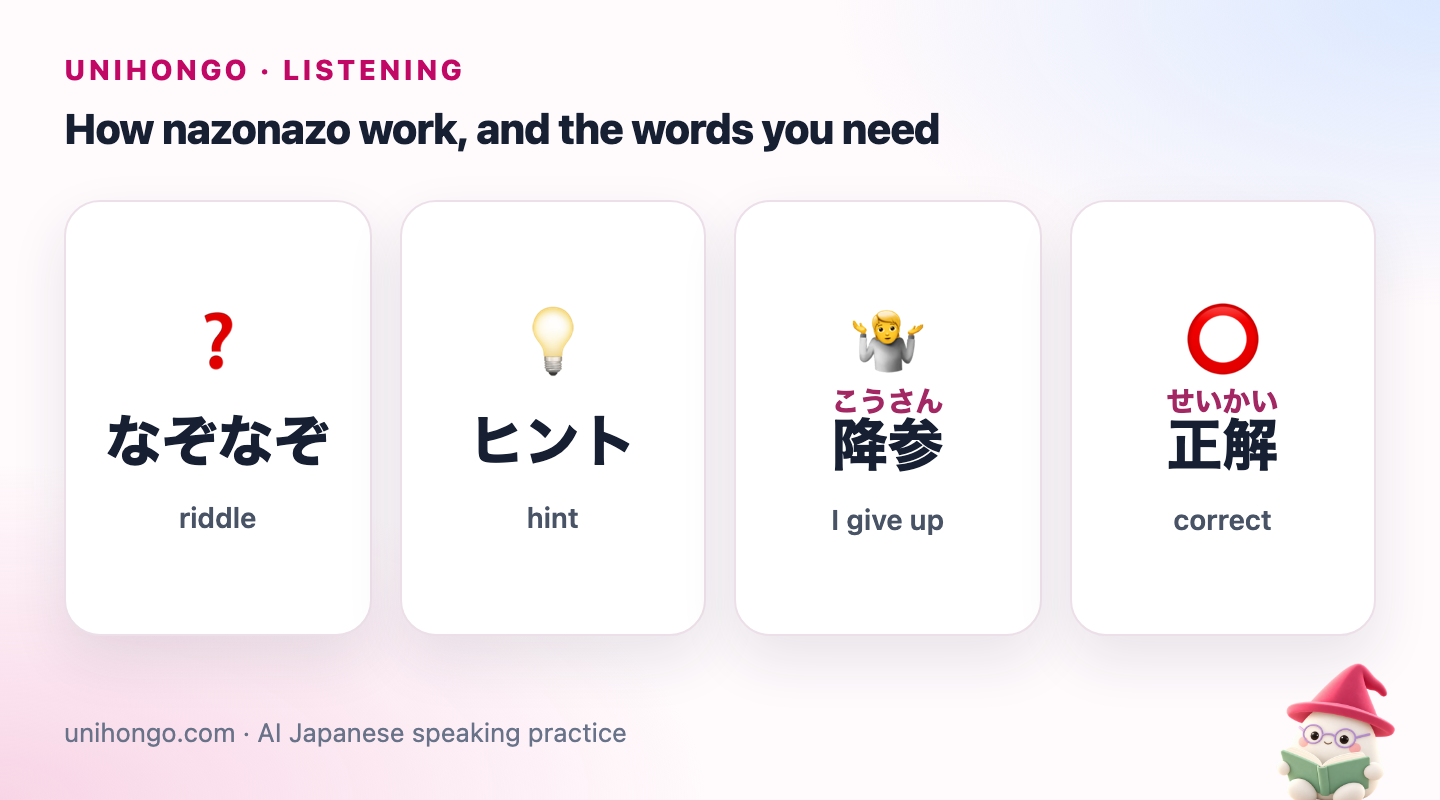
| Japanese | Romaji | Meaning |
|---|---|---|
| なぞなぞ | nazonazo | riddle |
| ヒント | hinto | hint |
| 降参 | kōsan | I give up |
| 正解 | seikai | correct |
| 答え | kotae | answer |
| 残念 | zannen | too bad, wrong |
| 惜しい | oshii | so close |
Riddle 1: the pan you cannot eat
| Japanese | Romaji | Meaning |
|---|---|---|
| パンはパンでも食べられないパンは? | Pan wa pan demo taberarenai pan wa? | It's a pan, but which pan can't you eat? |
| フライパン | furaipan | frying pan |
Pan (パン) is bread, a loanword from Portuguese. The riddle says: it is pan, and yet you cannot eat it. So you search for another word that contains the sound pan, and find furaipan. Children love to offer other answers: panda (パンダ) and pantsu (パンツ), underpants, both contain pan and neither is food.
The frame X wa X demo, followed by a condition and X wa?, is the most productive riddle pattern in Japanese, and you will meet it again and again. Taberarenai is the negative potential form of taberu, cannot eat, and demo here means even though it is.
Riddles 2 and 3: words hiding inside words
| Japanese | Romaji | Meaning |
|---|---|---|
| 冷蔵庫の中にいる動物は? | Reizōko no naka ni iru dōbutsu wa? | Which animal is inside the fridge? |
| ゾウ | zō | elephant |
| 世界の真ん中にいる虫は? | Sekai no mannaka ni iru mushi wa? | Which insect is in the middle of the world? |
| 蚊 | ka | mosquito |
Write reizōko in kana: れいぞうこ. The sounds ぞう sit in the middle, and zō (象) is an elephant. So there is an elephant inside the refrigerator, in the word itself.
The second riddle works the same way. Sekai is せかい, three kana. The middle kana is か, and ka (蚊) is a mosquito. The question sounds like geography, but it is about spelling.
Riddle 4: the animal that does a handstand
| Japanese | Romaji | Meaning |
|---|---|---|
| 逆立ちすると軽くなる動物は? | Sakadachi suru to karuku naru dōbutsu wa? | Which animal gets lighter in a handstand? |
| イルカ | iruka | dolphin |
Sakadachi (逆立ち) is a handstand, so turn the word upside down. Iruka is い, る, か. Read backwards it becomes か, る, い: karui (軽い), light in weight. The reversal only works in kana. In the alphabet, iruka backwards is akuri, which means nothing. This is why Japanese wordplay is counted in kana, never in letters.
Riddle 5: the fruit Dad dislikes
| Japanese | Romaji | Meaning |
|---|---|---|
| お父さんが嫌いな果物は? | Otōsan ga kirai na kudamono wa? | Which fruit does Dad dislike? |
| パパイヤ | papaiya | papaya |
Split the answer in two: papa (パパ), Dad, and iya (いや), a word that means no, I don't want that. Papaiya sounds like Dad says yuck. Iya is worth learning for real life: iya da is a casual, slightly childish way to refuse, and iya na describes something unpleasant.
Riddle 6: three animals go shopping
| Japanese | Romaji | Meaning |
|---|---|---|
| カメとラクダとサイが買い物に行きました。 | Kame to rakuda to sai ga kaimono ni ikimashita. | A turtle, a camel and a rhino went shopping. |
| 何を買ったでしょう? | Nani o katta deshō? | What did they buy? |
| カメラ | kamera | a camera |
Say the three animals in a row: kame, rakuda, sai. Now move the word breaks: kamera kudasai (カメラください), a camera, please. The animals' names turn out to be the order they gave at the shop. This one rewards a fast, smooth reading; told slowly, the listener never hears the hidden sentence.
Riddle 7: a classic with no pun
| Japanese | Romaji | Meaning |
|---|---|---|
| 上は洪水、下は大火事、なーんだ? | Ue wa kōzui, shita wa ōkaji, nānda? | Flood above, big fire below: what is it? |
| お風呂 | ofuro | the bath |
Not every nazonazo is a pun. This old one is a description: water on top, fire underneath. It refers to a traditional bath heated by a fire under the tub, so modern children sometimes need the explanation. It is still one of the first riddles many Japanese people think of, and it shows the rhythm of a classic riddle: two balanced halves and then nānda.
Phrases for a riddle exchange
| Japanese | Romaji | Meaning |
|---|---|---|
| なぞなぞです。 | Nazonazo desu. | Here is a riddle. |
| ヒントをください。 | Hinto o kudasai. | A hint, please. |
| もう一回言ってください。 | Mō ikkai itte kudasai. | Please say it once more. |
| わかった! | Wakatta! | I've got it! |
| 答えは何ですか。 | Kotae wa nan desu ka. | What is the answer? |
| 降参です。 | Kōsan desu. | I give up. |
| 正解です。 | Seikai desu. | That's correct. |
| 答えはフライパンです。 | Kotae wa furaipan desu. | The answer is a frying pan. |
| なるほど! | Naruhodo! | Oh, I see! |
Among friends, drop desu and kudasai: hinto chōdai (ヒントちょうだい), give me a hint, or just kōsan. A groan is also a correct response; Japanese puns are meant to hurt a little.
Why riddles sharpen your listening
Japanese has a small set of sounds, so many words share a pronunciation or sit inside longer words. In normal speech, context and pitch tell you which word is meant. Riddles remove the context on purpose and make you test several readings of the same sounds, which is exactly the skill you need when a fast sentence could be cut in two different places.
They also train you to hear kana one by one. To find the elephant in reizōko or the mosquito in sekai, you have to hold the word in your head as a row of beats. Learners who can do that find dictation, spelling and new vocabulary far easier.