

What you will hear at tills, on the phone and at stations
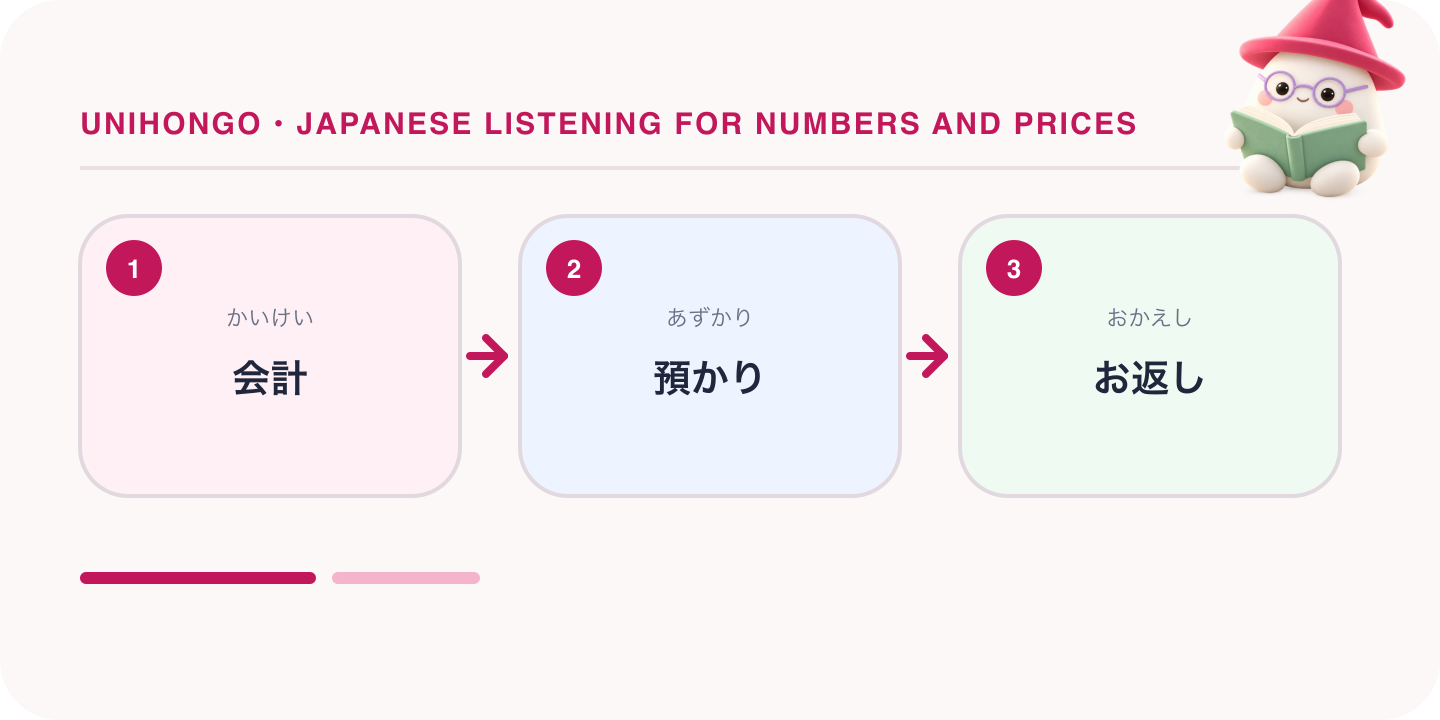
At the till, the sequence is nearly fixed. The cashier names the total with de gozaimasu, you pay, and if you paid in cash they announce what you gave and what you get back, using o-azukari for the amount received and o-kaeshi for the change. On the phone, the number you must catch is usually a date, a time and a party size, each confirmed once, plus a phone number read in blocks. At stations, announcements give platform numbers, departure times and delays in minutes, always in the same order.
What links these situations is the unit word. A price ends in en. A time ends in ji or fun. A date ends in gatsu or nichi. A platform is ban-sen, a delay is fun okure. If you listen for the unit first and let the number arrive before it, you know what kind of number is coming and how many digits to expect. This is the opposite of how learners usually listen, which is digit by digit from the front.
| Japanese | Romaji | Meaning |
|---|---|---|
| お会計、千二百八十円でございます。 | O-kaikei, sen-nihyaku-hachijū-en de gozaimasu. | Your total is 1,280 yen. |
| 二千円お預かりします。 | Ni-sen-en o-azukari shimasu. | Out of 2,000 yen. |
| 七百二十円のお返しです。 | Nana-hyaku-nijū-en no o-kaeshi desu. | 720 yen change. |
| 三番線から発車します。 | San-ban-sen kara hassha shimasu. | Departing from platform three. |
| 約十分ほど遅れております。 | Yaku juppun hodo okurete orimasu. | Running about ten minutes late. |
| 六時半に二名で予約をお願いします。 | Roku-ji-han ni ni-mei de yoyaku o onegai shimasu. | A reservation for two at half past six, please. |
Units and counters to pre-learn
The words below are the anchors. Learn the reading of each one together with its most common fused forms, because you will never hear hyaku on its own at a till; you will hear sanbyaku, roppyaku and happyaku.
| Unit | Reading | Used for and fused forms to expect |
|---|---|---|
| 円 | en | Yen; yon-hyaku-en, sen-en, ichi-man-en |
| 百 | hyaku | Hundred; sanbyaku, roppyaku, happyaku |
| 千 | sen | Thousand; sanzen, hassen |
| 万 | man | Ten thousand; ichi-man, jū-man, hyaku-man |
| 時 | ji | O'clock; yo-ji, shichi-ji, ku-ji |
| 分 | fun / pun | Minutes; ippun, sanpun, roppun, juppun |
| 月 | gatsu | Month; shi-gatsu, shichi-gatsu, ku-gatsu |
| 日 | nichi / ka | Day; tsuitachi, futsuka, yōka, jū-yokka |
| 番 | ban | Number in a series; san-ban, ban-sen for platforms |
| 個 | ko | General items; ikko, rokko, hakko, jukko |
| 本 | hon / pon / bon | Long things; ippon, sanbon, roppon |
| 名 | mei | People, polite; ichi-mei, ni-mei, san-mei |
Notice that the irregular ones cluster around one, three, six, eight and ten. If you drill only those five with each counter, you cover almost every sound change you will meet. The other digits attach cleanly.
Sample lines with prices and change
Read each line, cover the romaji, and write the figure as digits before checking. The point is to go straight from sound to digits without passing through English words. The receipts at Japanese shops show the same figures, so you can practise at every purchase by predicting the number before the receipt prints.
Tax phrasing is a common trap. Zeikomi means tax included and zeinuki means before tax; shelf labels often show both. The cashier states the tax-included total, so the number you hear may not match the larger figure you remember from the shelf.
| Japanese | Romaji | Meaning |
|---|---|---|
| 合計で三千四百五十円になります。 | Gōkei de sanzen-yonhyaku-gojū-en ni narimasu. | That comes to 3,450 yen in total. |
| こちら税込みで八百八十円です。 | Kochira zeikomi de happyaku-hachijū-en desu. | This is 880 yen including tax. |
| 一万円からでよろしいですか。 | Ichi-man-en kara de yoroshii desu ka. | Out of 10,000 yen, is that right? |
| 六千五百五十円のお返しになります。 | Roku-sen-gohyaku-gojū-en no o-kaeshi ni narimasu. | Your change is 6,550 yen. |
| ポイントが二百三十ポイントございます。 | Pointo ga nihyaku-sanjuppointo gozaimasu. | You have 230 points. |
| 二点で千円ちょうどです。 | Ni-ten de sen-en chōdo desu. | Two items, exactly 1,000 yen. |
Sample lines with times, dates and phone numbers
Times come with ji and fun, and the half hour is han. Dates use gatsu and nichi, with the irregular first ten days and the fourteenth, twentieth and twenty-fourth. Phone numbers are read in blocks with no between them. Duration uses jikan for hours and fun for minutes, and learners regularly confuse ni-ji, two o'clock, with ni-jikan, two hours; the kan is the only difference.
Dates are where the irregular readings bite. Tsuitachi is the first, futsuka the second, and so on up to tōka, the tenth; then most days are regular except jū-yokka, hatsuka and ni-jū-yokka. If a receptionist says hatsuka you need to hear twenty, not two, and only the vocabulary can save you.
| Japanese | Romaji | Meaning |
|---|---|---|
| 九時十五分に伺います。 | Ku-ji jū-go-fun ni ukagaimasu. | I'll come at nine fifteen. |
| 集合は四時半です。 | Shūgō wa yo-ji-han desu. | We meet at half past four. |
| 次の会議は二十日の午後二時からです。 | Tsugi no kaigi wa hatsuka no gogo ni-ji kara desu. | The next meeting is at 2 pm on the twentieth. |
| 電話番号は零九零の一二三四の五六七八です。 | Denwa bangō wa zero-kyū-zero no ichi-ni-san-yon no go-roku-nana-hachi desu. | The phone number is 090-1234-5678. |
| 所要時間は約一時間二十分です。 | Shoyō jikan wa yaku ichi-jikan nijuppun desu. | It takes about one hour twenty minutes. |
| 締め切りは来月の八日です。 | Shimekiri wa raigetsu no yōka desu. | The deadline is the eighth of next month. |
The sound changes that hide the digits
Most missed numbers come from four regular sound changes. First, gemination: a digit ending in a vowel loses it and doubles the next consonant, so ichi plus ko becomes ikko, roku plus hyaku becomes roppyaku, jū plus fun becomes juppun. Second, voicing: after san the h of hyaku and hon becomes b, giving sanbyaku and sanbon, and sen becomes zen in sanzen. Third, p-forms: after ichi, roku, hachi and jū, the h of hon and fun becomes p, giving ippon, roppun, happun and juppun. Fourth, the alternative readings: yon and shi, nana and shichi, kyū and ku, chosen by convention for each counter.
On top of these, real speech reduces unstressed syllables. Hachi-jū comes out as hachjū, and sen-en runs into sen-nen. In the total sen-nihyaku-hachijū-en, an unhurried cashier will produce something closer to sen-nihyak-hachjū-en. You cannot slow the cashier down, so you must know the target well enough to recognise it in reduced form.
- Gemination: ikko, roppyaku, hakko, juppun, issen
- Voicing after san: sanbyaku, sanzen, sanbon, sanpun as an exception
- P-forms: ippon, roppun, happun, juppun, ippun
- Alternative readings: yon-ji never, yo-ji always; shichi-ji, not nana-ji; ku-ji, not kyū-ji
- Reduction: hachjū, nijup, sen-nen in fast speech
Practise the list aloud in pairs, standard form then reduced form, so your ear stores both. Recognition depends on having produced the sound yourself, which is why reading drills alone leave people helpless at the till.
A step-by-step drill for number reflexes
This drill takes ten minutes a day and needs only a pen. Start with prices, then times, then phone numbers, then mixed. The goal is to write digits while the speaker is still talking, not after.
- Day one to three: listen to twenty prices from a shopping vlog or a cashier scene and write each as digits before the change is announced
- Day four to six: listen to a train or weather report and write every time and temperature you hear
- Day seven to nine: have a partner or your AI Sensei read ten phone numbers in blocks and write them; check and re-listen to the ones you missed
- Day ten to twelve: mix all three in one session and add counters such as ko, hon and mei
- Every day: say each number aloud in Japanese after writing it, so hearing and speaking reinforce each other
- Every day: end with three repeat-back confirmations at natural speed
Track your hit rate. Most learners go from around half to over ninety percent in two weeks, and the remaining misses are almost always dates, so add a dates-only round in week three.
Confirmation phrases that make misses harmless
Even native speakers repeat numbers back. On the phone it is standard practice, and at a counter it is simply careful. The core pattern is the number followed by de yoroshii desu ka, is that correct, or desu ne with a rising tone. If you missed it entirely, mō ichido onegai shimasu asks for a repeat, and yukkuri onegai shimasu asks for it slowly. Both are polite and expected.
For prices, the easiest confirmation is to show the note you are handing over and say the amount. For dates and times, repeat both together, because a mistake in either ruins the plan. For phone numbers, repeat each block and pause; the speaker will correct you the moment a block is wrong, which is faster than reading the whole thing back.
| Japanese | Romaji | Meaning |
|---|---|---|
| 千二百八十円でよろしいですか。 | Sen-nihyaku-hachijū-en de yoroshii desu ka. | 1,280 yen, is that correct? |
| すみません、もう一度お願いします。 | Sumimasen, mō ichido onegai shimasu. | Sorry, once more please. |
| 番号をゆっくりお願いできますか。 | Bangō o yukkuri onegai dekimasu ka. | Could you say the number slowly? |
| 二十日の二時ですね。 | Hatsuka no ni-ji desu ne. | The twentieth at two, right? |
| 零九零、一二三四、で合っていますか。 | Zero-kyū-zero, ichi-ni-san-yon, de atte imasu ka. | 090, 1234, is that right so far? |
| 書きますので、少々お待ちください。 | Kakimasu node, shōshō o-machi kudasai. | I'm writing it down, one moment please. |
Common mistakes and how to fix them
The first mistake is converting through English. Learners hear sanzen, think three thousand, then picture the digits. Cut out the middle step by writing digits directly; practise with a pen until sanzen and 3,000 are the same thing in your head. The second is losing the man boundary. Ichi-man-nisen is 12,000, not 1,200, because Japanese groups by ten thousand. Train yourself to hear man as a comma placed one digit further left than you expect.
The third is mishearing jū and ju. Jū alone is ten; ju-ichi does not exist. If you hear a short ju followed by a p sound, it is juppun, ten minutes, not a number in the tens. The fourth is ignoring intonation: a number said with rising desu ka is a question you must answer, not a statement to note down. And the fifth is pride. Asking for a repeat costs three seconds; getting on the wrong train costs an hour.
| Japanese | Romaji | Meaning |
|---|---|---|
| 一万二千円ですか、千二百円ですか。 | Ichi-man-nisen-en desu ka, sen-nihyaku-en desu ka. | Is that 12,000 yen or 1,200 yen? |
| 十分ですか、十時ですか。 | Juppun desu ka, jū-ji desu ka. | Ten minutes, or ten o'clock? |
| 四日ですか、八日ですか。 | Yokka desu ka, yōka desu ka. | The fourth, or the eighth? |
| 数字だけもう一度いいですか。 | Sūji dake mō ichido ii desu ka. | Could I have just the numbers again? |