

What you will hear from small children
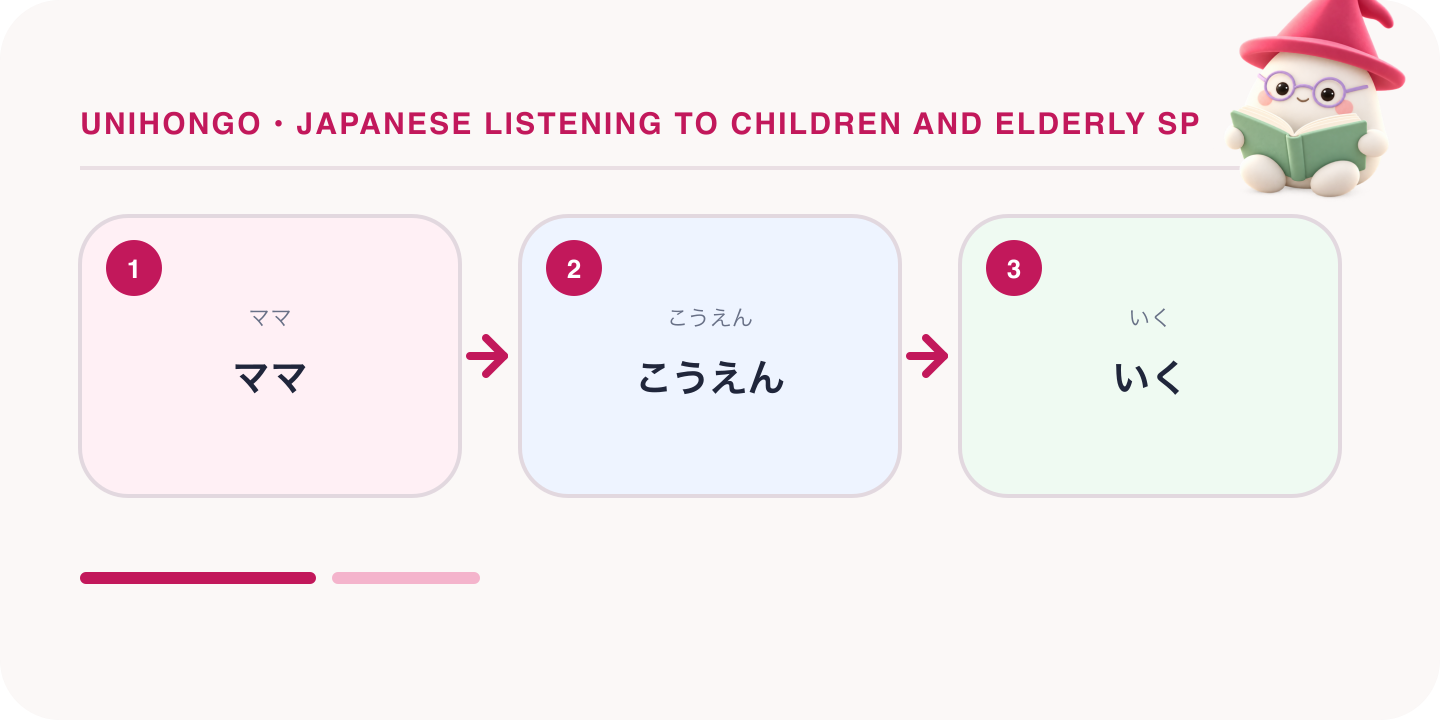
A Japanese child between two and five speaks in fragments. Particles go missing, so kōen iku means I want to go to the park and mama kutsu can mean Mum's shoes, Mum put my shoes on, or Mum, shoes. Verbs stay in the plain form, usually the te form as a request, tabete, or the ta form as a report, ochita. Baby words replace nouns: wan-wan, bū-bū, manma. Children also refer constantly to things and people outside the room, yesterday's cartoon or a friend at nursery, so context cannot rescue you.
Sound swaps are the other feature. Sa-row sounds are late to develop, so sakana becomes takana or shakana. Ra-row sounds come out as da: rāmen becomes dāmen, kore becomes kode. Long vowels shorten and small tsu doubles disappear, so gakkō becomes gako. Older children lose these, but a four-year-old with a lisp is normal and nothing to worry about.
| Japanese | Romaji | Meaning |
|---|---|---|
| ママ、こうえん、いく。 | Mama, kōen, iku. | Mum, park, going. (I want to go to the park.) |
| わんわん、いた。 | Wan-wan, ita. | There was a doggy. |
| これ、ちがうの。 | Kore, chigau no. | This isn't the right one. |
| おなか、すいた。まんま。 | Onaka, suita. Manma. | I'm hungry. Food. |
| たかな、たべたくない。 | Takana, tabetakunai. | I don't want to eat fish. (sakana) |
| せんせい、みて。できた。 | Sensei, mite. Dekita. | Teacher, look. I did it. |
Baby words and child forms to pre-learn
The words below appear in nurseries, paediatric clinics and family homes across Japan. Nursery teachers and grandparents use them to children, so you will hear them from adults too. Learn the reading and the adult word together so you can translate in either direction.
| Child word | Reading | Adult word and meaning |
|---|---|---|
| わんわん | wan-wan | inu, dog |
| にゃんにゃん | nyan-nyan | neko, cat |
| ブーブー | bū-bū | kuruma, car |
| まんま | manma | gohan, food or a meal |
| ねんね | nenne | neru, to sleep |
| おめめ | o-meme | me, eyes |
| ぽんぽん | ponpon | onaka, tummy |
| おてて | o-tete | te, hands |
| くっく | kukku | kutsu, shoes |
| たっち | tatchi | tatsu, to stand up |
| いたいいたい | itai itai | itai, it hurts |
| だっこ | dakko | carry me, a request to be picked up |
Two grammar features go with these. Children add no to the end of a statement, kore chigau no, and use the ta form as a general past, ochita, koronda. They also say jibun de, by myself, constantly, which tells you when to step back.
What you will hear from older speakers
Older speakers, broadly people over seventy-five, differ from the textbook in vocabulary and delivery more than in grammar. Words that were normal fifty years ago survive: benjo for toilet where younger people say toire, kāsan or okkā for mother in some regions, and shashinki for camera. Loanwords are older too: zubon for trousers is still universal, but you may also hear katakana words with older readings.
Dialect is stronger in older speakers because they grew up before television standardised speech. A grandmother in Hiroshima will use ken for kara, a grandfather in Tōhoku may drop and blur vowels, and older Kansai speakers use forms like dosu that younger people have abandoned. On top of this, many older people speak quietly, with less consonant precision, especially if they have dentures or a condition affecting speech.
| Japanese | Romaji | Meaning |
|---|---|---|
| ちょっと便所に行ってくるわ。 | Chotto benjo ni itte kuru wa. | I'm just off to the toilet. |
| 昔はここも田んぼじゃったんよ。 | Mukashi wa koko mo tanbo jatta n yo. | This used to be paddy fields too, you know. |
| 薬はもう飲んだかいな。 | Kusuri wa mō nonda kai na. | Have I taken my medicine yet, I wonder. |
| 膝がいけんのよ、雨の日は。 | Hiza ga iken no yo, ame no hi wa. | My knee's no good, on rainy days. |
| 孫がの、東京におるんじゃ。 | Mago ga no, Tōkyō ni oru n ja. | My grandchild, see, lives in Tokyo. |
| ありがとうね、助かったわ。 | Arigatō ne, tasukatta wa. | Thank you, that was a help. |
Older vocabulary and forms to pre-learn
The list below covers the forms that most often stop a carer or a visitor. Some are polite in a way that sounds heavy to younger ears; treat them as warmth, not distance. Regional items vary, so learn the ones for the region you live in first.
- Benjo and o-tearai: toilet, in place of the younger toire
- Kāsan, tōsan, jī-san, bā-san: family terms used without o-
- Ja and jatta: da and datta in western Japan
- Oru and orimasu: iru, to be, especially in the west and in polite speech
- Ken and kē: kara, because, in Chūgoku and Kyūshū
- Kai and kai na: soft question endings, often addressed to oneself
- Yoroshū: yoroshiku in older Kansai speech
- Gomen nasai ne and warui ne: soft apologies repeated often
- Shikata nai and shōganai: it cannot be helped, said with a sigh
Older speakers also use more honorific and humble forms with strangers, such as itadaku and mairu, and address carers with anta or omae-san in some regions without any rudeness intended.
The sound features that make each group hard
Children are hard because the signal is distorted in predictable ways. Consonant swaps follow developmental order: sa-row and ra-row come last, so expect ta, sha and da in their place. Pitch is high and rhythm uneven, with sudden loudness on the word that matters to the child and mumbling on the rest. Sentences are also incomplete, so you cannot use the sentence ending to work out the intent; you have to use the child's face and body.
Older speakers are hard because the signal is quiet and blurred. Consonants lose precision, especially s, t and k, so sore and kore can sound alike. Vowels lengthen and drift. Speech may be slow, which sounds easier but is not, because your working memory has to hold the start of a sentence for longer while waiting for the verb. Hearing loss on their side means they may not respond to your check question, and you may misread silence as agreement.
The strategy that works for both is the same: stop trying to hear every syllable and identify the content word, the one noun or verb the sentence is about. Then say it back with a rising tone. A child will correct you loudly; an older person will nod or repeat the sentence more clearly. Either way you are back in the conversation.
| Japanese | Romaji | Meaning |
|---|---|---|
| おさかな。おさかな、食べたくないの。 | O-sakana. O-sakana, tabetakunai no. | Fish. You don't want to eat the fish? |
| お薬ですね。もう飲みましたか。 | O-kusuri desu ne. Mō nomimashita ka. | The medicine, right? Have you taken it already? |
| 膝が痛いんですね。 | Hiza ga itai n desu ne. | Your knee hurts, is that right? |
| 公園に行きたいの。 | Kōen ni ikitai no. | You want to go to the park? |
| ゆっくりで大丈夫ですよ。 | Yukkuri de daijōbu desu yo. | Take your time, it's fine. |
A step-by-step drill for both kinds of speech
This drill uses children's television, nursery video diaries and interviews with older people, all easy to find on Japanese video sites. Spend ten minutes on each group per day for two weeks, then switch to live practice.
- Day one to three, children: watch a nursery or family vlog without subtitles and write the single content word of each child utterance
- Day four to six, children: replay with subtitles and note every sound swap; say the adult word aloud after each one
- Day seven to nine, older speakers: listen to an interview with someone over eighty and write every unfamiliar word, then look each one up
- Day ten to twelve, older speakers: replay at normal speed, holding each sentence until the verb arrives, then summarise in one line
- Every day: practise the repeat-back with rising tone on five sentences from each group
- Week three: switch to live practice with an AI Sensei or, if you can, real children and elders
Keep a notebook divided into two columns, child words and elder words, because the two vocabularies never overlap, and the sight of the growing lists is good motivation.
Strategies for parents, carers and teachers
Parents should learn the baby words their own child uses, because each child has personal ones alongside the standard ones, and keep a list on the fridge. Get down to eye level, wait, and ask the child to show you instead of repeating. Model the adult word once, gently, after you have understood: takana, ah, sakana ne.
Carers and healthcare workers should learn the older vocabulary for the body, medicine and daily routines, because those are the words that matter most and the ones most likely to be old-fashioned. Face the person, speak at a normal volume rather than shouting, and confirm the key word before acting on anything. Never assume silence is a yes.
Teachers of children should expect fragments and mumbling and treat them as data, not defiance. Reflect back what you heard in a full sentence so the child hears the target. For older adult learners in community classes, allow longer pauses, and do not rush to finish their sentences; many are simply searching for a word.
| Japanese | Romaji | Meaning |
|---|---|---|
| 見せて。どれ。 | Misete. Dore. | Show me. Which one? |
| おさかなね。おさかな、いやなの。 | O-sakana ne. O-sakana, iya na no. | Fish, right. You don't like the fish? |
| もう一度、お願いしてもいいですか。 | Mō ichido, onegai shite mo ii desu ka. | May I ask you to say that once more? |
| お薬は朝と夜ですね。 | O-kusuri wa asa to yoru desu ne. | The medicine is morning and evening, is that right? |
| 急がなくて大丈夫ですよ。 | Isoganakute daijōbu desu yo. | There's no need to hurry. |
When you get it wrong
With children, mistakes are cheap. If you misunderstand, the child says chigau and tries again, usually louder. The danger is pretending to understand: children notice, and they stop trying to communicate with you. Say wakaranai, misete, and let them lead. Do not laugh at sound swaps or repeat them back; the child is not joking.
With older people, mistakes cost more, because a misheard medicine time or a misread silence can matter. If you realise you acted on a wrong guess, say so plainly and apologise; older speakers appreciate directness more than a cover-up. If you repeatedly cannot understand, involve a family member or a colleague from the region rather than guessing. And if a normally clear older person suddenly becomes hard to understand, that change itself may be worth reporting.
| Japanese | Romaji | Meaning |
|---|---|---|
| ごめんね、わからなかった。もう一回、見せて。 | Gomen ne, wakaranakatta. Mō ikkai, misete. | Sorry, I didn't get it. Show me once more. |
| すみません、聞き間違えたようです。 | Sumimasen, kikimachigaeta yō desu. | Sorry, it seems I misheard. |
| ご家族の方に確認してもいいですか。 | Go-kazoku no kata ni kakunin shite mo ii desu ka. | May I check with your family? |
| 今日は少し聞き取りにくいですね。大丈夫ですか。 | Kyō wa sukoshi kikitorinikui desu ne. Daijōbu desu ka. | You're a little hard to hear today. Are you all right? |