
Why audiobooks are a gap worth filling
Most learners collect listening from short sources: clips, podcasts, a few minutes of anime. Audiobooks train a different muscle: following a long piece of connected Japanese, keeping track of characters, time and cause and effect. That is exactly the skill you need to understand a long story from a friend or a detailed explanation at work.
They also fill dead time. A commute, a walk or the washing-up becomes listening practice, and a story pulls you forward in a way drills never do.
| Japanese | Romaji | Meaning |
|---|---|---|
| 耳で本を読む | Mimi de hon o yomu | Reading books with your ears |
| 通勤中に聞いています。 | Tsūkinchū ni kiite imasu. | I listen while commuting. |
Four words for listening to books
These words appear in app menus, store pages and conversations about audiobooks. Arasuji, the plot summary, is also the word you need when you retell a story.
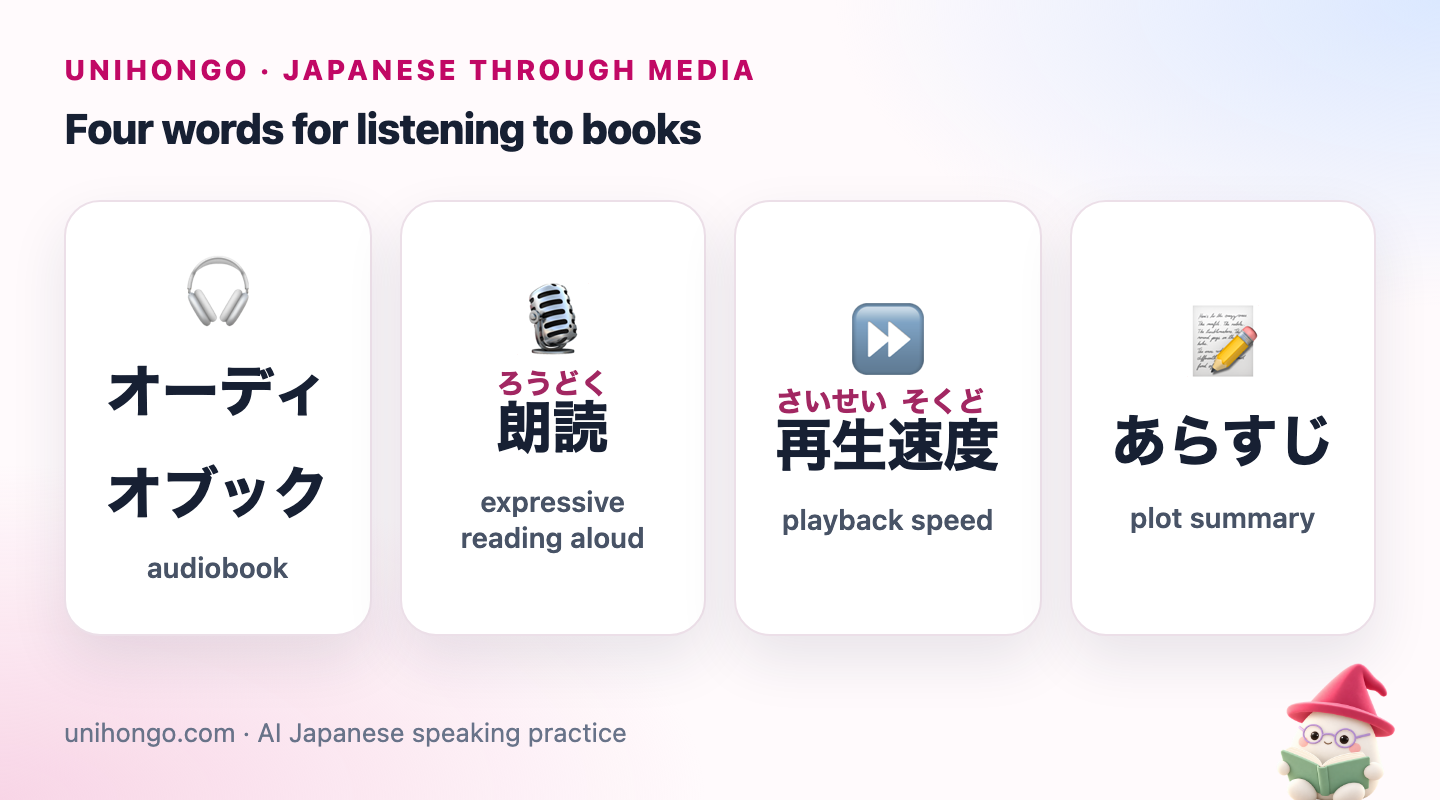
| Japanese | Romaji | Meaning |
|---|---|---|
| オーディオブック | ōdio bukku | audiobook |
| 朗読 | rōdoku | expressive reading aloud |
| 再生速度 | saisei sokudo | playback speed |
| あらすじ | arasuji | plot summary |
Rōdoku is a performance: a narrator gives voices, emotion and timing. Ondoku (音読), which you may know from classrooms, is simply reading aloud for practice. When you shadow a narrator, you are borrowing their rōdoku skills for your own ondoku.
Choosing a book by level
The best audiobook is one you can almost read on your own. If you need a dictionary for every line, the story collapses and listening becomes guessing.
| Level | What to choose | Why it works |
|---|---|---|
| Upper beginner | Folk tales and picture-book stories | Short, repetitive, familiar plots |
| Lower intermediate | Children's novels and classic short stories | Clear narration, everyday grammar |
| Intermediate | A translation of a book you know | You already know the plot |
| Upper intermediate | Essays and modern novels | Natural adult vocabulary and opinions |
| Advanced | Long novels, non-fiction, full-cast dramas | Speed, register and specialised words |
Many classic Japanese stories are in the public domain. Their texts are freely available online, and recordings by various narrators are easy to find, which makes them ideal for reading along. Some old stories use dated words, so check a modern summary before you start.
Read along, then let go of the text
Reading along is not cheating. It tells your brain which sounds belong to which words, and it shows you where your ears are filling in the wrong thing. The trick is to stop reading along once the chapter is clear, so you do not depend on it.
| Japanese | Romaji | Meaning |
|---|---|---|
| 本を見ながら聞きます。 | Hon o minagara kikimasu. | I listen while looking at the book. |
| ここが聞き取れなかった。 | Koko ga kikitorenakatta. | I couldn't catch this part. |
| もう一回、巻き戻そう。 | Mō ikkai, makimodosō. | Let's rewind once more. |
- Pass one: listen and read together. Mark words you could not hear.
- Pass two: read only the marked lines, then listen to them again.
- Pass three: listen without the text. Notice how much you now understand.
- Pass four, on another day: listen once more, then retell the chapter aloud.
Playback speed and shadowing the narrator
Most audiobook apps let you change the saisei sokudo, the playback speed. Slowing down helps you hear particles and endings, but very slow audio can sound strange, and you should not stay there. Use slow speed to learn a passage and normal speed to test yourself. Some fluent listeners use baisoku, double speed, to get through easy material faster, but that is for review, not for learning.
Shadowing means speaking along with the audio, a fraction of a second behind the narrator. Choose short passages of dialogue or description with clear emotion. Copy the pitch, the pauses and the speed, not only the words.
| Japanese | Romaji | Meaning |
|---|---|---|
| 再生速度を下げて聞きます。 | Saisei sokudo o sagete kikimasu. | I listen at a lower playback speed. |
| 倍速で聞くのはまだ早い。 | Baisoku de kiku no wa mada hayai. | It's too early for double speed. |
| ナレーターの後について読みます。 | Narētā no ato ni tsuite yomimasu. | I read right after the narrator. |
| 間の取り方をまねします。 | Ma no torikata o mane shimasu. | I copy how the narrator pauses. |
Retell the chapter aloud
Listening builds understanding; retelling builds speaking. After each chapter, summarise it in four to six sentences without looking. Kono shō de wa (in this chapter) is the natural opener. Use the present tense for plot, as Japanese summaries usually do, and connect events with sorede, tokoro ga and saigo ni.
Here is a model, based on Miyazawa Kenji's short story The Restaurant of Many Orders (注文の多い料理店), a classic Japanese children's tale that is widely available as both text and recordings. It is short, so treat it as one chapter.
| Japanese | Romaji | Meaning |
|---|---|---|
| この章では、二人の紳士が山で道に迷います。 | Kono shō de wa, futari no shinshi ga yama de michi ni mayoimasu. | In this chapter, two gentlemen get lost in the mountains. |
| 二人は、山の中で西洋料理店を見つけます。 | Futari wa, yama no naka de seiyō ryōriten o mitsukemasu. | They find a Western-style restaurant in the mountains. |
| 店には、変な注文がたくさんあります。 | Mise ni wa, hen na chūmon ga takusan arimasu. | The restaurant gives them lots of strange orders. |
| 実は、二人が食べられる方だったんです。 | Jitsu wa, futari ga taberareru hō datta n desu. | In fact, they were the ones about to be eaten. |
| 最後に、犬が来て二人は助かります。 | Saigo ni, inu ga kite futari wa tasukarimasu. | In the end, their dogs arrive and they are saved. |
Notice the structure: setting, discovery, problem, twist, ending. If your summary has those five beats, it will sound clear even with simple grammar.
Talking about what you are listening to
Audiobooks are also a conversation topic. Japanese friends and colleagues may ask what you do on your commute, and saying that you listen to Japanese books is a natural way to show your effort and to get recommendations. Plenty of Japanese people listen to audiobooks too, so you may well get a recommendation back.
Use the verb kiku (to listen) for audiobooks, not yomu (to read), although some people jokingly say mimi de yomu, reading with your ears. Kikiyasui, easy to listen to, is the natural compliment for a narrator's voice.
| Japanese | Romaji | Meaning |
|---|---|---|
| 今、何を聞いてるの? | Ima, nani o kiiteru no? | What are you listening to now? (casual) |
| 日本語のオーディオブックを聞いています。 | Nihongo no ōdio bukku o kiite imasu. | I'm listening to a Japanese audiobook. |
| ナレーターの声がすごく聞きやすいです。 | Narētā no koe ga sugoku kikiyasui desu. | The narrator's voice is really easy to follow. |
| 一日三十分くらい聞いています。 | Ichinichi sanjuppun kurai kiite imasu. | I listen for about thirty minutes a day. |
| やっと最後まで聞き終わりました。 | Yatto saigo made kikiowarimashita. | I finally finished listening to the whole thing. |
| おすすめの本はありますか? | Osusume no hon wa arimasu ka? | Do you have any book recommendations? |
Kikiowaru (to finish listening) follows the same pattern as yomiowaru (to finish reading) and tabeowaru (to finish eating): the verb stem plus owaru. Finishing a whole Japanese audiobook is a real milestone, and saying so aloud is a good way to celebrate it.
Common mistakes with audiobooks
- Choosing a book that is too hard. If you understand less than about half without the text, choose something easier.
- Only listening in the background. Passive listening helps a little; focused listening with a task helps far more.
- Never speaking. Without retelling or shadowing, audiobooks build comprehension but not speaking.
- Copying character voices in daily speech. Dramatic old men, princesses and villains speak in role language that sounds odd in conversation.
- Staying at slow speed for weeks. Move back to normal speed as soon as a chapter is familiar.