
Why unscripted shows teach what dramas cannot
Reality shows record people who are not actors talking to each other in ordinary places: a kitchen, a car, a café. They hesitate with ano and nanka, they trail off with kedo, and they avoid saying no directly. These are the habits that make Japanese sound natural, and they are almost absent from scripted dialogue.
The share-house format is especially useful because the cast are strangers at the start. You hear the whole life cycle of a relationship in Japanese, from formal introductions to in-jokes. These four lines sum it up.
| Japanese | Romaji | Meaning |
|---|---|---|
| タメ口でいいよ。 | Tameguchi de ii yo. | You can talk casually with me. |
| 正直に言うと… | Shōjiki ni iu to... | To be honest... |
| 気まずい | kimazui | awkward (atmosphere) |
| どう思う? | Dō omou? | What do you think? (casual) |
Share-house words you will hear every episode
A share house (シェアハウス) is a house where several unrelated people rent rooms and share the kitchen, bathroom and living room. Share houses are common in big Japanese cities, so this vocabulary transfers directly if you move to Japan.
| Japanese | Romaji | Meaning |
|---|---|---|
| 今日からよろしくお願いします。 | Kyō kara yoroshiku onegai shimasu. | Nice to meet you, from today on. (polite) |
| 掃除当番、誰だっけ? | Sōji tōban, dare datta kke? | Whose turn is it to clean again? (casual) |
| 冷蔵庫の私のプリン、食べた? | Reizōko no watashi no purin, tabeta? | Did you eat my pudding from the fridge? |
| Word | Meaning | Typical context |
|---|---|---|
| sheahausu | share house | Where the cast lives |
| kyōyū supēsu | shared space | Kitchen, living room, bathroom |
| sōji tōban | cleaning rota | A classic source of conflict |
| hikkoshi | moving house | Arrivals and departures |
| kokuhaku | confessing your feelings | The romance storylines |
| sotsugyō | graduating, leaving | When a cast member moves out |
Sotsugyō, literally graduation, is used for leaving a group in many contexts, from idol groups to share houses. When a housemate says sotsugyō shimasu, they mean they are moving out.
The polite-to-casual switch, step by step
The most valuable thing you can learn from these shows is when people stop using desu and masu with each other. On day one, everyone is polite. Then someone checks ages, because age matters for who may go casual first. Often the older person, or whoever feels closer, offers the switch.
| Japanese | Romaji | Meaning |
|---|---|---|
| 何歳ですか? | Nansai desu ka? | Housemate A: How old are you? (polite) |
| 二十四です。 | Nijūyon desu. | Housemate B: I'm twenty-four. |
| え、同い年だ! | E, onaidoshi da! | Housemate A: Oh, we're the same age! |
| じゃあ、タメ口でいいよ。 | Jā, tameguchi de ii yo. | Housemate B: Then let's talk casually. |
| うん、そうしよう。 | Un, sō shiyō. | Housemate A: Yeah, let's do that. |
Notice that the switch is negotiated out loud. That is why you should not jump to casual speech with someone older or senior on your own initiative. Wait for tameguchi de ii yo or keigo janakute ii yo. With people your own age in a relaxed setting, such as a share house or a class, switching early is normal, and staying too polite for weeks can feel distant.
A common learner mistake is switching halfway: casual verbs with polite endings on some sentences and not others. Once you go casual with someone, stay casual, and use polite speech for the people who have not offered it.
Talking about feelings and awkward moments
Reality shows are full of private interviews where cast members explain how they feel. These lines are emotional but everyday, and they are exactly what you need to talk about your own relationships.
| Japanese | Romaji | Meaning |
|---|---|---|
| ちょっと気まずいんだよね。 | Chotto kimazui n da yo ne. | Things are a bit awkward, you know. |
| 正直、モヤモヤしてる。 | Shōjiki, moyamoya shiteru. | Honestly, I feel uneasy about it. |
| 言いたいことがあるんだけど… | Iitai koto ga aru n da kedo... | There's something I want to say... |
| 傷ついた。 | Kizutsuita. | I was hurt. |
| 気持ちを伝えたい。 | Kimochi o tsutaetai. | I want to tell them how I feel. |
Moyamoya describes a cloudy, unresolved feeling: you are bothered but cannot quite name why. Kimazui is about the atmosphere between people, so say kimazui fun'iki (an awkward mood) rather than calling a person kimazui.
Listen also for the n da form in these lines: kimazui n da, aru n da. It adds a feeling of explaining your situation, which makes emotional talk sound warmer and less blunt than a bare statement.
Giving your opinion without starting a fight
Studio panels in many reality shows comment on what the cast did, and their opinions are a model for disagreeing gently. The pattern is: soften, give your view, end with to omou, and leave room for the other person.
| Japanese | Romaji | Meaning |
|---|---|---|
| 正直に言うと、彼も悪いと思う。 | Shōjiki ni iu to, kare mo warui to omou. | To be honest, I think he's also at fault. |
| 気持ちは分かるけど… | Kimochi wa wakaru kedo... | I understand how she feels, but... |
| 私だったら、先に謝るかな。 | Watashi dattara, saki ni ayamaru ka na. | If it were me, I'd probably apologise first. |
| どっちも悪くないと思います。 | Dotchi mo warukunai to omoimasu. | I don't think either of them is wrong. (polite) |
- Watashi dattara (if it were me) lets you disagree by talking about yourself, not attacking the other person.
- Ka na at the end makes an opinion sound tentative and friendly.
- Avoid zettai (absolutely) and machigatte iru (you are wrong) in a first opinion; they sound confrontational.
Scene to speech: describe a housemate conflict
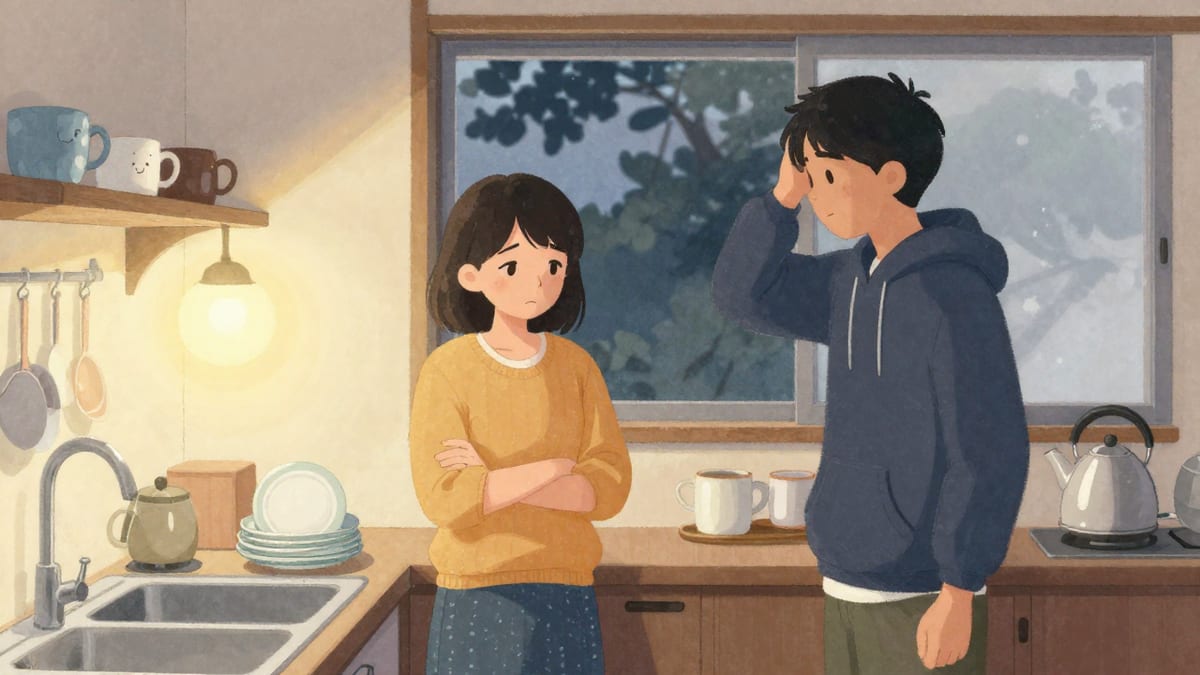
Here is the method in action. Watch a scene, close the video, and describe it in three parts: what happened, how each person felt, and what you think. Use the plain past tense for events and te-iru for ongoing states. This model retells a common kind of argument over shared chores.
| Japanese | Romaji | Meaning |
|---|---|---|
| ケンタが一週間、皿を洗わなかったんです。 | Kenta ga isshūkan, sara o arawanakatta n desu. | Kenta didn't wash the dishes for a week. |
| それで、アヤがすごく怒りました。 | Sorede, Aya ga sugoku okorimashita. | So Aya got really angry. |
| ケンタは、忙しかったと言っていました。 | Kenta wa, isogashikatta to itte imashita. | Kenta said he had been busy. |
| そのあと、家の中が気まずくなりました。 | Sono ato, ie no naka ga kimazuku narimashita. | After that, things got awkward in the house. |
| 正直に言うと、ケンタが先に謝るべきだと思います。 | Shōjiki ni iu to, Kenta ga saki ni ayamaru beki da to omoimasu. | Honestly, I think Kenta should apologise first. |
The names here are invented for practice. Use the real cast names from the episode you watched, and add -san if you are speaking politely about people you do not know.
Hints, hesitation and the indirect no
Watch a share-house episode closely and you will notice how rarely anyone says a flat no. Invitations are turned down with a trailing chotto, complaints start with nanka, and a cast member who is clearly upset may say betsu ni ii kedo, it's fine, in a voice that means the opposite. Learning to hear these signals is just as important as learning to say them.
Reality shows are an unusually good place to study this, because the private interviews often reveal what someone really meant after the scene. You hear the polite, vague line at the dinner table, and then the honest version to the camera. Compare the two and you learn how much meaning Japanese leaves to the listener.
| Japanese | Romaji | Meaning |
|---|---|---|
| 今日はちょっと… | Kyō wa chotto... | Today's a bit... (a soft no) |
| 考えとくね。 | Kangaetoku ne. | I'll think about it. (often a soft no) |
| 別にいいけど。 | Betsu ni ii kedo. | I mean, it's fine... (said when it is not) |
| なんか、うまく言えないけど… | Nanka, umaku ienai kedo... | I can't quite put it into words, but... |
| そういうつもりじゃなかった。 | Sō iu tsumori ja nakatta. | That's not what I meant. |
When not to use them: a soft no works for invitations and opinions, but at work or with official matters, vagueness can cause real confusion. If you genuinely cannot do something, follow chotto with a clear reason and an alternative: kyō wa chotto muzukashii n desu ga, ashita nara daijōbu desu.
Learner mistake: answering betsu ni ii kedo literally. If a friend says it with a flat face, it is a good moment to ask hontō ni daijōbu? and give them space to explain.
What transfers and what does not
Not everything in a reality show belongs in your daily Japanese. Cast members are on camera, and private interviews can be more dramatic than real life. Use this as a filter.
| Transfers well | Use with care |
|---|---|
| Fillers like ano, nanka, etto | Overusing nanka in every sentence |
| Softeners: kedo, ka na, to omou | Very blunt lines said for the camera |
| The polite-to-casual negotiation | Teasing that relies on long friendships |
| Vocabulary for home life and feelings | Studio slang and in-jokes |