
What to study for shadowing, chunking, transcript use, and retelling
This N3 shadowing guide gives you a four-step routine for turning a transcript into active listening skill. You will learn how to choose the right clip, mark chunks, compare rhythm, and retell the meaning so your practice transfers to new audio.
The useful unit is not a character or sound by itself. It is a Japanese word inside a situation. Read the examples aloud, notice the repeated patterns, and connect each new item to a task you would ask an AI Japanese teacher to practise with you.
Work in small, repeatable sets. Five focused items are enough for one session if you can retrieve them without looking, recognise them in a new sentence, and explain the difference between a correct answer and a tempting wrong one. That kind of practice is especially valuable for JLPT preparation because the test changes the surrounding vocabulary while keeping the underlying skill constant.
Core listening examples
Listen once for the situation, once for the key relationship, and once while checking the transcript. Then close the text and say the meaning aloud. This three-pass loop trains recognition, interpretation, and retrieval together.
| Japanese | Romaji | Meaning |
|---|---|---|
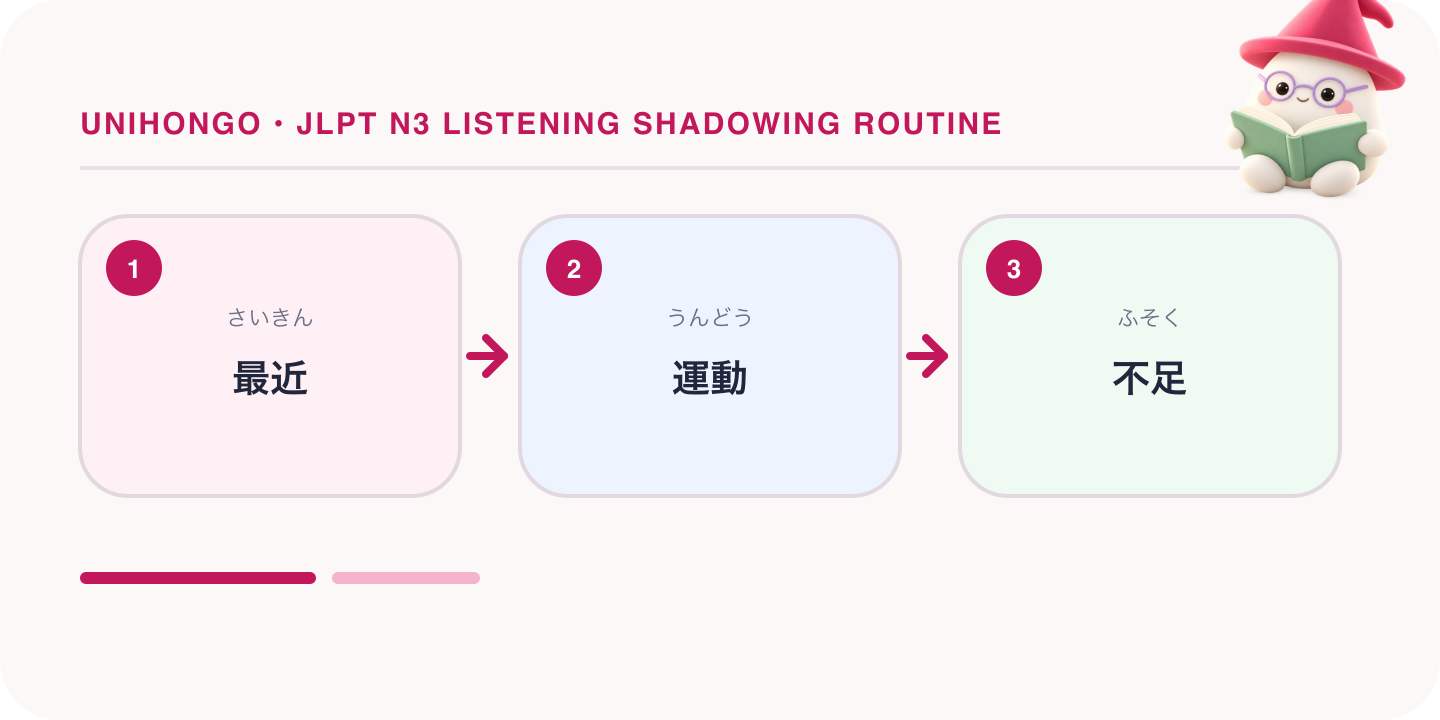
| 最近、運動不足だと感じています。 | Saikin, undō busoku da to kanjite imasu. | Recently, I feel that I do not exercise enough. |
| 健康のために、毎朝歩くことにしました。 | Kenkō no tame ni, maiasa aruku koto ni shimashita. | For my health, I decided to walk every morning. |
| 最初は大変でしたが、今は慣れました。 | Saisho wa taihen deshita ga, ima wa naremashita. | It was difficult at first, but I am used to it now. |
| 続けることが大切だと思います。 | Tsuzukeru koto ga taisetsu da to omoimasu. | I think continuing is important. |
| あなたはどう思いますか。 | Anata wa dō omoimasu ka? | What do you think? |
A practice loop that transfers
| Listening move | What to catch | AI Sensei prompt |
|---|---|---|
| Predict | Sets the scene | Tell me what to listen for |
| Chunk | Reduces processing load | Mark the phrase groups |
| Paraphrase | Tests meaning | Ask what the speaker means |
| Respond | Builds active skill | Continue the conversation |
How to avoid common listening traps
- Do not choose the first detail you hear if the speaker later corrects it.
- Do not write every word; keep only the answer target and the relationship.
- Do not use slow audio as your only input; return to natural speed.
- Do not read the transcript before your first listening attempt.
- Do not confuse recognising a phrase with being able to answer a follow-up.
A review plan for this JLPT level
Use a three-stage Listening review. On day one, listen for the situation and answer target questions. On day three, replay the smallest difficult section and shadow its chunks. At the end of the week, listen without a transcript and give a short spoken summary. For the higher levels, add an opinion or inference question so you practise the meaning behind the words.
Keep a mistake log with three columns: what I expected, what the Japanese actually did, and what clue I missed. This turns an incorrect answer into a future prediction. It also gives your AI Sensei useful material for personalised drills instead of sending you back to a generic exercise.
The next JLPT level
N2 audio becomes longer and less forgiving, so use retelling now. If you can explain a clip in simpler Japanese, you are building comprehension rather than memorising its sound pattern.
Use this article as a level checkpoint, not a finish line. When the core items feel automatic, raise the challenge one step: longer compounds for Kanji, or less transcript support and longer turns for Listening. Unihongo's AI Sensei can keep the practice at the edge of your level and turn mistakes into the next personalised exercise.