
Why games work for listening
Listening fails for two reasons. Either you do not recognise a word you actually know, because it sounds different at natural speed, or you miss a small sound difference that changes the meaning. Both are recognition problems, and recognition improves with many quick, clear repetitions. That is exactly what a game gives you.
A good listening game has three features. It has one clear task per round, such as grab, point or write. It gives instant feedback, so you know whether you heard correctly. And it is short enough to repeat. If a game has lots of reading on screen or lets you guess from pictures without listening, it is training something else.
| Japanese | Romaji | Meaning |
|---|---|---|
| よく聞いてね! | Yoku kiite ne! | Listen carefully! (casual) |
| もう一回お願いします。 | Mō ikkai onegai shimasu. | Once more, please. |
| ゆっくり言ってください。 | Yukkuri itte kudasai. | Please say it slowly. |
Four listening games to start with
These four formats cover most of what a beginner or lower-intermediate learner needs. Each one trains a slightly different part of listening.
| Japanese | Romaji | Meaning |
|---|---|---|
| かるた | karuta | karuta: hear it, grab the card |
| 伝言ゲーム | dengon gēmu | telephone game: pass a line on |
| ビンゴ | bingo | bingo: mark the number you hear |
| どっちでしょう? | Dotchi deshō? | Which one? Pick the word you hear |
Karuta trains fast word recognition. The telephone game, dengon gēmu, trains holding a whole sentence in your head. Bingo trains numbers, which are fast and easy to mishear. The which-one game trains fine sound differences that matter for meaning.
The which-one-did-I-say game
One player reads one word from a pair, and the other says which one they heard. It sounds simple, but it is the best way to train the long vowels and small pauses that textbooks mention and ears ignore. Use pairs of real words, because hearing a real meaning change makes the difference feel important.
Start with three or four pairs and play ten rounds, then add new pairs each week. When you can get every round right with clear, slow speech, ask your partner to say the words faster or inside a short sentence, such as kitte o kaimashita, I bought a stamp. That is much closer to what you will hear in a real post office.
| Japanese | Romaji | Meaning |
|---|---|---|
| おじさん | ojisan | uncle, middle-aged man |
| おじいさん | ojīsan | grandfather, elderly man |
| きて | kite | come (te-form) |
| きって | kitte | stamp |
| いえ | ie | house |
| いいえ | iie | no |
| Short version | Meaning | Long or paused version | Meaning |
|---|---|---|---|
| ojisan | uncle, middle-aged man | ojīsan | grandfather, old man |
| obasan | aunt, middle-aged woman | obāsan | grandmother, old woman |
| kite | come (te-form) | kitte | stamp |
| ie | house | iie | no |
| shujin | husband (old-fashioned) | shūjin | prisoner |
Play it with your eyes closed if you can, so you cannot read your partner's lips. Keep score, then swap roles; being the reader is also good practice, because you must say the difference clearly enough for someone else to hear it.
Number and time games
Prices, times, platform numbers and phone numbers come fast in real life, and they are easy to mishear because some numbers have two readings. Four is yon or shi, seven is nana or shichi, and nine is kyū or ku. Bingo with numbers from one to a hundred is a quick way to train them, and a time game is even more useful: one person says a time, the other sets it on a clock or writes it.
| Japanese | Romaji | Meaning |
|---|---|---|
| よんじゅうなな | yonjūnana | forty-seven |
| きゅうじゅうきゅう | kyūjūkyū | ninety-nine |
| 三時半 | sanji han | half past three |
| 七時十五分 | shichiji jūgofun | a quarter past seven |
| 九時 | kuji | nine o'clock |
| 四時 | yoji | four o'clock |
Times use fixed readings: four o'clock is yoji, not yonji, seven o'clock is usually shichiji, and nine o'clock is kuji. These are exactly the details that trip learners when they hear an announcement, so include them in your game.
Word-spotting: a solo game for shows and podcasts
When you listen to something above your level, it is easy to drift. A word-spotting game keeps you active. Before you press play, choose one common word, such as demo (but), chotto (a little) or sugoi (amazing), and count how many times you hear it in a short clip. Next time, choose two words. You will be surprised how many words you know once you are listening for them.
A harder version is particle spotting: count every ne and yo at the ends of sentences in a short conversation. It trains you to hear sentence endings, which carry a lot of the speaker's attitude in Japanese.
| Japanese | Romaji | Meaning |
|---|---|---|
| でも | demo | but |
| ちょっと | chotto | a little, a bit |
| すごい | sugoi | amazing, wow (casual) |
| そうですね | sō desu ne | that's right, let me see |
Karuta with Japanese friends or family
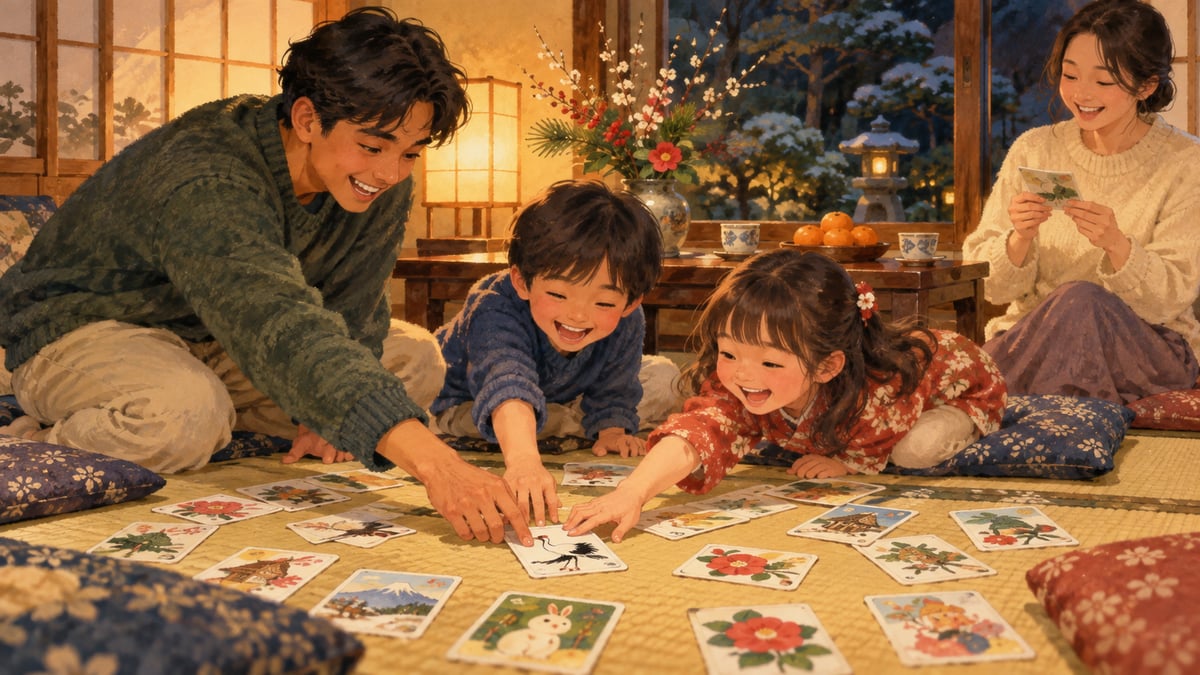
Karuta is a traditional card game, and many families play a simple picture version with children, often around New Year. The reader reads a card aloud, and everyone races to slap the matching card on the floor. If Japanese friends invite you, say yes: it is fast, noisy and excellent listening practice, and nobody minds if you lose to a seven-year-old.
You can also make your own: write words you are learning on cards, lay them out, and have a friend read definitions or example sentences. Customs and rules vary from family to family, so ask how they play before you start.
| Japanese | Romaji | Meaning |
|---|---|---|
| じゃあ、読むよ。 | Jā, yomu yo. | Reader: OK, I'm reading. (casual) |
| はい!取った! | Hai! Totta! | Player: There! Got it! |
| 早い! | Hayai! | Player: So fast! |
| もう一回読んで。 | Mō ikkai yonde. | You: Read it once more. (casual) |
| それ、お手つきだよ。 | Sore, otetsuki da yo. | Child: That's a wrong grab! |
Otetsuki means touching the wrong card, and it is one of the words you will hear most in a karuta game. In many family games it carries a small penalty, such as missing a turn, but each household has its own rules.
Common mistakes with listening games
- Reading instead of listening. If the word is shown on screen before you hear it, you are training reading.
- Staying at single words. Once a game is easy, move to phrases and sentences.
- Playing only with slow, clear voices. Mix in natural-speed audio as soon as you can.
- Guessing from context and calling it listening. In the which-one game, close your eyes.
- Skipping the reader role. Saying the pairs clearly is half the training.
Build a listening deck with Mocchi
Mocchi does not speak aloud, but it is good at making the material. Ask: "Make flashcards for the listening pairs ojisan and ojīsan, kite and kitte, ie and iie." With /create-flashcards, Mocchi creates the cards with a photo you pick for each, then reviews them with you using spaced repetition, so the pair you keep confusing comes back sooner.
Then play Kotoba Tank or Listen & Pick with your own deck: you hear the word and choose the right one, which is the which-one game with instant feedback. For the sound itself, the pronunciation coach lets you listen to drills slowed down, including long vowels and small tsu.