
A bottleneck, not a gap
There are two separate operations in understanding speech: recognising the words, and assembling them into a structure that means something. Learners work hard on the first and rarely on the second, so vocabulary tends to outrun parsing.
When that happens you get the experience this guide is about: every word is familiar, none of the sentence is available. It feels like failure and it is actually evidence that the first operation has got fast, which is why it appears at intermediate level and not at the start.
The reason it matters is that the obvious response, learning more words, is the wrong one. More vocabulary adds items to an already saturated process.
Why Japanese makes it worse
In many languages the structure of a sentence is largely settled early: the verb arrives second or third, and the rest is elaboration. Japanese does the opposite. The verb is last, and it carries tense, negation and politeness, so the sentence cannot be resolved until it ends.
Modification runs the same way. A clause describing a noun comes before it, so you hold a description without yet knowing what is being described, sometimes for several seconds.
The result is that a learner must retain more material for longer before any of it resolves, which is exactly the operation that is slow.
| Japanese | Romaji | Meaning |
|---|---|---|
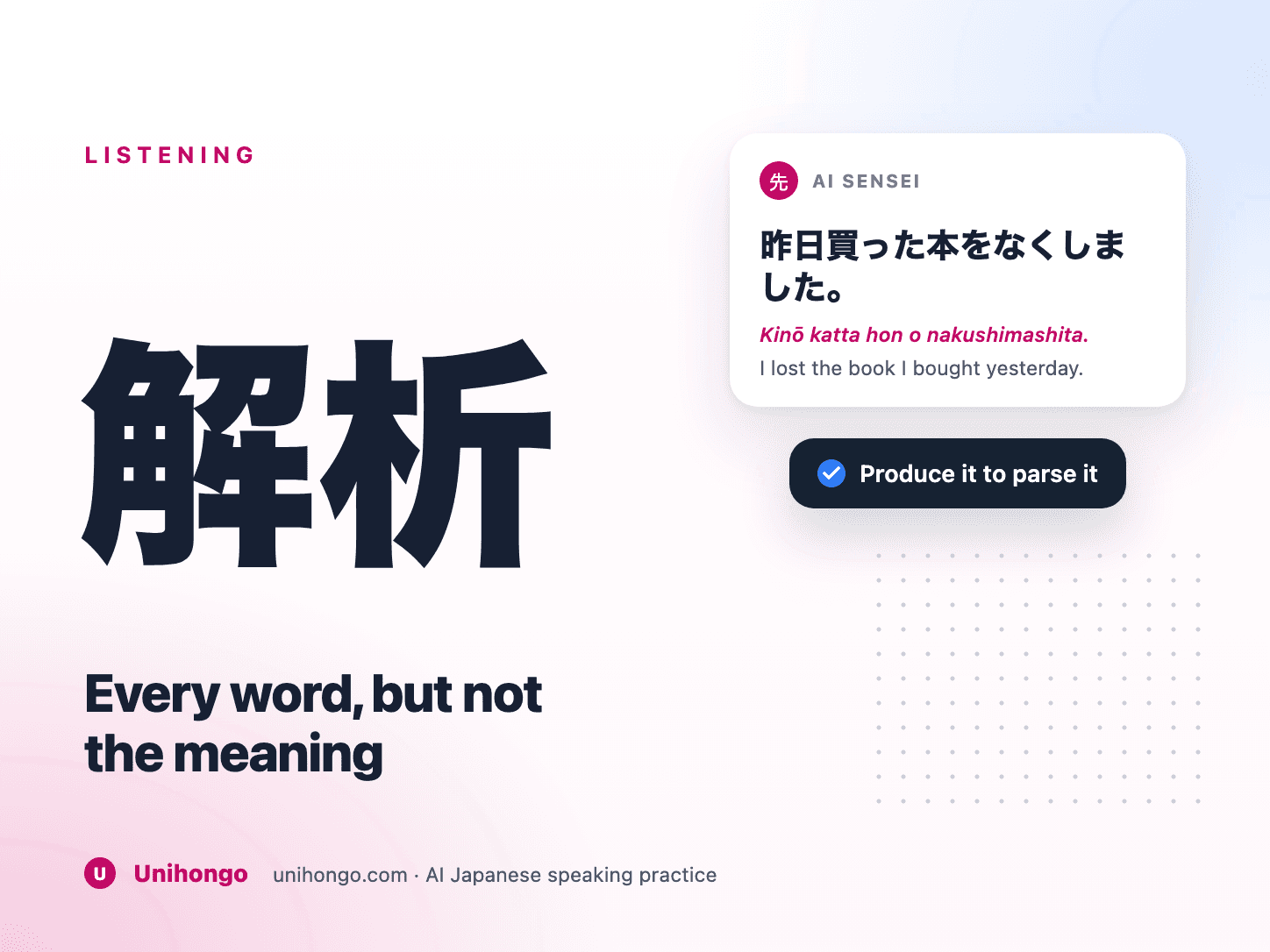
| 昨日買った本をなくしました。 | Kinō katta hon o nakushimashita. | I lost the book I bought yesterday. |
| 田中さんが話していた店に行きました。 | Tanaka-san ga hanashite ita mise ni ikimashita. | I went to the shop Tanaka mentioned. |
| 前に住んでいたところの近くです。 | Mae ni sunde ita tokoro no chikaku desu. | It is near where I used to live. |
| 行くと思っていたけど、行きませんでした。 | Iku to omotte ita kedo, ikimasen deshita. | I thought I would go, but I did not. |
| それができるかどうか分かりません。 | Sore ga dekiru ka dō ka wakarimasen. | I do not know whether that is possible. |
| 言おうとしたことを忘れました。 | Iō to shita koto o wasuremashita. | I forgot what I was going to say. |
In each of these the first several words cannot be interpreted until later ones arrive. That holding is the work your processing has to get fast at.
Chunking into phrases
The single most useful change is to stop listening for words. Words are the wrong unit: they are too small, there are too many of them, and Japanese runs them together so the boundaries are not reliably there anyway.
Phrases are the right unit. A phrase has a single pitch contour, it usually ends in a particle, and it corresponds to one piece of meaning. Learning to hear phrase boundaries reduces a twenty-word sentence to five things to hold.
- Listen for particles; they mark the end of a phrase.
- Listen for the pitch reset that starts a new phrase.
- Hold the meaning of each phrase, not its words.
- Wait for the verb before deciding what the sentence means.
- Accept a lag of a second or two behind the speaker; that is normal.
Training the structures directly
Parsing speed improves fastest for structures you produce yourself. A pattern you have built in your own speech is recognised much faster than one you have only ever met in listening, because you already know its shape.
This is the practical link between speaking and listening, and it is why speaking practice improves comprehension more than learners expect. The relative clause that defeats you in listening becomes tractable within days of your using it in your own sentences.
| Structure | Why it stalls parsing | Fix |
|---|---|---|
| Noun-modifying clause | Comes before the noun | Produce it yourself |
| Negation at the end | Reverses the sentence late | Wait for the verb |
| Embedded question | Nests another clause | Practise the pattern |
| Long topic phrase | Delays the comment | Listen for the particle |
| Chained te-forms | No boundary until the end | Hold each clause loosely |
Every fix in the right column is production or attention, not vocabulary. That is the shape of the whole problem.
Depth on short passages
Volume of new material does less here than depth on a small amount. A thirty-second passage listened to fifteen times teaches parsing; fifteen different passages heard once each teach very little, because you never get past the recognition stage.
The routine is to listen, transcribe what you actually heard, check it, and then listen again knowing what is there. The final listen, where a sentence you could not parse suddenly resolves, is where the learning happens.
- Choose thirty to sixty seconds, not five minutes.
- Listen three times with no text at all.
- Write down what you heard, gaps included.
- Check against the script and mark where the parse broke.
- Listen again until the sentence resolves in real time.
Letting speaking do some of the work
Because parsing improves fastest for structures you produce, speaking practice is an unusually efficient way to fix a listening problem. It is also the one most learners in this stage neglect, because the problem presents as a listening one.
Spoken sessions with an AI Sensei in Unihongo's immersive 3D classroom build the structures rather than only exposing you to them, and the session report shows which patterns you are avoiding, which is a good list of what to expect trouble parsing.
There is a direct diagnostic too. Answers that were grammatically fine but responded to the wrong question show up in the report, and that is the signature of a sentence whose ending arrived before you had finished parsing its beginning.
Expect this stage to ease rather than end. Most learners describe it as gradually becoming aware of meaning instead of words, over months rather than weeks.