
Why children's TV works for beginners
Programmes for children are designed for people who do not yet know much of the language, which is your situation too. Characters narrate their actions, emotions are shown clearly on faces, and the same words come back many times in one episode. The pictures do half the work, so you can follow the story while you are still decoding grammar.
There is also a cultural bonus. Almost every Japanese adult knows the theme songs and the characters, so being able to talk about them is a warm way into conversation with friends, colleagues and especially parents.
| Japanese | Romaji | Meaning |
|---|---|---|
| ドラえもん、助けて! | Doraemon, tasukete! | Doraemon, help me! |
| 子どもの番組で日本語を勉強しています。 | Kodomo no bangumi de nihongo o benkyō shite imasu. | I study Japanese with children's shows. |
The four names every Japanese child knows
These are the words to start with. Anpanman is a hero whose head is a bread roll filled with sweet bean paste. Doraemon is a robot cat from the future who helps a boy named Nobita with gadgets from his pocket. E-tele is the channel name, and minna de utaō is the kind of line you hear before a sing-along.
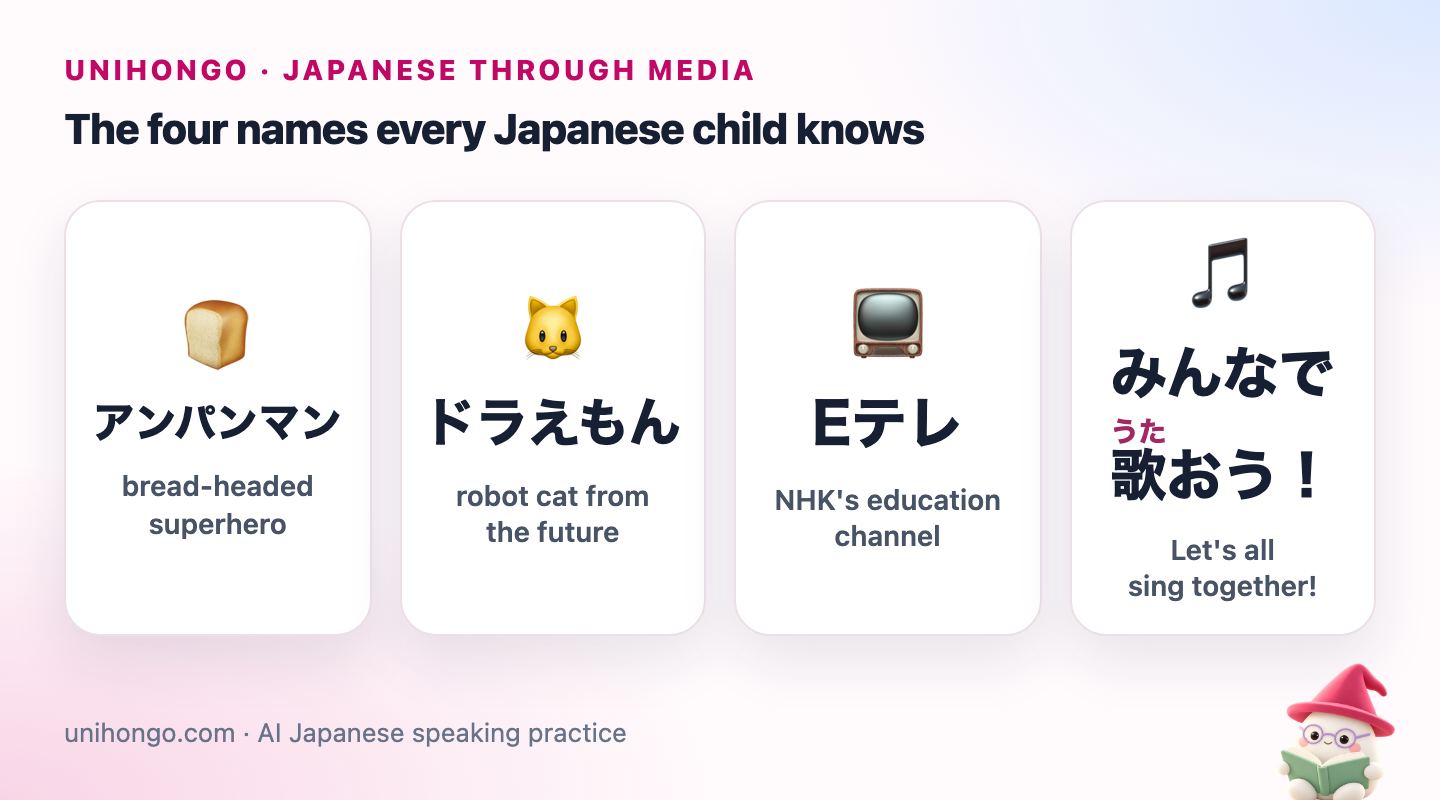
| Japanese | Romaji | Meaning |
|---|---|---|
| アンパンマン | Anpanman | bread-headed superhero |
| ドラえもん | Doraemon | robot cat from the future |
| Eテレ | E-tere | NHK's education channel |
| みんなで歌おう! | Minna de utaō! | Let's all sing together! |
Utaō is the volitional form of utau, to sing, meaning let's sing. Children's shows are full of volitional forms like ikō (let's go), tabeyō (let's eat) and asobō (let's play), which makes them a natural place to absorb this grammar.
Which show for which level
Match the show to your grammar, not to your age. If you understand the gist of most scenes, you are at the right level. If you understand every word, move up.
| Level | Kind of show | What you learn |
|---|---|---|
| Absolute beginner | Songs and short segments for toddlers | Greetings, body parts, colours, numbers |
| Beginner | Preschool programmes and Anpanman | Simple verbs, volitional forms, feelings |
| Upper beginner | Doraemon | Casual past tense, te-form, school life |
| Lower intermediate | Family anime for older children | Family talk, jokes, everyday customs |
Short is better than long. A ten-minute segment watched three times teaches more than a feature-length film watched once with subtitles.
Anpanman: kindness in simple Japanese
Anpanman stories are short and clear: someone is hungry or in trouble, the villain causes mischief, Anpanman helps, and everyone thanks him. He is famous for offering part of his own face to hungry characters. The lines are simple and emotionally obvious, which is ideal for a first anime.
| Japanese | Romaji | Meaning |
|---|---|---|
| ぼくの顔をお食べ。 | Boku no kao o otabe. | Eat some of my face. (his famous offer) |
| おなかがすいたよ。 | Onaka ga suita yo. | I'm hungry. (casual) |
| ありがとう、アンパンマン! | Arigatō, Anpanman! | Thank you, Anpanman! |
| 困っている人を助けます。 | Komatte iru hito o tasukemasu. | He helps people in trouble. |
Otabe is a soft, old-fashioned way of saying eat, used by a kind adult to a child. It is lovely to recognise, but do not use it with friends. Onaka ga suita and komatte iru, on the other hand, are everyday Japanese you will use for life.
Doraemon: secret gadgets and everyday grammar
Doraemon episodes usually follow a pattern. Nobita has a problem at school or at home, asks Doraemon for help, and gets a secret gadget, a himitsu dōgu (ひみつ道具). He uses it well at first, then misuses it, and it backfires. That pattern repeats the same grammar again and again: wanting, asking, trying and regretting.
| Japanese | Romaji | Meaning |
|---|---|---|
| しょうがないなあ。 | Shō ga nai nā. | Oh, all right then. (reluctant sigh) |
| どこでもドア! | Dokodemo doa! | The anywhere door! |
| テストで0点を取っちゃった。 | Tesuto de rei-ten o totchatta. | I got zero on the test. (casual) |
| その道具、貸してよ! | Sono dōgu, kashite yo! | Lend me that gadget! |
| 使いすぎて失敗しました。 | Tsukaisugite shippai shimashita. | He used it too much and it went wrong. |
Listen for chatta, the casual contraction of te shimatta, which shows something happened that you regret. It is one of the most useful features of spoken Japanese, and Doraemon is full of it.
Nobita and his friends speak like Japanese schoolboys, using boku, ore and rough casual endings. Learn to understand them, but think twice before copying ore or commands like kashite yo with people you do not know well.
Shadow the songs, then summarise the episode
Songs are the best shadowing material for beginners: the melody fixes the rhythm, the words repeat, and you will want to sing them anyway. Play a song, pause after each line, and sing it back. When you know it, sing along with the video at full speed. Then switch from listening to speaking with a five-sentence summary.
| Japanese | Romaji | Meaning |
|---|---|---|
| のび太がテストで0点を取りました。 | Nobita ga tesuto de rei-ten o torimashita. | Nobita got zero on a test. |
| それで、ドラえもんに助けを頼みました。 | Sorede, Doraemon ni tasuke o tanomimashita. | So he asked Doraemon for help. |
| ドラえもんはひみつ道具を出しました。 | Doraemon wa himitsu dōgu o dashimashita. | Doraemon brought out a secret gadget. |
| でも、のび太は使いすぎました。 | Demo, Nobita wa tsukaisugimashita. | But Nobita used it too much. |
| 最後は、お母さんに怒られました。 | Saigo wa, okāsan ni okoraremashita. | In the end, his mum told him off. |
The daily greetings children's TV drills
Programmes for young children spend a lot of time on routines: waking up, eating, going out and coming home. That makes them the best place to hear the set phrases of Japanese family life said again and again, in the right situations. These are not childish; adults use every one of them daily.
Notice that most come in pairs. One person says the first line and the other has a fixed reply, so you learn both sides of each exchange.
| Japanese | Romaji | Meaning |
|---|---|---|
| いただきます。 | Itadakimasu. | Said before eating |
| ごちそうさまでした。 | Gochisōsama deshita. | Said after eating |
| 行ってきます。 | Ittekimasu. | I'm off! (leaving home) |
| 行ってらっしゃい。 | Itterasshai. | Have a good day! (reply) |
| ただいま。 | Tadaima. | I'm home! |
| おかえり。 | Okaeri. | Welcome back! (casual reply) |
Children's shows usually use the casual forms between family members and the polite forms with teachers and strangers, which models the register system clearly. A character says ohayō to their mother and ohayō gozaimasu to the teacher at the gate. Listen for that contrast; it is the same one you will need with friends and with coworkers.
A common learner mistake is saying tadaima when arriving somewhere that is not your home, such as a friend's house. There, say ojama shimasu, excuse me for intruding. Tadaima is for the place where you live, or jokingly for a place where you feel at home, such as a favourite café.
Child speech you should not copy
The grammar of children's TV is real Japanese, but some words are used only by or to small children. Recognise them, then use the adult form yourself.
| Child form | Meaning | Adult form to use |
|---|---|---|
| mama, papa | mum, dad | haha, chichi (my parents); okāsan, otōsan |
| ~mon (dakara ~ da mon) | because...! (sulky) | ~kara, ~node |
| wanwan, nyannyan | doggy, kitty | inu, neko |
| otabe, onenne | eat up, sleepy-time | tabete, neru |
Adults do say mama and papa to small children, and some adults use them for their own parents in private. In conversation with other adults, though, talking about your parents as haha and chichi sounds mature and polite.