
The meaning lives at the end of the sentence
In English the important words arrive early, so an English-trained ear relaxes after the first few. Japanese does the opposite. The verb closes the sentence, and everything that decides what the sentence actually claims is glued to that verb: whether it happened, whether it did not happen, whether it is a question, how polite the speaker is being, and how sure they are. A listener who stops paying attention at the halfway point hears the topic and misses the point.
The fix is a deliberate habit rather than a technique. When a Japanese sentence starts, decide that you will not begin interpreting until you have heard the final syllables, even if you have already understood the subject and the object. It feels uncomfortable for the first week because you are holding meaning unresolved, and that discomfort is the skill being built.
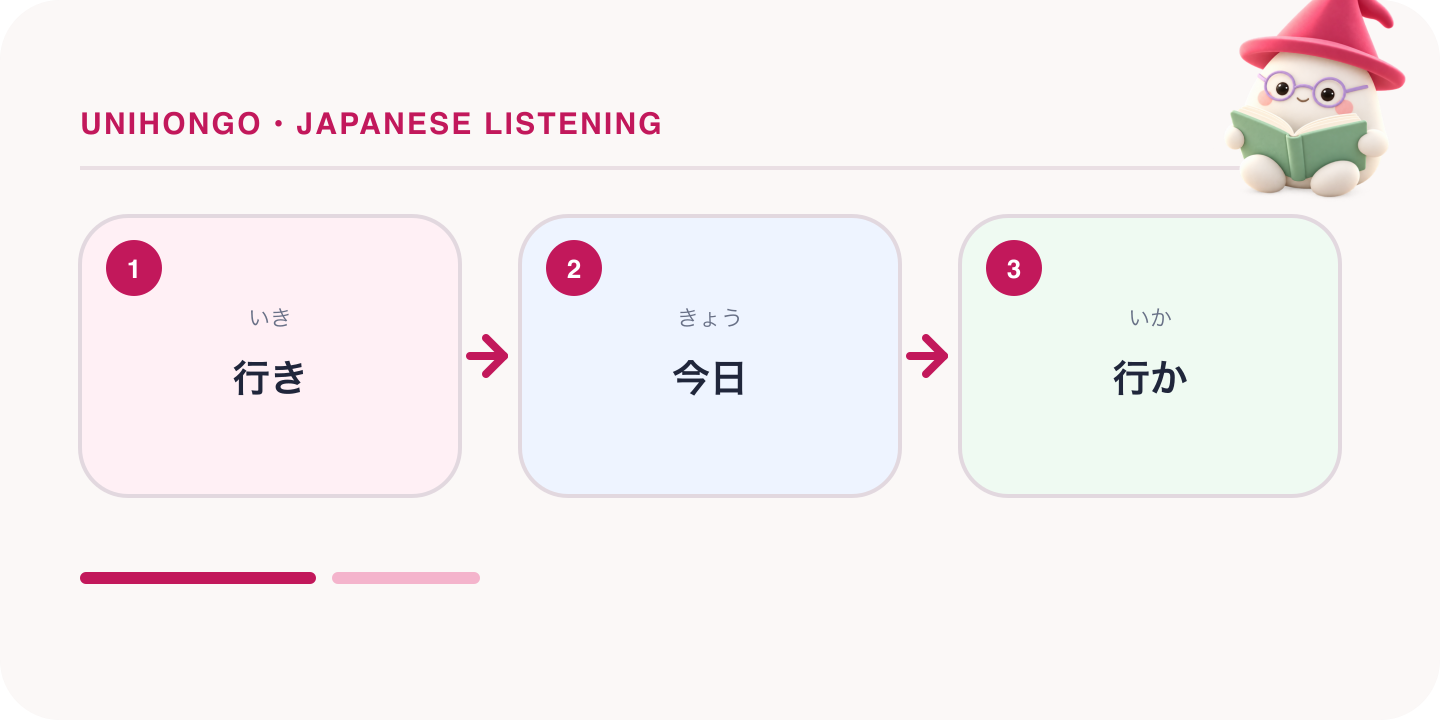
| Japanese | Romaji | Meaning |
|---|---|---|
| 行きます。 | Ikimasu. | I will go. |
| 行きません。 | Ikimasen. | I will not go. |
| 行きました。 | Ikimashita. | I went. |
| 行きませんでした。 | Ikimasen deshita. | I did not go. |
| 行きますか? | Ikimasu ka? | Are you going? |
| 行きましょうか? | Ikimashō ka? | Shall we go? |
Six different messages, one shared opening. Anyone who decides the meaning after hearing iki has a one in six chance of being right, and will be confidently wrong the rest of the time.
Train the ear for the grammar tail
Tails are short, unstressed and predictable, which makes them both easy to miss and easy to drill. Spend a week listening only for endings and ignoring content entirely. Play a clip, write down the tails you hear in order, and check them against the transcript. You will find that your errors cluster: many learners hear masen reliably but miss the difference between mashita and masen deshita, or fail to notice sō desu, which turns a fact into a report.
| Japanese | Romaji | Meaning |
|---|---|---|
| 今日は行かないと思います。 | Kyō wa ikanai to omoimasu. | I do not think I will go today. |
| まだ届いていません。 | Mada todoite imasen. | It has not arrived yet. |
| もう終わりましたか? | Mō owarimashita ka? | Has it finished already? |
| ちょっと難しいかもしれません。 | Chotto muzukashii kamo shiremasen. | It might be a little difficult. |
| 明日は休みだそうです。 | Ashita wa yasumi da sō desu. | I hear tomorrow is a day off. |
| 先に始めてもいいですか? | Saki ni hajimete mo ii desu ka? | Is it all right if we start first? |
| ここで待ってください。 | Koko de matte kudasai. | Please wait here. |
| 行かなくてもいいですよ。 | Ikanakute mo ii desu yo. | You do not have to go. |
Listen in phrases, not in words
Speech does not arrive as separate words with gaps between them. It arrives as phrase-sized lumps, each one a noun with its particle or a verb with its ending, and native listeners process the lump rather than its parts. A learner who tries to identify every individual word runs out of time before the sentence ends, because the identification is slower than the speech.
Practise by marking phrase boundaries instead of writing full transcripts. Play a line, draw a slash wherever you feel a break, and only then check the text. Your slashes will land in the right places surprisingly often, which is evidence that the ear already groups sound correctly and the conscious mind has been getting in the way.
| Japanese | Romaji | Meaning |
|---|---|---|
| 来週の月曜日に / 会議室で / 打ち合わせを / します。 | Raishū no getsuyōbi ni / kaigishitsu de / uchiawase o / shimasu. | We will have a meeting in the meeting room next Monday. |
| 昨日の夜 / 友達と / 映画を / 見ました。 | Kinō no yoru / tomodachi to / eiga o / mimashita. | Last night I watched a film with a friend. |
| この電車は / 次の駅で / 少し / 止まります。 | Kono densha wa / tsugi no eki de / sukoshi / tomarimasu. | This train will stop for a short while at the next station. |
| すみませんが / 今日は / ちょっと / 都合が悪いです。 | Sumimasen ga / kyō wa / chotto / tsugō ga warui desu. | I am sorry, but today is a little inconvenient for me. |
Predict before the speaker finishes
Fluent listeners are not decoding faster than you; they are guessing better. Japanese is generous with openers that announce what is coming. When a member of staff says osoreirimasu ga, a refusal or an awkward request is on the way. When someone says yoroshikereba, an offer follows. Learning twenty of these openers converts the second half of a sentence from a surprise into a confirmation, and confirmation is far cheaper to process.
| Japanese | Romaji | Meaning |
|---|---|---|
| 恐れ入りますが、少々お待ちいただけますか? | Osoreirimasu ga, shōshō omachi itadakemasu ka? | Staff: I am sorry to trouble you, could you wait a moment? |
| 申し訳ございませんが、ただいま満席です。 | Mōshiwake gozaimasen ga, tadaima manseki desu. | Staff: I am very sorry, we are full at the moment. |
| よろしければ、こちらの席はいかがですか? | Yoroshikereba, kochira no seki wa ikaga desu ka? | Staff: If it suits you, how about this seat? |
| 失礼ですが、ご予約はされていますか? | Shitsurei desu ga, goyoyaku wa sarete imasu ka? | Staff: Excuse me, do you have a reservation? |
| 念のため、確認させていただきます。 | Nen no tame, kakunin sasete itadakimasu. | Staff: Just to be sure, allow me to confirm. |
| あいにくですが、その日は空いておりません。 | Ainiku desu ga, sono hi wa aite orimasen. | Staff: Unfortunately, that day is not free. |
Each of these makes the rest of the sentence narrower. After ainiku desu ga you already know the answer is no, so the words that follow only have to tell you why, and you can spend your attention on that instead of on the whole utterance.
The sounds that vanish at speed
Japanese devoices the vowels i and u between voiceless consonants and at the end of many words, so suki desu lands closer to s'ki des and shitsurei shimasu closer to sh'tsurei sh'mas. Nothing is being pronounced wrongly; this is standard Tokyo speech, and the careful textbook version is the unusual one. If you learned words only from slow audio, your stored version of them does not match what people say.
| Japanese | Romaji | Meaning |
|---|---|---|
| 好きです。 | Suki desu. | I like it. The u sounds nearly silent, close to s'ki des |
| 靴を買いました。 | Kutsu o kaimashita. | I bought shoes. Kutsu often lands close to k'tsu |
| 失礼します。 | Shitsurei shimasu. | Excuse me. The squeezed vowels give sh'tsurei sh'mas |
| ここに置きます。 | Koko ni okimasu. | I will put it here. The final u almost disappears |
| 六時からです。 | Roku-ji kara desu. | It is from six. The u in roku is barely voiced |
The drill is to record yourself saying these lines at conversational speed and compare with a native recording. A word you can pronounce with its vowel devoiced is a word you will recognise when someone else devoices it. The pronunciation guide on this blog covers the mouth positions in more detail.
Contracted forms and dropped particles
Beyond devoicing, casual speech rewrites whole endings. Te iru loses its i, te shimau collapses to chau, te oku becomes toku, and ra in ranai often turns into a doubled n. Particles disappear when the sentence is short and the meaning obvious. None of this is slang, and all of it appears in ordinary conversation between colleagues and friends, so a learner trained only on polite recorded dialogue meets it as a wall.
| Japanese | Romaji | Meaning |
|---|---|---|
| 何をしていますか? → 何してますか? | Nani o shite imasu ka? → Nani shitemasu ka? | What are you doing? The particle o goes and shite imasu shortens |
| 見ておいてください。 → 見といてください。 | Mite oite kudasai. → Mitoite kudasai. | Please take a look at it in advance |
| 読んでしまった。 → 読んじゃった。 | Yonde shimatta. → Yonjatta. | I went and read it, casual |
| 分からない。 → 分かんない。 | Wakaranai. → Wakannai. | I do not get it, casual |
| すみません。 → すいません。 | Sumimasen. → Suimasen. | Sorry, in relaxed everyday speech |
| これはいくらですか? → これ、いくらですか? | Kore wa ikura desu ka? → Kore, ikura desu ka? | How much is this? The topic particle is dropped |
| ご飯を食べた? → ご飯食べた? | Gohan o tabeta? → Gohan tabeta? | Have you eaten? Casual, with o dropped |
Holding a sentence while it finishes
Understanding a long spoken sentence requires keeping unresolved material in memory until the verb arrives. Learners lose it because they translate as they go, and translation consumes the same working memory the sentence needs. The remedy is to stop translating and instead hold images or roles: someone, something, somewhere, then wait for the verb to say what happened.
- Listen to a long sentence and repeat the last three words only, without understanding them, to prove your memory can hold them.
- Then repeat the last five, then the last eight, growing the span over a week.
- Practise saying back a full sentence you did not fully understand; comprehension often arrives while your mouth is repeating it.
- Do not stop the audio to look up a word. Finish the sentence first, then decide whether the word mattered.
- Count sentences rather than words when you check yourself: how many complete sentences did you follow from start to finish?
Missed-word causes and the drill for each
| What you missed | Why it happened | Drill that fixes it |
|---|---|---|
| The negative | Nai and masen arrive last, after attention has dropped | Listen to pairs of the same sentence, positive and negative, and name which one you heard |
| The past tense | Mashita and ta are short and unstressed | Shadow six tails on one verb stem until the shapes are automatic |
| A word you already know | It was said at speed with a devoiced vowel | Slow the audio, hear the word, then return to full speed and hear it again |
| The particle | It was dropped or swallowed in casual speech | Transcribe ten short lines and write the missing particles back in yourself |
| The whole second half | You paused to translate the first half | Replay and force yourself to reach the full stop before thinking about meaning |
| Who was doing it | The subject was named two sentences earlier and never repeated | Summarise who is doing what after every short section of audio |
| The number | The counter changed how the number sounds | Say one number aloud across five different counters, daily |
| A name | Unfamiliar names sound like unknown vocabulary | Note it as a name and keep listening rather than stopping to decode it |
| The question | Ka was quiet or replaced by rising intonation | Listen to statement and question pairs and mark the rise |
Recovering without freezing
The costly moment in real conversation is not the missed word; it is the two seconds you spend thinking about it, during which you miss everything else. Trained listeners drop the word immediately and keep going, then repair at the end if the gap mattered. Practise the repair lines until they come out without hesitation, because a fluent request for repetition keeps the conversation alive and a silent panic ends it.
| Japanese | Romaji | Meaning |
|---|---|---|
| すみません、もう一度お願いします。 | Sumimasen, mō ichido onegai shimasu. | Sorry, once more please. |
| もう少しゆっくりお願いできますか? | Mō sukoshi yukkuri onegai dekimasu ka? | Could you speak a little more slowly? |
| 今の、最後だけもう一度いいですか? | Ima no, saigo dake mō ichido ii desu ka? | Could you repeat just the last part of that? |
| それはどういう意味ですか? | Sore wa dō iu imi desu ka? | What does that mean? |
| 明日は休みということですか? | Ashita wa yasumi to iu koto desu ka? | Do you mean that tomorrow is a day off? |
| すみません、聞き取れませんでした。 | Sumimasen, kikitoremasen deshita. | Sorry, I could not catch that. |
| 三時ですね。分かりました。 | San-ji desu ne. Wakarimashita. | Three o'clock, right. Understood. |
Notice the last line. Repeating back the one detail you did catch both confirms it and buys you a moment, and it sounds like an engaged listener rather than a struggling one. Roleplay missions such as the cafe or the workplace call are a low-cost place to practise these, because you can miss a word deliberately and try the repair.
A weekly listening ladder
| Day | Material and speed | What you do |
|---|---|---|
| Monday | Learner audio at slightly reduced speed | Listen twice, then write a one-line summary from memory |
| Tuesday | The same clip at full speed | Listen once with no script, then read the script and find your gaps |
| Wednesday | A new learner clip | Shadow thirty seconds line by line, matching the tails exactly |
| Thursday | The Wednesday clip again | Write down only the endings you hear, then check them |
| Friday | Short audio made for native speakers | Accept partial understanding and note three chunks you caught |
| Saturday | Anything you enjoy watching | Ten minutes with subtitles off, then the same ten with subtitles on |
| Sunday | No new listening | Retell the week's clips aloud and answer questions about them |
The ladder works because the difficulty rises and falls within the week instead of climbing forever. Repeating Wednesday's clip on Thursday is not wasted time; the second hearing is where the ear does its learning, and the first hearing only maps the territory.
Checking that you really understood
The feeling of understanding is unreliable, especially with familiar material where memory fills the gaps. Test yourself with output instead. Retelling a clip in Japanese exposes every place where you knew the gist but not the grammar, because you cannot reproduce a tail you did not hear. Answering questions about the clip exposes the details you skipped over while you were following the main line.
| Japanese | Romaji | Meaning |
|---|---|---|
| この話は何についてですか? | Kono hanashi wa nani ni tsuite desu ka? | What is this passage about? |
| 誰が何をしましたか? | Dare ga nani o shimashita ka? | Who did what? |
| いつ、どこであった話ですか? | Itsu, doko de atta hanashi desu ka? | When and where did this happen? |
| 最後に何と言いましたか? | Saigo ni nan to iimashita ka? | What did they say at the end? |
| それは終わりましたか、まだですか? | Sore wa owarimashita ka, mada desu ka? | Has it finished, or not yet? |
- Retell each clip in three Japanese sentences without looking at the script.
- Answer the five questions above aloud, in Japanese, before checking anything.
- Mark every sentence where your retelling used a different ending from the original.
- Relisten only to those sentences, and shadow them until the ending is yours.