

What you will hear at the register
A register interaction is a script with fixed slots. First a greeting, then a confirmation of what you are buying, then a series of yes-or-no questions about heating, bags, points and payment, then the total, then the change or the card, then a closing line. Nothing in that sequence is improvised. The cashier is not talking to you so much as running a routine, and the routine is the same at every branch of every chain.
That is why prediction works. When you have put a bento on the counter, you know a question about heating is coming. When you have not brought a bag, you know a question about bags is coming. If you predict the phrase, you only need to confirm it, and confirming a phrase you expect is far easier than decoding one you did not.
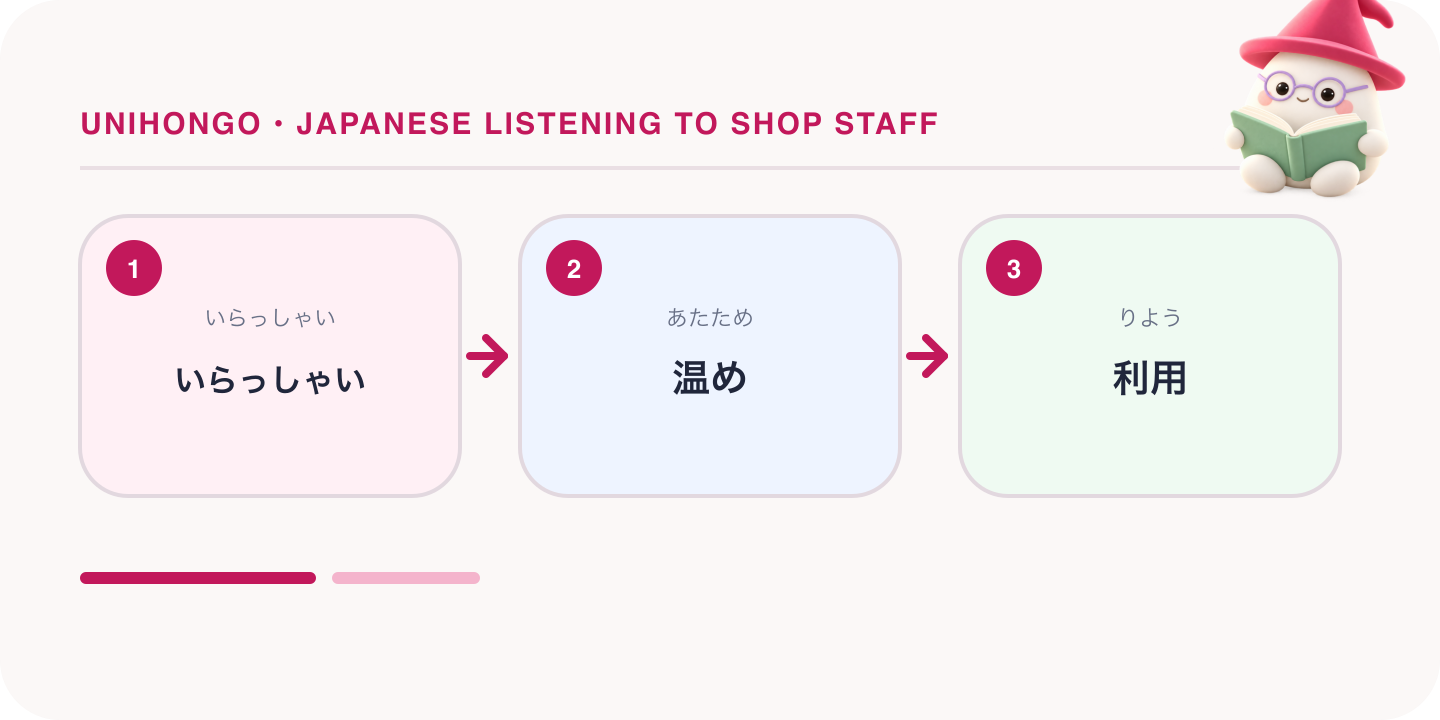
| Japanese | Romaji | Meaning |
|---|---|---|
| いらっしゃいませ、こんにちは。 | Irasshaimase, konnichiwa. | Welcome, hello. |
| こちら温めますか。 | Kochira atatamemasu ka. | Shall I heat this? |
| 袋はご利用ですか。 | Fukuro wa go-riyō desu ka. | Will you be using a bag? |
| ポイントカードはお持ちですか。 | Pointo kādo wa o-mochi desu ka. | Do you have a point card? |
| お支払いはいかがなさいますか。 | O-shiharai wa ikaga nasaimasu ka. | How will you be paying? |
| ありがとうございました。 | Arigatō gozaimashita. | Thank you very much. |
Why the phrases blur
Three things happen to keigo when it is spoken at register speed. First, unvoiced vowels vanish. The i in desu ka and the u at the end of masu are already whispered in careful speech; at speed they disappear completely, so atatamemasu ka becomes something like atatamemas'ka. Second, long honorific verbs contract. Irasshaimase, with its five moras, comes out as sshaimase or even just ase. Arigatō gozaimashita becomes ariyashta. Third, the whole phrase takes on one rhythm, a single rising-then-falling melody, and the melody replaces the word boundaries.
The result is that a phrase like o-shiharai wa ikaga nasaimasu ka sounds like two beats: oshiharai and ikaganasaimaska. There is no gap between ikaga and nasaimasu, and the ka is so light that it might be a breath. This is not sloppy Japanese; it is normal service Japanese, and native customers process it as a melody rather than as words.
The practical consequence is that you should stop trying to hear every syllable. Learn the melody of each script phrase, the way you know a doorbell chime, and match the melody rather than the words.
| Japanese | Romaji | Meaning |
|---|---|---|
| こちら温めますか。 | Kochira atatamemas'ka. | Shall I heat this? (as actually heard) |
| お箸はお付けしますか。 | O-hashi wa o-tsuke shimas'ka. | Shall I include chopsticks? (as actually heard) |
| レシートはご入用ですか。 | Reshīto wa go-iriyō des'ka. | Do you need the receipt? (as actually heard) |
| 以上でよろしいでしょうか。 | Ijō de yoroshii deshō ka. | Is that everything? |
| 少々お待ちください。 | Shōshō o-machi kudasai. | One moment, please. |
Finding the question inside the keigo
Almost every register question has the same shape: a noun, a particle, and a polite verb that means do you have it, will you use it, or shall I do it. The polite verb is the part that blurs, and it is also the part you do not need. The noun tells you what the question is about, and the intonation tells you it is a question. So the listening strategy is: catch the noun, hear the rise, answer.
The nouns are a short list: fukuro, bag; pointo kādo, point card; reshīto, receipt; o-hashi, chopsticks; supūn, spoon; o-shiharai, payment; and at cafés, saizu, size; tennai, in store; and o-mochikaeri, takeaway. The verbs come from an even shorter list: go-riyō desu ka, will you use; o-mochi desu ka, do you have; o-tsuke shimasu ka, shall I include; and yoroshii deshō ka, is that all right. Any noun can pair with almost any of these verbs and the meaning is still clear from the noun alone.
A special case is the ending yoroshii deshō ka, which turns a statement into a request for confirmation. Kono mama de yoroshii deshō ka is asking whether you want the item as it is, without a bag. Ijō de yoroshii deshō ka is asking whether you are finished. Hear the noun before de, and you have the question.
| Japanese | Romaji | Meaning |
|---|---|---|
| 店内でお召し上がりですか。 | Tennai de o-meshiagari desu ka. | Will you be eating in? |
| サイズはいかがなさいますか。 | Saizu wa ikaga nasaimasu ka. | What size would you like? |
| ホットとアイス、どちらになさいますか。 | Hotto to aisu, dochira ni nasaimasu ka. | Hot or iced, which would you like? |
| このままでよろしいですか。 | Kono mama de yoroshii desu ka. | Is it all right as it is, without a bag? |
| お名前をお伺いしてもよろしいですか。 | O-namae o o-ukagai shite mo yoroshii desu ka. | May I ask your name? |
| クーポンはお持ちでしょうか。 | Kūpon wa o-mochi deshō ka. | Do you have a coupon? |
The blurred forms and what they really are
The table below lists the phrases as they are written, the reading you will find in a textbook, and the compressed version you will actually hear. Practise saying the compressed version yourself; producing the blur is the fastest way to learn to hear it.
| Phrase | Reading | How it sounds at speed |
|---|---|---|
| いらっしゃいませ | irasshaimase | sshaimase, or a rising ase |
| ありがとうございました | arigatō gozaimashita | ariyashta, ending on a fall |
| 温めますか | atatamemasu ka | atatamemas'ka |
| 袋はご利用ですか | fukuro wa go-riyō desu ka | fukuro goriyō des'ka |
| お箸はお付けしますか | o-hashi wa o-tsuke shimasu ka | ohashi otsukeshimas'ka |
| ポイントカードはお持ちですか | pointo kādo wa o-mochi desu ka | pointokādo omochides'ka |
| お支払いはいかがなさいますか | o-shiharai wa ikaga nasaimasu ka | oshiharai ikaganasaimas'ka |
| 以上でよろしいでしょうか | ijō de yoroshii deshō ka | ijōde yoroshdeshoka |
| 少々お待ちください | shōshō o-machi kudasai | shōsho omachkudasai |
| お待たせいたしました | o-matase itashimashita | omatase'tashimashta |
| レシートはご入用ですか | reshīto wa go-iriyō desu ka | reshīto goiriyōdes'ka |
Notice that the noun at the front survives intact in every row. That is the part the cashier needs you to hear, so it is the part that stays clear.
The replies you need
Because the questions are yes-or-no, your replies can be short. Hai with a nod accepts anything: heating, a bag, a receipt. To decline, daijōbu desu is the everyday no-thank-you and works for bags, receipts, chopsticks and point cards alike. Onegai shimasu asks for whatever was just offered. For payment, name the method: genkin de, in cash; kādo de, by card; or the name of the electronic payment you use.
Cafés need a few more words: tennai de, eating in; mochikaeri de, takeaway; and a size, usually the English word in katakana. If the question was which of two options, repeat one of the options with de. Keep the replies short and plain; you are not expected to match the cashier's keigo, and a long polite reply slows the script down.
| Japanese | Romaji | Meaning |
|---|---|---|
| はい、お願いします。 | Hai, onegai shimasu. | Yes, please. |
| 大丈夫です。 | Daijōbu desu. | No, thank you. |
| 袋はいらないです。 | Fukuro wa iranai desu. | I don't need a bag. |
| カードでお願いします。 | Kādo de onegai shimasu. | By card, please. |
| 持ち帰りで。 | Mochikaeri de. | Takeaway. |
| ホットのトールで。 | Hotto no tōru de. | Hot, tall size. |
| ポイントカードはないです。 | Pointo kādo wa nai desu. | I don't have a point card. |
A step-by-step listening drill
You can train register listening without going to a shop, using recordings of real interactions, videos of convenience store visits, or your AI Sensei. The order matters: melody first, nouns second, full phrases last.
- Step one: listen to one full checkout without trying to understand, three times, just for the rhythm
- Step two: on the fourth listen, count the questions by counting the rises in pitch
- Step three: write the noun you hear at the start of each question, nothing else
- Step four: check your nouns against the phrase list and note which ones you missed
- Step five: say each compressed form aloud until it feels natural in your own mouth
- Step six: listen again and answer each question aloud within one second of the rise
- Step seven: go to a real shop, predict every question before it comes, and answer
Repeat the drill with a café recording, then a supermarket, then a drugstore. Each has its own script, but the shape of the questions is identical, so the third script comes much faster than the first.
When the script changes
The danger of prediction is that you answer a question that was not asked. Cashiers occasionally leave the script: an item is out of stock, an age check is needed for alcohol, the card reader wants you to insert rather than tap, or a campaign means they offer you something extra. The sign that the script has changed is usually a full sentence with an ordinary verb rather than a fixed chunk, often preceded by a small apology or a pause.
When you hear that change, stop predicting and switch to ordinary listening. It is fine to ask for a repeat. The phrases below let you slow the cashier down without stopping the queue.
| Japanese | Romaji | Meaning |
|---|---|---|
| すみません、もう一度お願いします。 | Sumimasen, mō ichido onegai shimasu. | Sorry, once more please. |
| ゆっくり言ってもらえますか。 | Yukkuri itte moraemasu ka. | Could you say that slowly? |
| 年齢確認ボタンを押してください。 | Nenrei kakunin botan o oshite kudasai. | Please press the age confirmation button. |
| こちら、差し込みでお願いします。 | Kochira, sashikomi de onegai shimasu. | Please insert the card here. |
| 申し訳ございません、こちら売り切れです。 | Mōshiwake gozaimasen, kochira urikire desu. | I'm sorry, this one is sold out. |
Mistakes that keep learners frozen
The most common mistake is trying to translate the keigo in real time. By the time you have worked out that go-riyō is an honorific noun form of use, the cashier has asked two more questions. Let the keigo go; it is decoration on a yes-or-no question. The second mistake is waiting for silence before answering. Cashiers leave almost no gap, so answer on the rise of the question, not after it. The third is over-answering. A full polite sentence in reply to fukuro wa go-riyō desu ka makes the cashier wait; a single daijōbu desu keeps everything moving and sounds far more natural.
Finally, do not treat a blank moment as failure. Native speakers mishear cashiers too, and the standard response is a quick e? with a rise, which prompts an instant repeat. Borrow it.
| Japanese | Romaji | Meaning |
|---|---|---|
| え? | E? | Sorry? (with a rise) |
| あ、袋ですか。大丈夫です。 | A, fukuro desu ka. Daijōbu desu. | Oh, a bag? No, thank you. |
| 温めなくて大丈夫です。 | Atatamenakute daijōbu desu. | No need to heat it. |