

What you will hear, and in what order
An automated line almost always runs in the same order. It opens by thanking you for calling and naming the company. Next comes the purpose sentence: to connect you to the right department, please choose from the following. Then the numbered options, each one a description followed by a number. Finally, a repeat offer and, on many systems, the transfer to a person.
Knowing the order means you can relax through the opening. Save your attention for the moment the voice says tsugi no naka kara, from the following, or o-erabi kudasai, please choose. That is the signal that options are starting.
| Japanese | Romaji | Meaning |
|---|---|---|
| お電話ありがとうございます。 | O-denwa arigatō gozaimasu. | Thank you for calling. |
| ご用件に合わせて、番号を選択してください。 | Go-yōken ni awasete, bangō o sentaku shite kudasai. | Please select a number according to your enquiry. |
| もう一度お聞きになりたい場合は、シャープを押してください。 | Mō ichido o-kiki ni naritai baai wa, shāpu o oshite kudasai. | To hear this again, press the hash key. |
The option pattern: description first, number last
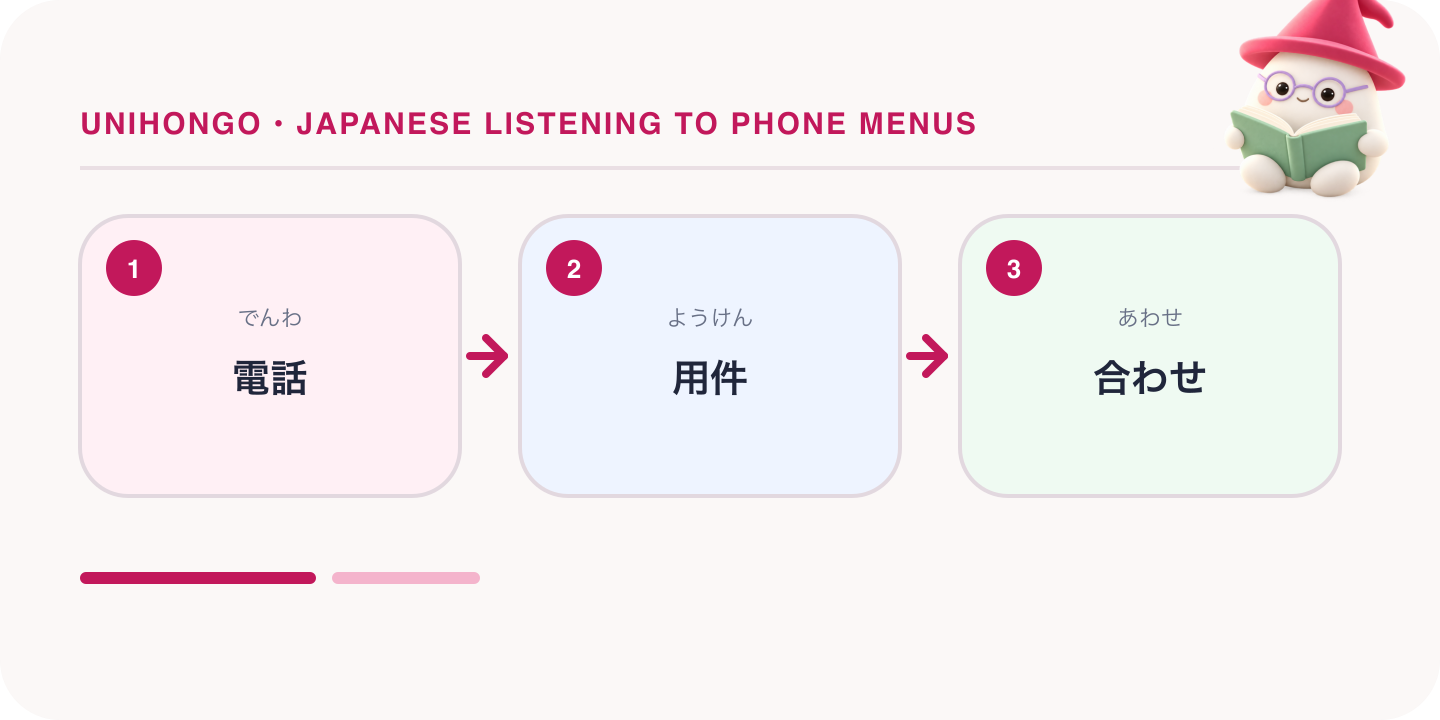
The single most important pattern is the shape of an option. In English, menus say press one for deliveries. Japanese menus reverse the order: the description comes first, then wa, then the number. Haitatsu ni kansuru o-toiawase wa, ichi o oshite kudasai: for enquiries about deliveries, press one. Listen for the description, and when you hear the one you want, the number is about to follow.
Descriptions use a few formal nouns joined with ni kansuru, concerning, or no kata wa, for those who. O-toiawase is an enquiry, o-mōshikomi is an application, henkō is a change, kaiyaku is a cancellation, and kakunin is a confirmation. The instruction verb is nearly always oshite kudasai, press, occasionally nyūryoku shite kudasai, enter, for longer numbers.
Numbers are read as ichi, ni, san, yon, go, roku, nana, hachi, kyū, zero. The system never uses shi or shichi, because they are easy to mishear.
| Japanese | Romaji | Meaning |
|---|---|---|
| 配達に関するお問い合わせは、一を押してください。 | Haitatsu ni kansuru o-toiawase wa, ichi o oshite kudasai. | For enquiries about deliveries, press one. |
| 再配達のお申し込みは、二を押してください。 | Saihaitatsu no o-mōshikomi wa, ni o oshite kudasai. | To request redelivery, press two. |
| ご契約内容の変更は、三を押してください。 | Go-keiyaku naiyō no henkō wa, san o oshite kudasai. | To change your contract details, press three. |
| その他のお問い合わせは、九を押してください。 | Sono ta no o-toiawase wa, kyū o oshite kudasai. | For other enquiries, press nine. |
| オペレーターにおつなぎする場合は、ゼロを押してください。 | Operētā ni o-tsunagi suru baai wa, zero o oshite kudasai. | To be connected to an operator, press zero. |
Delivery notifications
Delivery calls and messages are the automated Japanese most residents meet first. After a missed parcel, the slip in your letterbox, the fuzai renraku hyō, gives a number, and the line will ask for the tracking number, the redelivery date and a time window. The recorded voice reads the windows in fixed forms: gozenchū, morning; jūyoji kara jūrokuji, fourteen to sixteen hundred hours; and so on. It then confirms what you entered and asks you to press one if correct.
Some companies call you rather than the other way round, with a recorded message that gives an expected time window and asks you to press a key to confirm. Exactly how each company works changes over time, so treat the slip in your letterbox as the authority.
| Japanese | Romaji | Meaning |
|---|---|---|
| お荷物のお問い合わせ番号を入力してください。 | O-nimotsu no o-toiawase bangō o nyūryoku shite kudasai. | Please enter the tracking number of your parcel. |
| ご希望の配達日を、四桁で入力してください。 | Go-kibō no haitatsu-bi o, yonketa de nyūryoku shite kudasai. | Please enter your preferred delivery date as four digits. |
| 午前中をご希望の場合は、一を押してください。 | Gozenchū o go-kibō no baai wa, ichi o oshite kudasai. | If you would like the morning, press one. |
| 十八時から二十時の間をご希望の場合は、四を押してください。 | Jūhachiji kara nijūji no aida o go-kibō no baai wa, yon o oshite kudasai. | If you would like between eighteen and twenty hundred hours, press four. |
| 入力内容を確認します。よろしければ、一を押してください。 | Nyūryoku naiyō o kakunin shimasu. Yoroshikereba, ichi o oshite kudasai. | I will confirm your entry. If correct, press one. |
Vocabulary to pre-learn
The words below appear on almost every automated line. Many are formal compounds you might never say, but you only need to recognise them. Read the table aloud twice, then cover the meaning column and test yourself.
| Word | Reading | Meaning |
|---|---|---|
| 音声ガイダンス | onsei gaidansu | voice guidance, the recorded menu |
| お問い合わせ | o-toiawase | enquiry |
| お申し込み | o-mōshikomi | application, request |
| 担当者 | tantōsha | the person in charge |
| オペレーター | operētā | operator, human agent |
| 受付時間 | uketsuke jikan | opening hours for calls |
| 再配達 | saihaitatsu | redelivery |
| 不在連絡票 | fuzai renraku hyō | missed delivery notice |
| 口座番号 | kōza bangō | bank account number |
| 暗証番号 | anshō bangō | PIN |
| ご契約 | go-keiyaku | your contract |
| 検針 | kenshin | meter reading |
| お客様番号 | o-kyakusama bangō | customer number |
| 転送 | tensō | transfer of the call |
Bank lines add words for balances, zandaka, and transfers, furikomi. Utility lines add hikkoshi, moving house, and shiharai, payment, for the options about starting, stopping or paying for service.
Bank and utility lines
Bank and utility menus have one extra feature: they ask you to enter identifying numbers before you reach anything useful. A bank line may ask for your account number and PIN by keypad, and a utility line for the o-kyakusama bangō printed on your bill. The instruction is nyūryoku shite kudasai, please enter, and the voice will often specify the number of digits with keta.
Utility lines also route by situation. Moving house, starting or stopping service, a power cut, and a gas smell each have their own option, and the gas company's emergency option usually comes first and is worth learning by heart. Bank lines route by product: accounts, cards, loans, and lost or stolen cards.
| Japanese | Romaji | Meaning |
|---|---|---|
| 口座番号を入力してください。 | Kōza bangō o nyūryoku shite kudasai. | Please enter your account number. |
| 暗証番号を四桁で入力してください。 | Anshō bangō o yonketa de nyūryoku shite kudasai. | Please enter your four-digit PIN. |
| お客様番号は、検針票に記載されています。 | O-kyakusama bangō wa, kenshin hyō ni kisai sarete imasu. | Your customer number is printed on the meter reading slip. |
| ガス漏れなど緊急の場合は、一を押してください。 | Gasu more nado kinkyū no baai wa, ichi o oshite kudasai. | For emergencies such as a gas leak, press one. |
| お引っ越しに伴う手続きは、二を押してください。 | O-hikkoshi ni tomonau tetsuzuki wa, ni o oshite kudasai. | For procedures related to moving house, press two. |
Why the recordings are harder than they sound
The voice is slow and clear, so why do learners struggle? Three reasons. First, memory load: you hear five options before you can act, and by option four you have forgotten option one. Second, formality: the vocabulary is keigo and Sino-Japanese, so ordinary conversational listening does not help; o-toiawase and tantōsha simply have to be learned. Third, there is no negotiation. A person will rephrase when you hesitate; a recording just loops, and each loop feels like pressure.
The drill below addresses all three problems in order.
- Step one: find a company's phone menu that is also written on its website, and read the options before you call
- Step two: call, listen to the whole menu once without pressing anything, and write one noun per option
- Step three: let it repeat, and this time write the number next to each noun
- Step four: hang up, then say the whole menu aloud from your notes, description first and number last
- Step five: call again and press your option within two seconds of hearing it
- Step six: practise reading your own phone number and a twelve-digit tracking number aloud with pauses
- Step seven: role-play the handover to a person with your AI Sensei, starting from the operator's greeting
Choose a low-stakes line for the first attempts, such as a delivery company or a store's information line. Do not practise on emergency numbers.
Reaching a person
When the menu does not fit your need, or when the options are too confusing, the goal is a human. Listen for operētā, tantōsha or kakari no mono, a member of staff, in the last option, and for the number zero. If the system uses voice recognition, which is increasingly common, saying operētā clearly, or the phrase tantōsha ni tsunaide kudasai, connect me to the person in charge, may work. If nothing works, staying silent through two loops often triggers a transfer.
Once a person answers, the phrases below get you started. Say that your Japanese is limited if you like; staff will slow down and simplify.
| Japanese | Romaji | Meaning |
|---|---|---|
| オペレーターをお願いします。 | Operētā o onegai shimasu. | An operator, please. |
| 担当者につないでください。 | Tantōsha ni tsunaide kudasai. | Please connect me to the person in charge. |
| 日本語があまり得意ではないので、ゆっくりお願いします。 | Nihongo ga amari tokui de wa nai node, yukkuri onegai shimasu. | My Japanese is not very strong, so slowly, please. |
| 不在連絡票が入っていたので、再配達をお願いしたいです。 | Fuzai renraku hyō ga haitte ita node, saihaitatsu o onegai shitai desu. | There was a missed delivery notice, so I'd like to request redelivery. |
When something goes wrong
The common failures are pressing the wrong number, entering a number with the wrong count of digits, and being cut off because the line is outside its uketsuke jikan, opening hours. For a wrong option, most menus let you press a key to go back, often the asterisk, or you can simply hang up and redial; nothing is lost. For a digit error, the voice will say the entry could not be confirmed and ask you to re-enter, so listen for the count in keta and enter slowly.
If the line says it is closed, it will state the hours, usually as heijitsu, weekdays, and a range with kara and made. Write the hours down; the same sentence will play tomorrow. If the menu loops without ever offering a person, look for a chat or web form instead.
| Japanese | Romaji | Meaning |
|---|---|---|
| ただいまの時間は、受付時間外です。 | Tadaima no jikan wa, uketsuke jikan-gai desu. | The line is currently outside its opening hours. |
| 受付時間は、平日の九時から十七時までです。 | Uketsuke jikan wa, heijitsu no kuji kara jūshichiji made desu. | Opening hours are weekdays from nine to seventeen hundred hours. |
| 入力内容が確認できませんでした。もう一度入力してください。 | Nyūryoku naiyō ga kakunin dekimasen deshita. Mō ichido nyūryoku shite kudasai. | Your entry could not be confirmed. Please enter it again. |
| 前のメニューに戻る場合は、米印を押してください。 | Mae no menyū ni modoru baai wa, komejirushi o oshite kudasai. | To return to the previous menu, press the asterisk. |