
What anime can teach you well
Anime gives language an emotional and visual setting. A phrase attached to a character's surprise, a train platform, and a specific reply is easier to retrieve than the same phrase in an isolated list. Repeated voices help you adapt to individual speech patterns, while episode structure provides sustained listening that beginner exercises rarely offer.
It is especially useful for hearing contractions and sentence endings. Textbooks may present te shimatta, but dialogue lets you hear chatta; they teach te iru, while characters say teru. Anime also exposes aizuchi such as un, sō, and naruhodo—the small responses that keep conversation alive.
What anime does not teach by itself
- A sequenced grammar curriculum that notices your missing foundations.
- Reliable knowledge of which expressions fit a customer, manager, stranger, or friend.
- Active recall: understanding a line does not guarantee you can produce it later.
- Interactive repair when you misunderstand or the other person changes topic.
- Balanced reading, kanji production, and formal or workplace communication.
This is not a reason to stop watching. It is a reason to give anime one clear job inside a broader plan: rich listening and phrase discovery. Let a course supply sequence, a review system supply recall, and real or simulated conversation supply output.
Choose material that matches your goal
| Type | Learning value | Main caution |
|---|---|---|
| Everyday school or family | Frequent daily actions and casual relationships | Teen speech may not fit adult workplaces |
| Workplace or slice of life | Modern routines, service language, social nuance | Industry vocabulary may be specialised |
| Sports | Repeated goals, teamwork, and encouragement | Excited commands and shouting dominate |
| Fantasy or battle | Motivation and clear emotional context | Invented terms, archaic speech, and rough register |
| Historical | Culture and older forms | Low transfer to ordinary modern conversation |
Difficulty is not only vocabulary. A calm show about a familiar activity can be easier than a children's comedy full of puns and rapid voices. Choose something you genuinely want to rewatch, then study a narrow, useful scene instead of trying to mine every unknown word.
A twenty-minute active scene method
- Minutes 0–2: watch a 20–40 second scene without subtitles and write what you understood.
- Minutes 2–6: replay with Japanese subtitles or a legal transcript; look up only meaning-blocking words.
- Minutes 6–10: divide the audio into lines and listen until word boundaries become clear.
- Minutes 10–14: shadow the character, copying mora timing while keeping the voice natural for you.
- Minutes 14–17: choose two transferable patterns and create three substitutions for each.
- Minutes 17–20: close the source, retell the moment, and save the lines you could not retrieve.
Register traps: lines to understand before you copy
| Anime form | What it signals | Safer everyday option |
|---|---|---|
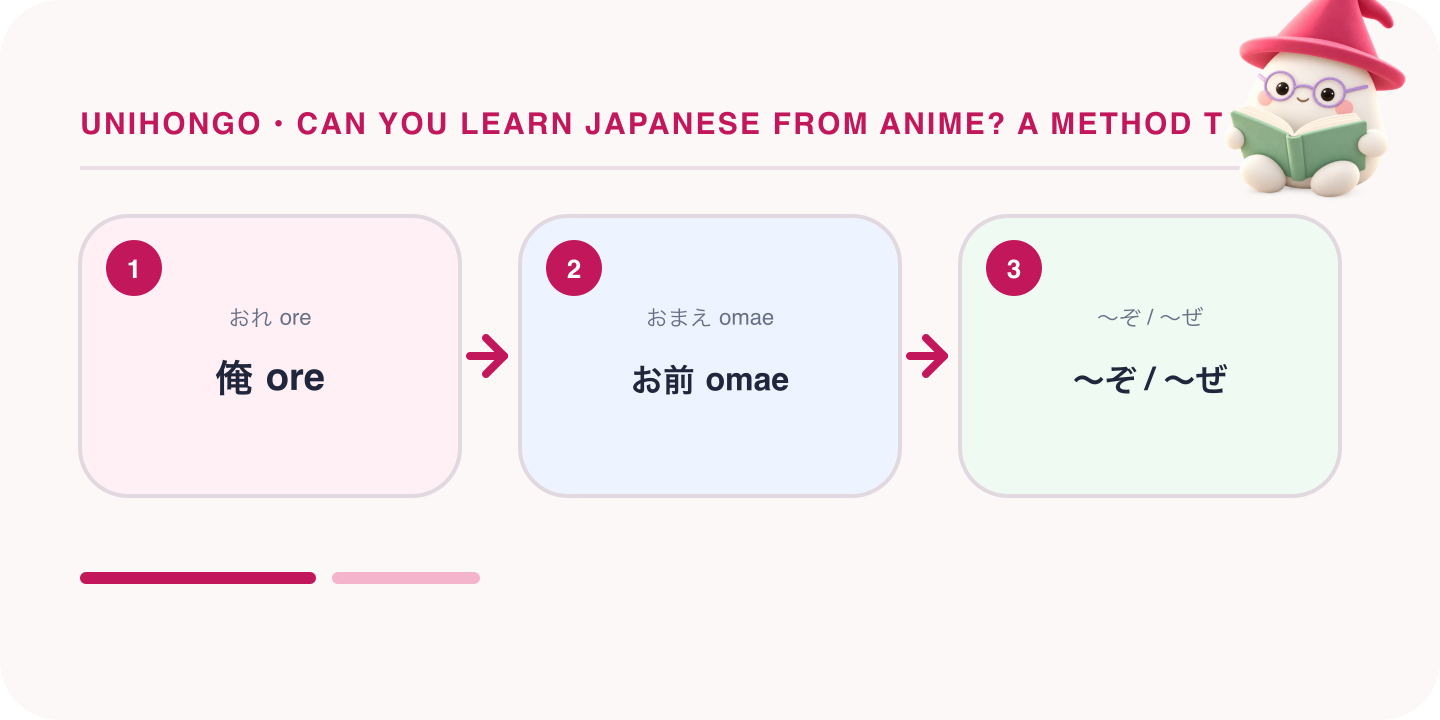
| 俺 ore | Masculine, casual, sometimes rough self-reference | 私 watashi until you know the group |
| お前 omae | Very familiar or confrontational 'you' | Name + san, or omit the pronoun |
| 〜ぞ / 〜ぜ | Forceful masculine emphasis | Neutral ending or よ yo |
| 貴様 kisama | Hostile 'you' in modern use | Do not use in ordinary conversation |
| 〜でござる de gozaru | Archaic or comic stylisation | です desu |
| 命令形 imperative | Direct command, urgent or hierarchical | 〜てください te kudasai |
Even ordinary forms depend on relationship. Da yo can be warm among friends and too blunt with a client. Before saving a line, ask who is speaking, to whom, with what power difference, and in what emotional state. Those four questions turn entertainment into sociolinguistic study.
Turn a memorable line into reusable Japanese
Do not memorise only the quote. Find the grammatical frame and substitute details. If a character says mada owattenai, recognise mada + negative as 'not yet', then create mada tabetenai, mada kimattenai, and mada dekitenai. Convert one version into polite speech: mada owatte imasen.
Next, make the phrase interactive. Ask mada owatte inai n desu ka, answer when it will finish, and request help. A quote becomes language when you can change tense, politeness, subject, and context without returning to the original scene.
A weekly anime learning routine
Watch for pleasure first so the habit remains rewarding. On two or three days, return to one selected scene and use the twenty-minute method. Review no more than five phrases from the episode, and choose them for usefulness rather than dramatic impact. On another day, speak about the episode or roleplay a parallel situation.
Keep one weekly register check. Ask a teacher or AI tutor how each saved expression sounds, who might say it, and how to make it polite. Unihongo can then place the neutral versions into a live scenario, so your listening interest feeds speaking ability instead of remaining a collection of quotes.