

What you will actually hear in a vlog
A typical vlog has three registers stitched together. There is the greeting and sign-off, which is semi-scripted and relatively clear. There is narration, where the vlogger explains what they are doing while doing it, in plain form with lots of n da and kedo. And there are reactions: the short bursts when something is delicious, surprising or annoying, which are the fastest and most useful part.
In narration, expect sentences that end early. A vlogger will say kyō wa chotto and then move on, leaving the listener to fill in that today is a bit something. Sentences end with kedo, kara or shi and never get a main clause. This is not bad Japanese; it is what natural spoken Japanese sounds like, and learning to accept an unfinished sentence is part of the skill.
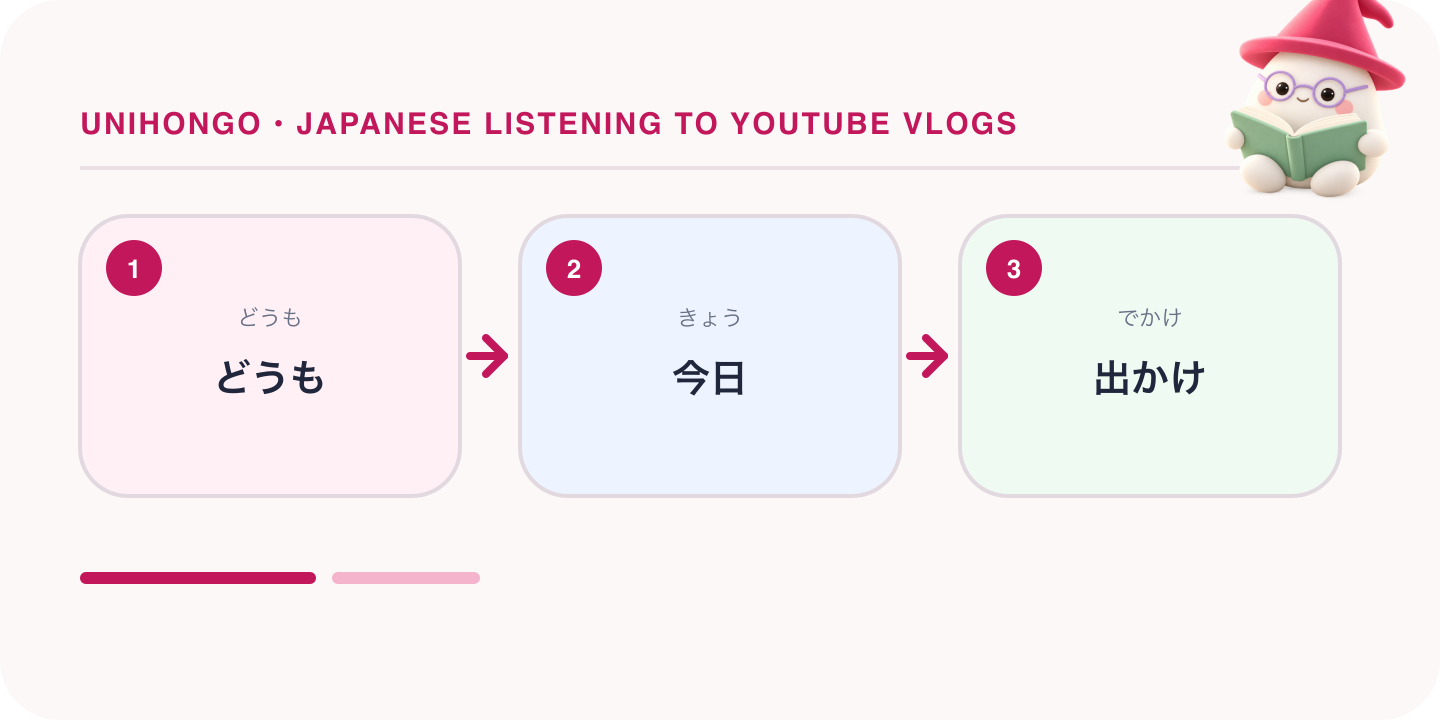
| Japanese | Romaji | Meaning |
|---|---|---|
| はい、どうも。今日は朝から出かけます。 | Hai, dōmo. Kyō wa asa kara dekakemasu. | Hi there. Today I'm heading out from the morning. |
| 今、コーヒー淹れてるんだけど、豆がもうないんだよね。 | Ima, kōhī iretern da kedo, mame ga mō nai n da yo ne. | I'm making coffee now, but I've basically run out of beans. |
| これ、めっちゃ美味しそうじゃない? | Kore, metcha oishisō ja nai? | Doesn't this look amazing? |
| ってことで、駅に向かってます。 | Tte koto de, eki ni mukattemasu. | So anyway, I'm heading to the station. |
| 今日はこんな感じで終わりです。 | Kyō wa konna kanji de owari desu. | That's about it for today. |
The contractions to pre-learn
Casual speech compresses grammar into short sounds, and vloggers use the same dozen compressions constantly. Te iru becomes teru: tabeteru, eating. Te shimau becomes chau, and its past chatta: tabechatta, ended up eating it. Te oku becomes toku: yattoku, I'll do it in advance. Nakereba becomes nakya and nakute wa becomes nakucha: ikanakya, ikanakucha, I have to go. To iu becomes tte, and no da becomes n da. Learn each one as a sound, not as a rule, because you will never have time to reconstruct it while listening.
The table gives the full form, the reading of the contraction, and an example. Say each example aloud at speed until the contracted form feels more natural than the full one. That is when your ear starts catching it.
| Full form | Reading | Contracted form and example |
|---|---|---|
| 食べている | tabete iru | tabeteru, I'm eating |
| 食べてしまった | tabete shimatta | tabechatta, I ended up eating it |
| やっておく | yatte oku | yattoku, I'll get it done beforehand |
| 行かなければ | ikanakereba | ikanakya, I've got to go |
| わからない | wakaranai | wakannai, no idea |
| 食べてはいけない | tabete wa ikenai | tabecha ikenai, mustn't eat it |
| ということで | to iu koto de | tte koto de, so anyway |
| するのだ | suru no da | suru n da, the thing is I do it |
| すごい | sugoi | sugē, wow, in rough male speech |
| 行かなくては | ikanakute wa | ikanakucha, I've got to go |
| 来てしまう | kite shimau | kichau, will end up coming |
| 行った方がいい | itta hō ga ii | itta hō ga ii yo, you'd better go |
Vowel changes ride on top of these: ai becomes ē in rough speech, so wakaranai can become wakannē and sugoi can become sugē. You do not need to say these forms, but you need to hear them.
Fillers and the gaps they fill
Fillers are the words a speaker uses while thinking, and vlogs are full of them because vloggers think on camera. Ētto and anō are the classic pause sounds. Nanka is sort of, or like, and it precedes almost any new idea. Maa is well, a shrug in sound. Yappari, often shortened to yappa, means as expected. Tte iu ka, or tte yū ka, means or rather, and introduces a correction.
Fillers are useful to listeners for two reasons. First, they mark where a new thought starts, so they help you segment the stream. Second, they are low-content, which means you can use the half second they take to catch up. When you hear ētto, you are not missing anything; the speaker is waiting for their own next word, and so can you.
| Japanese | Romaji | Meaning |
|---|---|---|
| えっと、今日は何しようかな。 | Ētto, kyō wa nani shiyō kana. | Um, what shall I do today? |
| なんか、最近ずっと眠いんだよね。 | Nanka, saikin zutto nemui n da yo ne. | Like, I've been sleepy all the time lately. |
| まあ、しょうがないか。 | Maa, shōganai ka. | Well, can't be helped, I suppose. |
| やっぱ、朝はパンだよね。 | Yappa, asa wa pan da yo ne. | Bread for breakfast, obviously, right? |
| っていうか、もう十二時じゃん。 | Tte yū ka, mō jūniji jan. | Actually, wait, it's already twelve. |
Sentence-final particles and tone
In casual speech, the end of the sentence carries the attitude. Ne seeks agreement or shares a feeling. Yo asserts something the listener may not know. Yo ne combines both: I think so, and you do too, right? Na is a self-directed ne, used when thinking aloud, which vloggers do constantly. Kana wonders. Jan, from ja nai, points out something obvious with a touch of surprise. Sa keeps the listener's attention through a longer story.
These particles are said quickly and softly, but they are not optional decoration. Kore oishii yo and kore oishii ne are different acts: one tells you, the other invites you. Listening for the particle tells you whether the vlogger is informing, sharing, wondering or just holding the floor.
| Japanese | Romaji | Meaning |
|---|---|---|
| 今日、寒いね。 | Kyō, samui ne. | It's cold today, isn't it. |
| これ、本当に美味しいよ。 | Kore, hontō ni oishii yo. | This is really good, I'm telling you. |
| やっぱ家が一番だよね。 | Yappa ie ga ichiban da yo ne. | Home really is best, right? |
| どうしようかな。 | Dō shiyō kana. | What should I do, I wonder. |
| もう秋じゃん。 | Mō aki jan. | It's already autumn, look. |
| 昨日さ、友達と海行ったんだけどさ。 | Kinō sa, tomodachi to umi itta n da kedo sa. | So yesterday, right, I went to the sea with a friend. |
Fast reactions
Reactions are the most repeated lines in any vlog and the best value for your listening time. They are short, emotional and fast, and the same twenty cover almost everything: surprise, delight, disgust, disappointment. Because they are so short, you can learn them as whole sounds with their intonation, and because they repeat, you will hear each one dozens of times in a single channel.
Reactions also transfer directly to conversation. If you can produce e, maji de with the right rise, you can keep a Japanese friend talking for an hour. So learn them for listening, then steal them for speaking.
| Japanese | Romaji | Meaning |
|---|---|---|
| え、まじで? | E, maji de? | What, seriously? |
| やばい、うますぎる。 | Yabai, umasugiru. | Wow, this is too good. |
| うわ、最悪。 | Uwa, saiaku. | Ugh, the worst. |
| えー、嘘でしょ。 | Ē, uso desho. | No way, you're kidding. |
| おお、いい感じ。 | Ō, ii kanji. | Ooh, that's nice. |
| ちょっと待って、これ何? | Chotto matte, kore nani? | Hang on, what is this? |
Why vlogs are hard to hear
Three features make vlogs harder than scripted media. Speed, obviously: a relaxed vlogger speaks at natural conversational pace, and reactions are faster still. Contractions, because the grammar you learned in full form arrives as a two-syllable blur. And the audio itself: vlogs are recorded on phones in kitchens, on trains and in the street, with music underneath, so the signal is worse than a studio recording.
There is also a structural difficulty. Written Japanese and polite speech put the verb at the end, so you can wait for it. Casual speech often drops the verb entirely, drops the subject, and trails off, so you have to infer meaning from a noun, a particle and a tone. That inference only develops through exposure to many unfinished sentences.
- Step one: watch one minute at normal speed with no subtitles, and write down the topic only
- Step two: watch the same minute at three-quarters speed with Japanese subtitles, and mark every contraction
- Step three: watch it again at three-quarters with no subtitles and say each contraction as you hear it
- Step four: watch at normal speed with no subtitles and count the fillers and final particles
- Step five: shadow the minute at normal speed, matching the intonation of the reactions
- Step six: write three sentences the vlogger said, in full polite form, to prove you decoded them
- Step seven: move to the next minute, and never re-watch a minute more than five times
Five passes at one minute is better than one pass at five minutes. Depth first, then breadth, and the breadth comes fast once the sounds are in place.
A weekly routine
Consistency matters more than volume. Choose one vlogger for a month so their voice, habits and favourite fillers become familiar; the second month with a new vlogger will be far easier because you will be learning only the new person, not the whole skill. Aim for fifteen to twenty minutes a day, most of it on a single short clip.
Monday to Thursday, do the seven-step drill on one new minute per day. Friday, watch a full video of the same vlogger at normal speed with no subtitles, purely for enjoyment, and notice how much more you catch than on Monday. Saturday, speak: take the week's contractions, fillers and reactions into a casual conversation with your AI Sensei, or with a friend if you have one. Sunday, rest, or watch something else entirely.
| Japanese | Romaji | Meaning |
|---|---|---|
| 今週は毎日ちょっとずつ見てる。 | Konshū wa mainichi chotto zutsu miteru. | This week I'm watching a bit every day. |
| 聞き取れなかったところ、もう一回見よ。 | Kikitorenakatta tokoro, mō ikkai miyo. | The bit I couldn't catch, let me watch it once more. |
| 最初はやばかったけど、だんだん慣れてきた。 | Saisho wa yabakatta kedo, dandan narete kita. | It was rough at first, but I'm gradually getting used to it. |
Mistakes that slow you down
The first mistake is watching with English subtitles and calling it listening practice. You will enjoy the video and learn nothing about the sounds. The second is choosing a channel by interest alone; a chaotic street-food vlog with shouting and traffic may be fun, but a calm kitchen vlog teaches you more per minute. The third is slowing playback too far. At half speed the pitch and rhythm are wrong, and you train your ear on something nobody says.
The fourth mistake is treating fillers, particles and unfinished sentences as errors to be filtered out. They are the language. When you can hear nanka, sa and kedo as meaningful choices, you will hear vlogs the way their intended audience does. And the last mistake is never speaking. Contractions and reactions only settle when you have said them, so end every week in conversation.
| Japanese | Romaji | Meaning |
|---|---|---|
| 字幕なしで、もう一回聞いてみる。 | Jimaku nashi de, mō ikkai kiite miru. | I'll try listening once more without subtitles. |
| この人、話すの速すぎない? | Kono hito, hanasu no hayasuginai? | This person talks way too fast, don't they? |
| でも、なんとなくわかる。 | Demo, nantonaku wakaru. | But I sort of get it. |