
Why variety shows teach real spoken Japanese
A typical variety show mixes a studio panel with filmed segments: comedians visiting a town, celebrities tasting food, quizzes, challenges and hidden-camera pranks. Almost none of the talk is fully scripted. People interrupt, repeat, trail off and react, which is exactly how Japanese sounds outside a textbook. The Japanese word is baraeti bangumi (バラエティ番組), and people usually shorten it to baraeti.
Three features make the format useful for learners: the telop captions, the constant short reactions, and the comic double act of boke and tsukkomi. The four cards below are the words you will meet first.
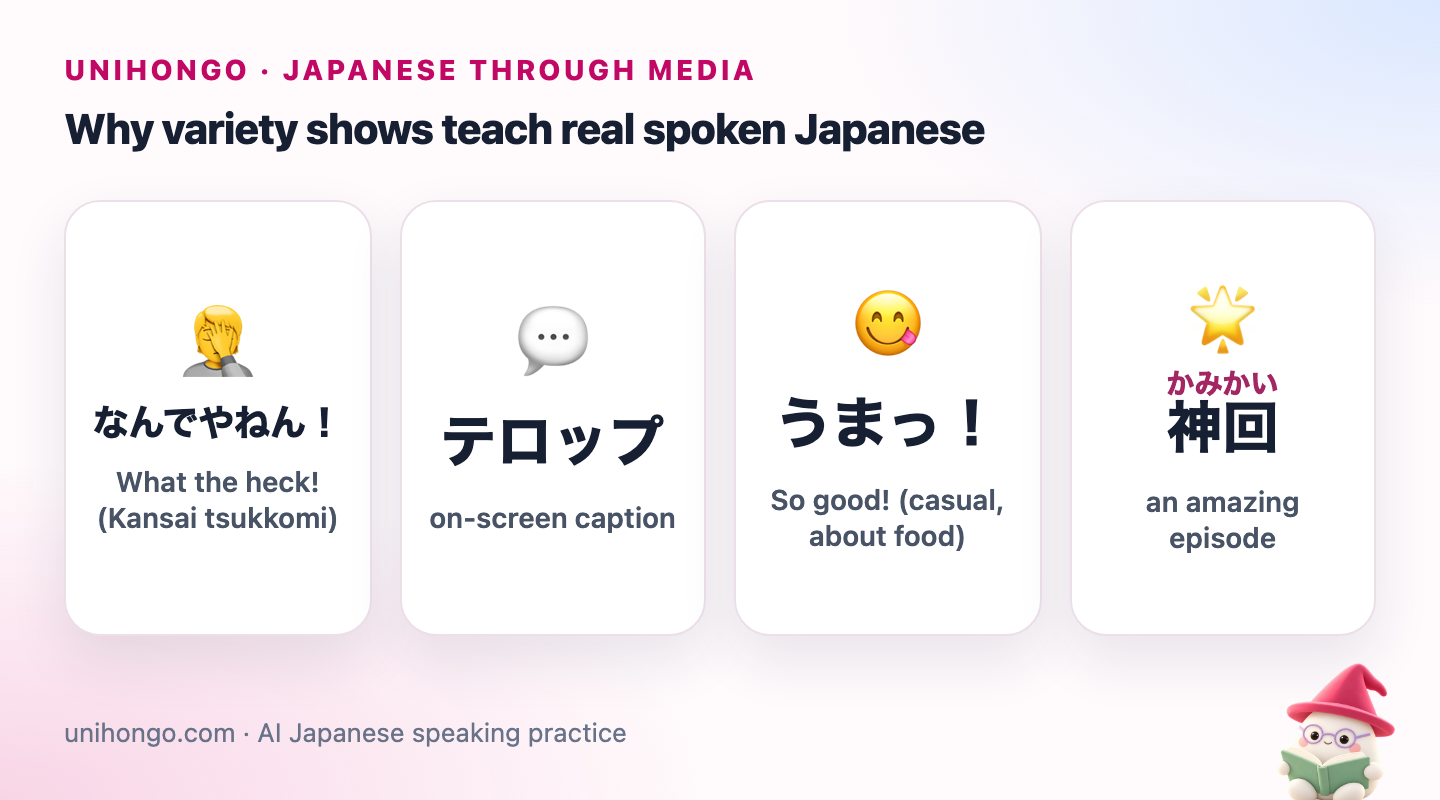
| Japanese | Romaji | Meaning |
|---|---|---|
| なんでやねん! | Nande ya nen! | What the heck! (Kansai tsukkomi) |
| テロップ | teroppu | on-screen caption |
| うまっ! | Uma! | So good! (casual, about food) |
| 神回 | kamikai | an amazing episode |
Kamikai literally means a god episode. Fans use it for any episode they loved, of any kind of show, and you will see it in comments under clips.
How to use telop without letting it listen for you
Telop is not the same as subtitles. Editors choose which lines to show, and they often exaggerate them with colour, size and sound effects to sell the joke. Sometimes the caption tidies up what was said, and sometimes it adds a comment nobody actually spoke. That makes telop a great support, but a poor replacement for your ears.
A good routine is to watch a short clip once while reading everything, then again while trying to hear each captioned line before it appears. When the caption shows a word you did not catch, pause, read it and say the line aloud yourself.
| Japanese | Romaji | Meaning |
|---|---|---|
| テロップを読みながら聞きます。 | Teroppu o yominagara kikimasu. | I listen while reading the captions. |
| 今、何て言ったの? | Ima, nan te itta no? | What did they just say? (casual) |
| もう一回見てみよう。 | Mō ikkai mite miyō. | Let's watch it one more time. |
| Kind of telop | What it shows | How to use it |
|---|---|---|
| Repeated speech | A key line someone just said | Hear it first, then check it |
| Name labels | Who is speaking and their job | Learn titles like geinin (comedian) |
| Editor comments | A joke or note added in editing | Read it, but do not expect it in speech |
| Sound words | Effects such as a gasp or a thud | Collect onomatopoeia for later |
The reaction words that fill every studio
Watch the small inset window in the corner of the screen, called the waipu (ワイプ), where panellists' faces are shown while a clip plays. They are rarely silent. Short reactions keep the conversation alive, show you are listening, and are the easiest part of a variety show to copy into your own speech.
| Japanese | Romaji | Meaning |
|---|---|---|
| えー、すごい! | Ē, sugoi! | Whoa, amazing! (surprise) |
| へえ、そうなんだ。 | Hē, sō nan da. | Huh, is that so. (casual, interested) |
| マジで? | Maji de? | Seriously? (casual) |
| 本当ですか? | Hontō desu ka? | Really? (polite) |
| なるほど。 | Naruhodo. | I see. |
| うそでしょ! | Uso desho! | No way! (casual) |
| やばい! | Yabai! | Wow! / Oh no! (casual) |
Notice how the same feeling has a casual and a polite form. Maji de and uso desho are for friends. With a teacher, a client or someone older, use hontō desu ka or sō nan desu ka. Naruhodo is fine with peers, but to a boss it can sound a little like you are judging whether their point is valid, so many people say sō nan desu ne instead.
Learners often overuse sugoi and yabai. They are real and frequent, but a panel that only said sugoi would be dull. Try to follow a reaction with one detail: ē, sonna ni takai n desu ka, what, it's that expensive?
Boke and tsukkomi: the engine of the jokes
Most Japanese comedy runs on a two-person pattern. The boke (ボケ) says something silly or plays dumb, and the tsukkomi (ツッコミ) points out the absurdity, often with a quick line and a light tap on the shoulder. The pattern comes from manzai, stand-up comedy for two, and it spills over into variety panels and even friends' conversations.
Here is a tiny exchange of the kind you will hear constantly. The first line is the boke; the replies are different tsukkomi.
| Japanese | Romaji | Meaning |
|---|---|---|
| 昨日、月に行ってきました。 | Kinō, tsuki ni itte kimashita. | Boke: I went to the moon yesterday. |
| 行けるか! | Ikeru ka! | Tsukkomi: As if you could! (casual) |
| いや、おかしいでしょ! | Iya, okashii desho! | Tsukkomi: Come on, that's weird! (standard) |
| なんでやねん。 | Nande ya nen. | Tsukkomi: What the heck. (Kansai) |
When not to use it: tsukkomi is teasing, so keep it for friends who are already joking with you. Do not use it on a boss, a customer or someone you have just met. Nande ya nen is Kansai dialect; many people from other regions use it jokingly, but if you are not from Kansai, saying it in a flat, careful accent can sound like an impression. The standard iya, okashii desho or nande is safer.
Words for talking about the shows themselves
Once you start watching, you will want to talk about what you saw. These lines use common industry and fan words. Geinin (芸人) means a comedian or entertainer and is usually said with -san when you talk about them politely. Roke (ロケ) is short for location shoot and refers to the filmed outdoor segments.
| Japanese | Romaji | Meaning |
|---|---|---|
| 昨日の回、神回だった! | Kinō no kai, kamikai datta! | Yesterday's episode was amazing! (casual) |
| ロケのコーナーが好きです。 | Roke no kōnā ga suki desu. | I like the location segments. |
| あの芸人さん、ツッコミがうまいね。 | Ano geinin-san, tsukkomi ga umai ne. | That comedian is great at tsukkomi, huh. |
| リアクションが大きくて面白い。 | Riakushon ga ōkikute omoshiroi. | Their reactions are big and funny. |
| どの番組をよく見ますか? | Dono bangumi o yoku mimasu ka? | Which shows do you often watch? |
Turn a segment into speaking: the retell method
Watching alone builds listening. To build speaking, you need to produce the language yourself. After each short segment, close the video and retell it in four to six sentences in the plain or polite past tense. Use simple connectors to keep the order clear, and finish with your own opinion. Here is a model retelling of a food location segment.
| Japanese | Romaji | Meaning |
|---|---|---|
| 最初に、芸人さんがラーメン屋に行きました。 | Saisho ni, geinin-san ga rāmen-ya ni ikimashita. | First, a comedian went to a ramen shop. |
| それから、店主にスープの秘密を聞きました。 | Sorekara, tenshu ni sūpu no himitsu o kikimashita. | Then he asked the owner the secret of the broth. |
| 一口食べて、すごく驚いていました。 | Hitokuchi tabete, sugoku odoroite imashita. | He took one bite and looked really surprised. |
| 最後に、みんなで大笑いしました。 | Saigo ni, minna de ōwarai shimashita. | At the end, everyone burst out laughing. |
| 私もそのお店に行ってみたいです。 | Watashi mo sono omise ni itte mitai desu. | I'd like to try that shop too. |
- Keep it short: five clear sentences beat twenty broken ones.
- Use te-iru for what people looked like or were doing: odoroite imashita, waratte imashita.
- Do not try to reproduce the jokes word for word. Describe what happened and how people reacted.
- Record yourself and compare with the clip: did you use any of the reactions you heard?
Mini dialogue: react like a panellist
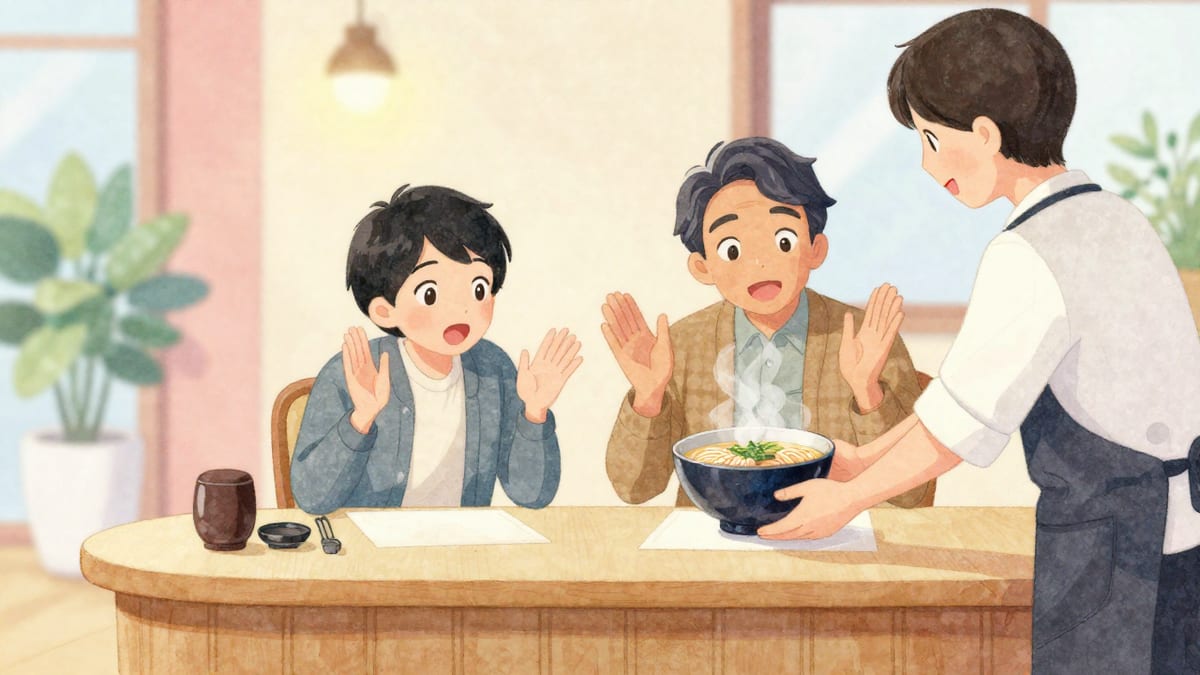
Now put the reactions into a studio-style exchange. The host shows a surprising fact, and the panellist reacts, asks a follow-up and gives an opinion. This is the shape of most variety-show talk, and it is also the shape of a lively conversation with friends.
| Japanese | Romaji | Meaning |
|---|---|---|
| このラーメン、一杯三千円なんです。 | Kono rāmen, ippai sanzen-en nan desu. | Host: This ramen is 3,000 yen a bowl. |
| えー!高いですね! | Ē! Takai desu ne! | Panellist: What? That's expensive! |
| でも、スープを十時間煮込んでいます。 | Demo, sūpu o jū-jikan nikonde imasu. | Host: But the broth simmers for ten hours. |
| へえ、それなら食べてみたいです。 | Hē, sore nara tabete mitai desu. | Panellist: Oh, then I'd like to try it. |
| どうぞ、食べてみてください。 | Dōzo, tabete mite kudasai. | Host: Go ahead, give it a try. |
| うまっ!これは神回ですね。 | Uma! Kore wa kamikai desu ne. | Panellist: So good! This is a great episode. |
Notice the mix: the panellist speaks politely to the host with desu, but the instant food reaction uma slips out in casual form. That is natural. A spontaneous reaction is often casual, and the sentence around it returns to polite speech.
Common mistakes when copying variety-show Japanese
- Copying rough comedian speech into polite settings. Comedians may say omae (you) or kuso (damn) for laughs; these sound rude in daily life.
- Using uma or umee everywhere. They are casual and slightly masculine-sounding; oishii is always safe.
- Treating telop comments as things people say. Editor captions are often written jokes, not spoken lines.
- Playing tsukkomi on strangers. Correcting someone's joke loudly only works once there is trust.
- Watching for hours without speaking. Two minutes of retelling after each segment is worth more than another episode.