
What rakugo is, in one minute
The word rakugo is written 落語: 落 means to fall or drop and 語 means talk, a reference to the story dropping into its punchline. A performer in a kimono walks onto a raised stage called the kōza (高座), kneels on a cushion, bows and starts talking. There is no costume change, no set and no other actor. For an hour or for ten minutes, one person creates a whole street full of characters.
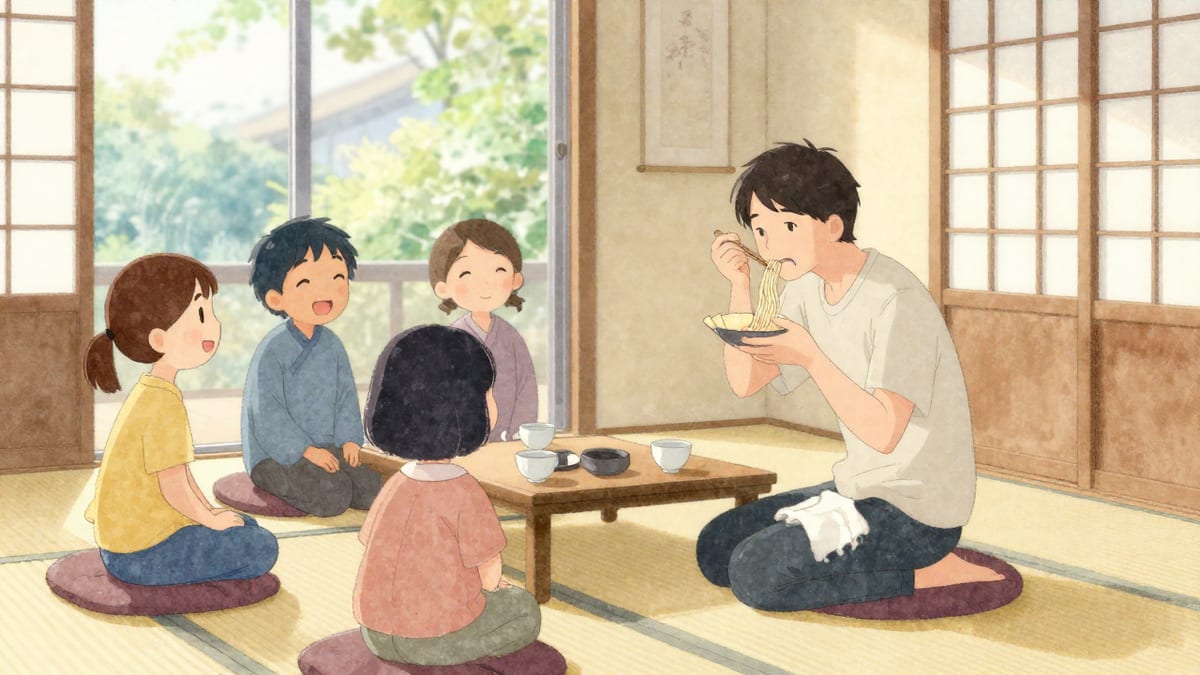
The two props do everything. A folding fan, the sensu, becomes chopsticks, a pipe, a brush or a sword. A hand towel, the tenugui, becomes a wallet, a letter or a book. Watching how a performer eats imaginary noodles with a fan is part of the fun.
| Japanese | Romaji | Meaning |
|---|---|---|
| 落語を聞きに行こう。 | Rakugo o kiki ni ikō. | Let's go and hear some rakugo. |
| 一人で全部の役をやるんだ。 | Hitori de zenbu no yaku o yaru n da. | One person plays every role. |
The four words that explain a performance
A rakugo performance has a clear shape. The performer, the hanashika, opens with a relaxed chat, slides into the story, and ends on a punchline, at which point they bow and leave. These four words are all you need to follow it.
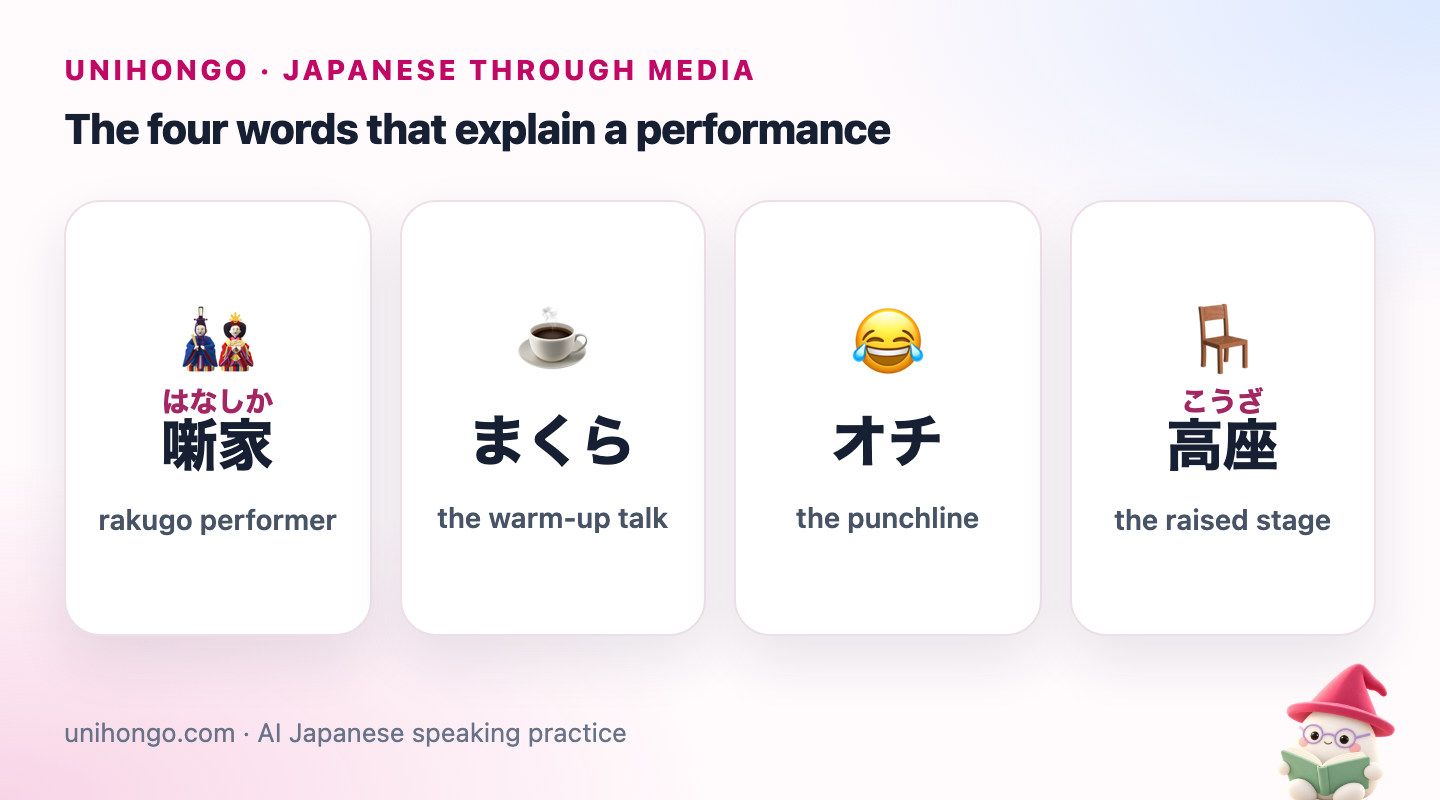
| Japanese | Romaji | Meaning |
|---|---|---|
| 噺家 | hanashika | rakugo performer |
| まくら | makura | the warm-up talk |
| オチ | ochi | the punchline |
| 高座 | kōza | the raised stage |
The makura is often the easiest part for learners. Performers chat about the weather, the news or their own lives in modern Japanese before introducing the world of the story, so it is a good warm-up for your ears too.
Ochi is also used in everyday conversation. If a friend's long story has no punch, someone may tease them with ochi wa? (so what's the punchline?), especially in Kansai.
How one voice plays everyone: kamishimo
To switch between characters, the performer turns their head slightly to the left or right. This technique is called kamishimo (上下). By convention, the higher-status character, such as the master or the landlord, faces one way and the lower-status visitor faces the other. Combined with a change of voice and speech style, it lets the audience follow a fast conversation with no narration.
This is where rakugo becomes a grammar lesson. Listen to how two classic characters speak: the gentle old retired man, the go-inkyo, and the rough, quick-tempered craftsman.
| Japanese | Romaji | Meaning |
|---|---|---|
| おや、熊さんかい。まあ、お上がり。 | Oya, Kuma-san kai. Mā, oagari. | Old man: Oh, it's you, Kuma. Do come in. |
| ご隠居、ちょいと聞きてえことがあるんで。 | Goinkyo, choito kikitē koto ga aru n de. | Craftsman: Sir, there's somethin' I wanna ask. |
| 何だい、言ってごらん。 | Nan dai, itte goran. | Old man: What is it? Go on, tell me. |
The craftsman's kikitē is a rough, old Tokyo pronunciation of kikitai, I want to ask. This kind of speech is fun to hear and to imitate in a story, but it is character speech. Do not use it in daily conversation; it would sound like you are playing a role.
Beginner stories: Jugemu and Toki Soba
Jugemu (寿限無) is the story of a baby whose parents ask a priest for a lucky name. Every suggestion sounds good, so they use them all, and the boy ends up with a name that takes a long breath to say. Every time someone calls him, they must recite the whole thing. In a common version, the boy bumps a friend's head, and by the time everyone has finished saying the name to complain, the bump has gone down. Many Japanese children learn the name by heart as a tongue twister.
Toki Soba (時そば) is about a man who cheats a noodle seller. He pays sixteen mon for his soba by counting the coins into the seller's hand, and in the middle he asks the time. The seller answers kokonotsu, nine, and the man carries on from ten, so he pays one coin less. A fool who watched him tries the same trick the next night, but arrives earlier, and the answer is yotsu, four.
| Japanese | Romaji | Meaning |
|---|---|---|
| 寿限無、寿限無、五劫の擦り切れ… | Jugemu, jugemu, gokō no surikire... | Jugemu, Jugemu, endless ages... (start of the name) |
| ひい、ふう、みい、よう… | Hī, fū, mī, yō... | One, two, three, four... (old counting) |
| 今、何刻だい? | Ima, nandoki dai? | What time is it now? (old style) |
| へい、九つで。 | Hei, kokonotsu de. | It's the ninth hour, sir. |
| とお、十一、十二… | Tō, jūichi, jūni... | Ten, eleven, twelve... |
How to listen to rakugo at your level
| Level | What to try | Focus on |
|---|---|---|
| Upper beginner | English or bilingual rakugo, then a short classic in Japanese | The format and the punchline |
| Intermediate | Toki Soba, Jugemu and other short classics | Who is speaking, from speech style |
| Upper intermediate | Full performances with the makura | Modern chat in the makura, timing |
| Advanced | Longer story pieces and live shows | Old vocabulary, Kansai versus Tokyo styles |
There are two main traditions: Tokyo rakugo and Kamigata rakugo from the Osaka area. Kamigata performers speak Kansai dialect and often use a small desk and wooden clappers to mark rhythm. If you live in or love the Kansai region, Kamigata stories are a lively source of dialect.
In Tokyo, theatres called yose (寄席) run variety programmes of rakugo and other performing arts on most days. You can walk in, sit for a few hours, and hear many performers at different levels.
Retell a rakugo bit, switching voices
Now perform it yourself. Act out the counting scene of Toki Soba with two voices: a cheeky, fast customer and a polite, slightly tired noodle seller. Turn your head a little to one side for each. Then step out of the story and retell it in modern Japanese, as a narrator.
| Japanese | Romaji | Meaning |
|---|---|---|
| おい、そば屋さん、一杯くれ。 | Oi, sobaya-san, ippai kure. | Customer: Hey, soba man, give me a bowl. |
| へい、お待ち。 | Hei, omachi. | Seller: Here you are, sir. |
| いくらだい? | Ikura dai? | Customer: How much? |
| 十六文です。 | Jūroku mon desu. | Seller: Sixteen mon. |
| ある男がそば屋をだましました。 | Aru otoko ga sobaya o damashimashita. | Narrator: A man tricked a noodle seller. |
| 途中で時間を聞いて、一文払いませんでした。 | Tochū de jikan o kiite, ichimon haraimasen deshita. | Narrator: He asked the time midway and didn't pay one mon. |
- Pause before the punchline. Rakugo timing is about the silence before the ochi.
- Exaggerate the contrast: kure and dai for the customer, desu and polite hei for the seller.
- Retell the same story as a narrator in polite past tense. It is a different skill from acting it.
What rakugo teaches you about everyday speaking
- Speech style reveals relationships. Who uses desu, who uses kure, who calls whom -san: you learn to read status from grammar.
- Pauses are part of meaning. Performers wait a beat before key lines, a habit that makes any story clearer.
- Gesture supports words. Using your hands to show eating, writing or paying makes your Japanese easier to follow.
- A story needs connectors. Narration relies on suru to, sorede and tokoro ga, the same words you need to tell friends about your weekend.