

Start with the meaning in context
The sentence below gives choosing when a transcript helps a real context. Read it once for its overall meaning, then look at the words and particles around the main expression. Those nearby details help you see what role it plays rather than relying on a loose English equivalent.
For listening assessment, listen before reading. For learning a difficult passage, a transcript can reveal what to practise after an honest first attempt. If the sentence feels difficult, divide it into meaningful chunks and check one unknown item at a time. You do not need to understand every detail before you can identify the main relationship.
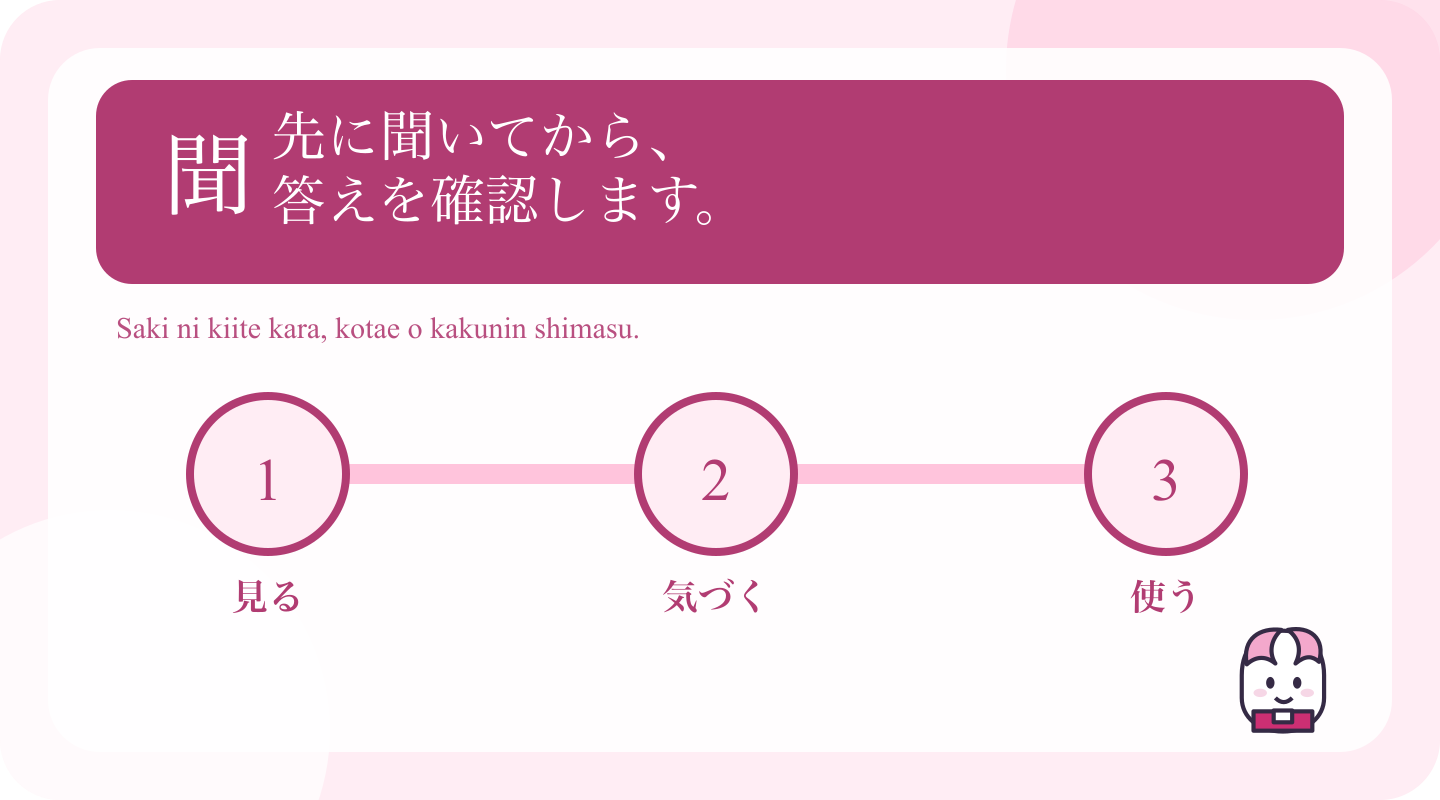
| Japanese | Romaji | Meaning |
|---|---|---|
| 先に聞いてから、答えを確認します。 | Saki ni kiite kara, kotae o kakunin shimasu. | I’ll listen first, then check the answer. |
| 例を声に出して、もう一度練習します。 | Rei o koe ni dashite, mō ichido renshū shimasu. | I’ll say the example aloud and practise once more. |
| 自分の生活に合わせて、文を変えてみましょう。 | Jibun no seikatsu ni awasete, bun o kaete mimashō. | Let’s change the sentence to fit your own life. |
Notice the choice that changes the meaning
A useful study question is not only “What does this expression mean?” but also “Why does it fit here?” Check the speaker, the situation, the verb form, and what the listener is expected to know. This is especially helpful with choosing when a transcript helps, where context can change how an expression should be understood.
Make a small contrast in your notes: one sentence where the expression is natural, and one nearby situation where you would choose another form. The contrast gives memory something specific to retrieve.
| Study step | What to notice | Try this |
|---|---|---|
| Meaning | The job the phrase does | Explain it without a dictionary gloss |
| Form | What attaches before or after it | Mark the verb or particle |
| Context | Relationship and situation | Name who is speaking to whom |
Avoid the shortcut that causes confusion
A common trap is learning a rule as if it covered every sentence. Japanese has patterns that overlap in English translation but differ in form, tone, or information structure. Keep the rule narrow enough to be useful, and let examples show its limits.
When a reference gives several meanings, do not force them into one sentence. Record the example and situation together. A short note about who said it and why is often more useful than a longer list of synonyms.
- Underline the exact form you are studying.
- Circle the word or particle that helps establish its role.
- Write one sentence that fits your own situation.
Practise retrieval, then make it personal
Use the short routine in the practice box and return to the same pattern tomorrow. Try a fresh example rather than repeating the exact same sentence. If you can recognize choosing when a transcript helps in reading but cannot produce it while speaking, practise a one-sentence answer before moving to a longer exchange.
A tutor or conversation partner can add useful unpredictability. Ask them to change one detail in the situation so you must adapt the sentence, then review only the correction that helps you communicate more clearly.